Band 5.0 IELTS Writing Task 1 Model Answer
Overall Band Score: 5.0 · IELTS Summit Mastery · 2026-11-18
IELTS Writing Task 1 question
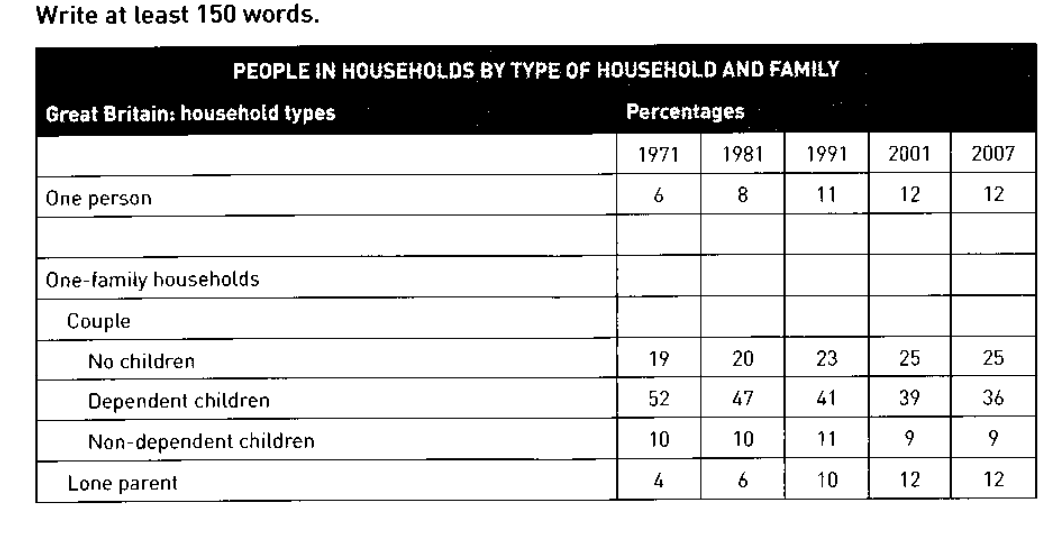
The table below shows the change in some household types in Great Britain from 1971 to 2007.
Summarise the information by selecting and reporting the main features, and make comparisons where relevant.
PEOPLE IN HOUSEHOLDS BY TYPE OF HOUSEHOLD AND FAMILY
Student answer (Band 5.0)
The table is showing data from the households by types for the Great Britain from the year 1971 till 2007. The table have six columns in which the frist colmn shows the type of the house hold, weather the household have one-person, or a one-family hosehold. The Family type household is frther devided into three catagories. One is the family without any children, the second is family with dependent children and the third one is the family with independent childrens.
The next columns are the persentage colmns showing the increasing and declining persentage for each catagory. these persentages are compared for the five different decades starting from 1971 and to the 2007. if we focus one the frist row then we analyz that the one person household is increasing from the 1971 for each year. in the one-family household the persentage of the families with no children showing significant increase each year. However, the families with both dependent and independent children face decline over the five years. The largest decline is seen across the dependent children across each year.
AI examiner evaluation
| Criterion | Band |
|---|---|
| Task Achievement / Task Response | 5.0 |
| Coherence and Cohesion | 5.5 |
| Lexical Resource | 5.0 |
| Grammatical Range and Accuracy | 5.0 |
| Overall | 5.0 |
Task Achievement / Task Response: Band 5.0
You identify several genuine patterns: the proportion of one-person households rises, couples without children increase, and households with dependent children show the largest decline. However, the response only partially summarises the table. It gives no specific figures, so the scale of these changes is unclear, and it omits the important overview that the dependent-children category remains the largest despite falling from 52% to 36%. The claim that both dependent and “independent” children face decline is also inaccurate: the table says non-dependent children, whose share fluctuates before ending at 9%, rather than declining steadily. Include a concise overview and support the main comparisons with accurate data.
Coherence and Cohesion: Band 5.5
The response has a basic sequence: it introduces the table, describes its categories, and then comments on trends. Linking words such as “However” help signal contrast, and the final sentence highlights the largest decline. Nevertheless, the first paragraph spends considerable space explaining the table’s layout, while the trend discussion is compressed into one long paragraph, so the progression from overview to key comparisons is not clear. Some connections are repetitive or awkward, such as repeatedly referring to “the next columns” and “the percentages.” Organise the response into a brief introduction, a clear overview, and focused detail paragraphs, grouping rising categories separately from falling ones.
Lexical Resource: Band 5.0
You use some relevant task vocabulary, including “household,” “dependent children,” “decline,” and “significant increase,” which makes the general subject understandable. However, the range is limited and several word choices or forms are inaccurate: “independent childrens” should be “non-dependent children,” and “household by types” is an awkward description. Spelling errors such as “persentage,” “catagory,” and “devided” are frequent enough to distract the reader. Some phrases, including “face decline” and “increasing from the 1971,” are not natural collocations. Use the table’s exact labels and practise accurate spelling and standard trend language to make comparisons clearer and more precise.
Grammatical Range and Accuracy: Band 5.0
You attempt both simple statements and longer sentences, including a contrast introduced by “However,” but the range is limited and errors occur frequently. For example, “The table have six columns” has subject–verb disagreement, while “the one person household is increasing” uses an unsuitable progressive form for a change across years. Articles and sentence construction are also problematic in “the families with no children showing significant increase each year,” which lacks a finite verb and an article before “significant increase.” Capitalisation and punctuation are inconsistent, particularly where a new sentence begins with lowercase “these.” Build accuracy with clear present-simple reporting forms, correct agreement, and complete clauses before attempting longer sentences.
See this exact question answered at other band scores. The same prompt compared across bands.
Browse more IELTS Writing model answers or get your own writing scored by the same AI examiner.