Band 5.5 IELTS Writing Task 1 Model Answer
Overall Band Score: 5.5 · IELTS Summit Mastery · 2026-11-18
IELTS Writing Task 1 question
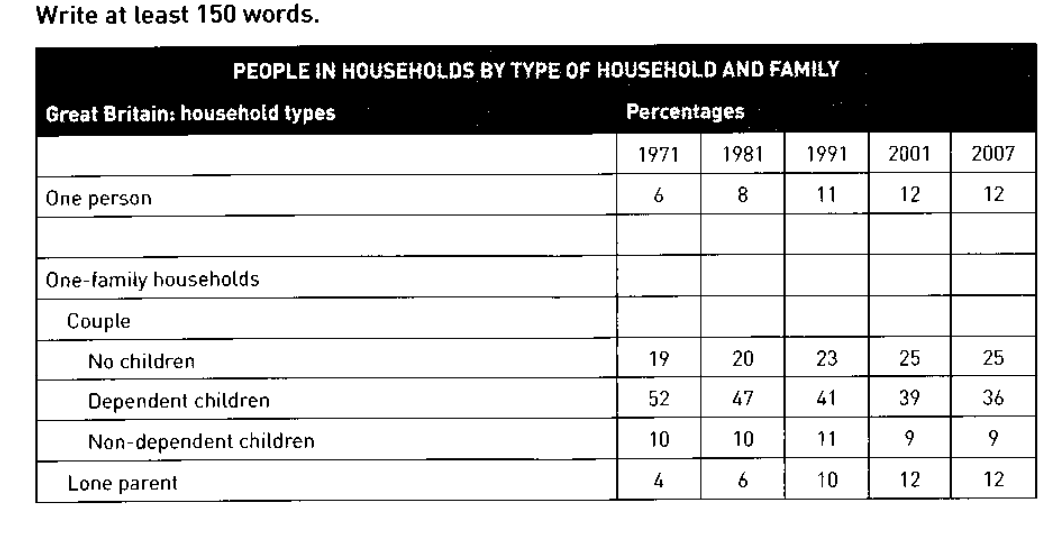
The table below shows the change in some household types in Great Britain from 1971 to 2007.
Summarise the information by selecting and reporting the main features, and make comparisons where relevant.
PEOPLE IN HOUSEHOLDS BY TYPE OF HOUSEHOLD AND FAMILY
Student answer (Band 5.5)
The table provides the information about fluctuations that have been recorded in household type in Great Britain from 1971 to 2007. Household types are divided into 3 categories out of which 1 category One-family households are further distributed into 4 sub-categories.
The concept of One-family households prevailed over the time. The households with dependent children carried the highest proportion in 1971 and maintained its position till 2007, however the number kept on fluctuating.
Single-parent household was the lowest and reported as 4% in 1971 and but household with non dependent children carries the position at last in 2001 and 2007 as 9%. For family households, the category where dependent children lives with parent was 52% in 1971 and 36% in 2007. While, the families where they do not have any children is at the second place with 19% and 25% in 1971 and 2007 respectively.
As demonstrated in the table, there is no reading for the couple households and we are unable to provide any information about that. One person household reported the second lowest proportion as 6% in 1971 while it maintained the same reading as Lone parent houseld i.e., 12% in 2007.
Overall, there have been changes in the houshold types in Great Britain but it is significant to mention that category where there are no children it kept on increasing gradually till 1991 and remains constant afterwards.
AI examiner evaluation
| Criterion | Band |
|---|---|
| Task Achievement / Task Response | 5.0 |
| Coherence and Cohesion | 5.0 |
| Lexical Resource | 5.5 |
| Grammatical Range and Accuracy | 5.5 |
| Overall | 5.5 |
Task Achievement / Task Response: Band 5.0
You identify several relevant patterns, including the decline in households with dependent children (52% to 36%) and the rise in couples without children (19% to 25%). However, the response only partly summarises the table: it gives little attention to the overall rise in one-person and lone-parent households, and the overview is not sufficiently clear or comprehensive. The claim that dependent-child households “maintained its position till 2007” is misleading because their share fell substantially, even though they remained the largest category. You also say there is “no reading” for couple households, although the table provides figures for couples with and without children. Select the main trends accurately and compare the categories more directly.
Coherence and Cohesion: Band 5.0
The response has paragraph breaks and a broadly recognisable sequence: it introduces the table, discusses family categories, and then mentions one-person households. Some linking expressions, such as “however” and “Overall,” help signal relationships between ideas. Nevertheless, the progression is not consistently clear. The discussion moves between rankings, individual years and categories without a clear organising principle, and the final overview repeats a detail about childless couples rather than drawing together the main trends. Connections are also sometimes awkward, as in “Single-parent household was the lowest and reported as 4% ... and but...”. Grouping the main increases together and contrasting them with the decline in dependent-child households would make the organisation easier to follow.
Lexical Resource: Band 5.5
You use some task-relevant vocabulary, including “proportion,” “category,” “sub-categories” and “gradually,” and the reader can generally understand the trends you intend to describe. However, the range is limited by repeated use of “household,” “category” and “position,” while several choices are imprecise or unnatural. For example, “fluctuations” suggests repeated rises and falls, although most figures show a steady trend or remain stable; “carried the highest proportion” is also an awkward collocation. Spelling errors such as “houseld” and “houshold” reduce accuracy. Use precise trend language and vary expressions for shares and household groups.
Grammatical Range and Accuracy: Band 5.5
The response attempts a mixture of simple and more complex sentences, including clauses joined with “while” and “however.” Meaning is usually recoverable, but errors in sentence construction and agreement occur across the response. For example, “the number kept on fluctuating” does not clearly refer to the percentage, and “the category where dependent children lives with parent was 52%” has problems with agreement and clause structure. The sentence beginning “While, the families...” is also an incomplete dependent clause, and “it kept on increasing ... and remains constant” shifts tense inconsistently. Practise forming complete comparisons and maintaining consistent past-tense reporting; check articles, plurals and subject–verb agreement.
See this exact question answered at other band scores. The same prompt compared across bands.
Browse more IELTS Writing model answers or get your own writing scored by the same AI examiner.