Band 5.5 IELTS Writing Task 1 Model Answer
Overall Band Score: 5.5 · IELTS Summit Mastery · 2026-11-19
IELTS Writing Task 1 question
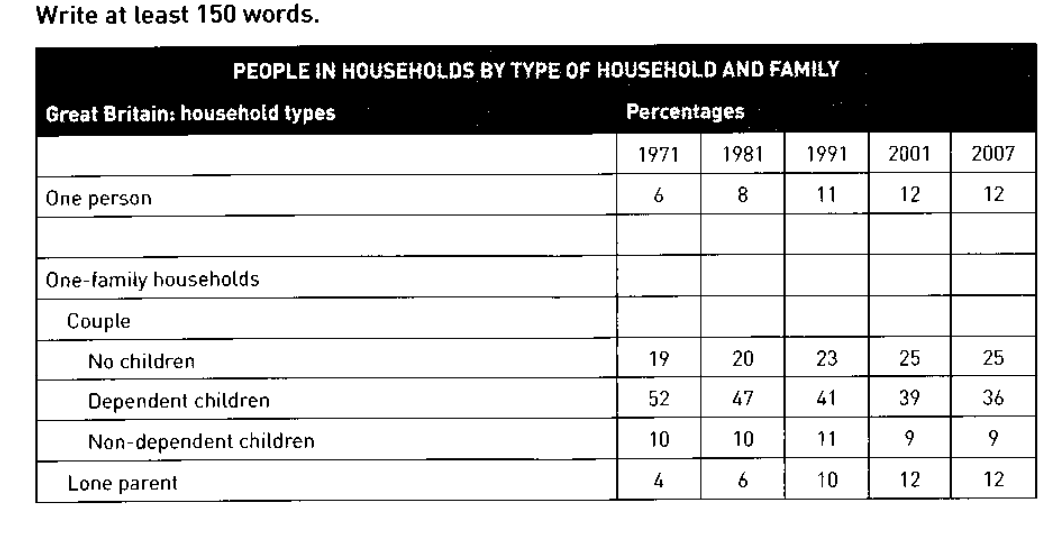
The table below shows the change in some household types in Great Britain from 1971 to 2007.
Summarise the information by selecting and reporting the main features, and make comparisons where relevant.
PEOPLE IN HOUSEHOLDS BY TYPE OF HOUSEHOLD AND FAMILY
Student answer (Band 5.5)
The table displays the change in seven household types in Great Britain in 1971 to 2007.
Overall, most household types have increased in percentage across all years . Dependant children household recorded the highest percentage across all the years .Two family households were not accounted for in the years provided.
One person and no children type of household recorded the same trend.One person family started at 6% while no children household began with 19% this was in the year 1971. They both increased by 2% in the following year and later grew by 3% in the subsequent year. After that, they reported a stable percentage of 12% and 25% respectively. Additionally lone parent household has an increase throughout the four year period recorded. In 1971 it started at 4% and gradually increased to 12% in 2007.
Dependant and non dependent children households recorded a significant drop across the years.In 1971 they recorded 52% and 10% in that order. The numbers declined slowly and in 2007, they were at 36% and 9%.
AI examiner evaluation
| Criterion | Band |
|---|---|
| Task Achievement / Task Response | 5.0 |
| Coherence and Cohesion | 6.0 |
| Lexical Resource | 6.0 |
| Grammatical Range and Accuracy | 5.5 |
| Overall | 5.5 |
Task Achievement / Task Response: Band 5.0
You identify several important patterns, including the rise in one-person and child-free couple households and the decline in households with dependent children. The figures you give for these categories are broadly accurate, and the overview recognises that dependent-child households remained the largest group. However, the overview is weakened by saying that “most household types have increased” without acknowledging the clear decline in dependent-child households, and “Two family households were not accounted for” is inaccurate: the table includes one-family household categories, not a missing two-family category. Some comparisons are also imprecise; for example, the figures do not rise by the same amounts at each stage. A clearer, more accurate overview and more precise reporting of changes would make the response more complete.
Coherence and Cohesion: Band 6.0
The response has a coherent overall arrangement: it begins with an overview, groups the rising categories together, and then discusses the two declining categories. This gives the reader a generally clear route through the information. Linking phrases such as “Overall,” “Additionally,” and “After that” help signal relationships between points. However, some connections are mechanical or unclear. “One person and no children type of household recorded the same trend” is followed by figures that do not share the same starting values or changes, so the comparison is confusing. The sentence about “Two family households” also interrupts the overview rather than supporting it. Make comparisons more explicit and use paragraphing consistently to separate the overview from the detailed comparisons.
Lexical Resource: Band 6.0
You use an adequate range of vocabulary for describing table data, including “percentage,” “increased,” “declined,” “gradually,” and “stable.” These choices make the main trends understandable, and terms such as “dependent children” and “lone parent” are relevant to the subject. Some wording is imprecise or repetitive, however: “recorded” appears several times, while “in the following year” and “the subsequent year” do not clearly identify the table’s time intervals. “Two family households” is also an inaccurate label for the categories shown. Aim for more precise collocations and vary the verbs used to describe data, while retaining the table’s exact category names. Spelling and word-form consistency, especially “dependent,” would also improve control.
Grammatical Range and Accuracy: Band 5.5
You attempt a mix of simple and more developed sentences, including the contrast between the two declining categories and the sentence beginning “While” is not needed to communicate the trends. Most of the meaning remains understandable, but some grammatical errors and punctuation problems are noticeable. For example, “The table displays the change … in 1971 to 2007” uses an incorrect preposition; “in Great Britain in 1971 to 2007” also lacks a clear time construction. In “One person family started,” the article and noun phrase are not well formed, and “lone parent household has an increase” uses an awkward tense and structure. There are also spaces before full stops and missing spaces after them. Practise accurate time phrases (“from … to …”) and check articles, verb forms, and sentence punctuation.
See this exact question answered at other band scores. The same prompt compared across bands.
Browse more IELTS Writing model answers or get your own writing scored by the same AI examiner.