Band 5.5 IELTS Writing Task 1 Model Answer
Overall Band Score: 5.5 · IELTS Summit Mastery · 2026-11-19
IELTS Writing Task 1 question
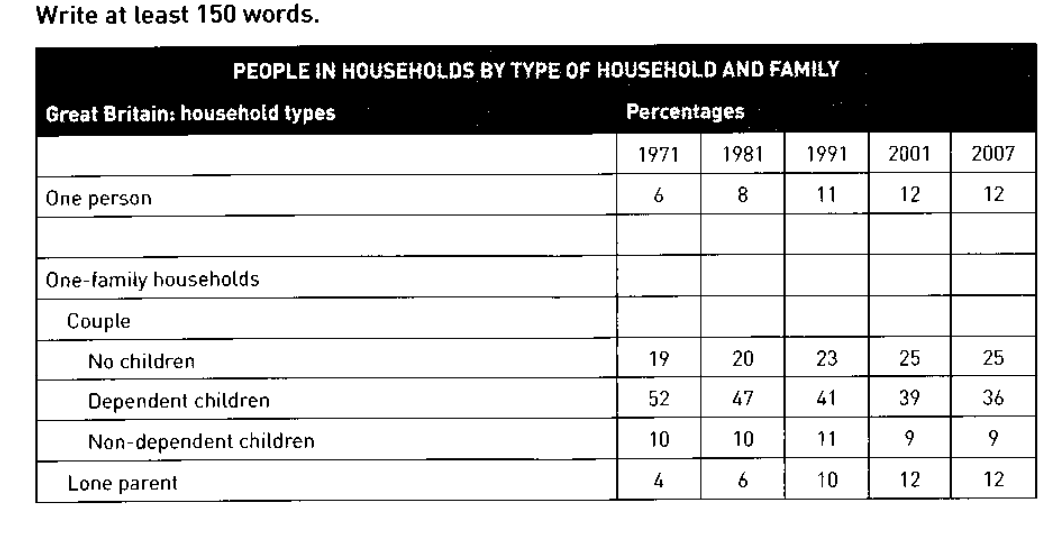
The table below shows the change in some household types in Great Britain from 1971 to 2007.
Summarise the information by selecting and reporting the main features, and make comparisons where relevant.
PEOPLE IN HOUSEHOLDS BY TYPE OF HOUSEHOLD AND FAMILY
Student answer (Band 5.5)
The chart demonstrates the variation among data of family types in Britain during 1971 till 2007. The overall trend has a increasing effect throughout the years but household with dependent children has the highest rise among all other categories. Whereas numbers in non - dependent children has faced decline in this time.
Firstly, One person household has been increasing by being at 6 in 1971 to 12 in 2001 and remained unchanged till 2007. Similarly Couple with no children has been rapidly rising from 19 in 1971 to 25 in 2001 and 2007. However, the number of dependent children rose and fallen during the years by being on peak in 1971 and 1981 by 52 and 47 respectively and declined in next two years and ended up at 36 in 2007.
Although, non-dependent children stayed constant in 1971 and 1981 by 10, it rose by 11 in 1991 but finally it reached on 9 in last two years. Furthermore, the amount of lone parent has been fluctuating from 4 in 1971 to 12 in 2007. In conclusion, it was evident that the change in the type of household has been changing over the years.
AI examiner evaluation
| Criterion | Band |
|---|---|
| Task Achievement / Task Response | 5.0 |
| Coherence and Cohesion | 5.5 |
| Lexical Resource | 5.5 |
| Grammatical Range and Accuracy | 5.5 |
| Overall | 5.5 |
Task Achievement / Task Response: Band 5.0
You report several relevant figures and identify the broad movement in most categories, including the rise in one-person households and the fall in households with dependent children. However, the overview is unclear and partly inaccurate: “household with dependent children has the highest rise” contradicts the data, as this category falls from 52% to 36%; it was the largest category, not the one with the greatest rise. The claim that non-dependent children “faced decline” also misses their broadly stable pattern. Some details are imprecise, such as saying dependent-child figures declined in the “next two years” rather than the later years shown. A clearer overview of the main contrasts and more accurate trend descriptions would make the response more complete.
Coherence and Cohesion: Band 5.5
The response has a recognisable structure, moving from an introduction and overview to two detail paragraphs, with a concluding sentence. The categories are generally presented in a sensible order, and connectors such as “Similarly,” “However,” and “Furthermore” help signal comparisons. However, progression is weakened by the contradictory overview and by some links that do not express the relationship accurately; “Although” at the start of the third paragraph does not lead to a contrasting main clause. The final sentence repeats the general idea of change without adding a useful summary. Grouping the main increases together and contrasting them with the declining dependent-child category would create a clearer progression, while more precise linking would make cohesion less mechanical.
Lexical Resource: Band 5.5
You use a range of task-related terms, including “dependent children,” “lone parent,” “declined,” and “remained unchanged,” so the reader can identify the categories and general movements. However, several word choices and collocations are unnatural or imprecise, such as “variation among data,” “increasing effect,” “rose and fallen,” and “reached on 9.” “Fluctuating” is also not an accurate description of the lone-parent figures, which rise steadily. These choices sometimes make the intended trend less clear. Aim for standard chart language such as “the proportion of,” “increased from … to,” and “fell steadily,” and check that the chosen verb matches the actual pattern. This would improve precision without requiring more elaborate vocabulary.
Grammatical Range and Accuracy: Band 5.5
You attempt a mixture of simple and complex sentences, including clauses introduced by “Whereas,” “However,” and “Although,” and most of the data remains understandable. There are nevertheless recurring errors in sentence construction and verb forms. For example, “The overall trend has a increasing effect” has an article and structure problem, while “the number … rose and fallen” mixes verb forms. The clause beginning “Although, non-dependent children stayed constant…” is not correctly punctuated or connected, and “it reached on 9” uses an incorrect preposition within the sentence pattern. Some sentences also shift awkwardly between past and present forms. Practise forming complete contrast clauses and use consistent past-tense reporting for the historical figures; this will make your varied structures more controlled.
See this exact question answered at other band scores. The same prompt compared across bands.
Browse more IELTS Writing model answers or get your own writing scored by the same AI examiner.