Band 5.5 IELTS Writing Task 1 Model Answer
Overall Band Score: 5.5 · IELTS Summit Mastery · 2026-11-19
IELTS Writing Task 1 question
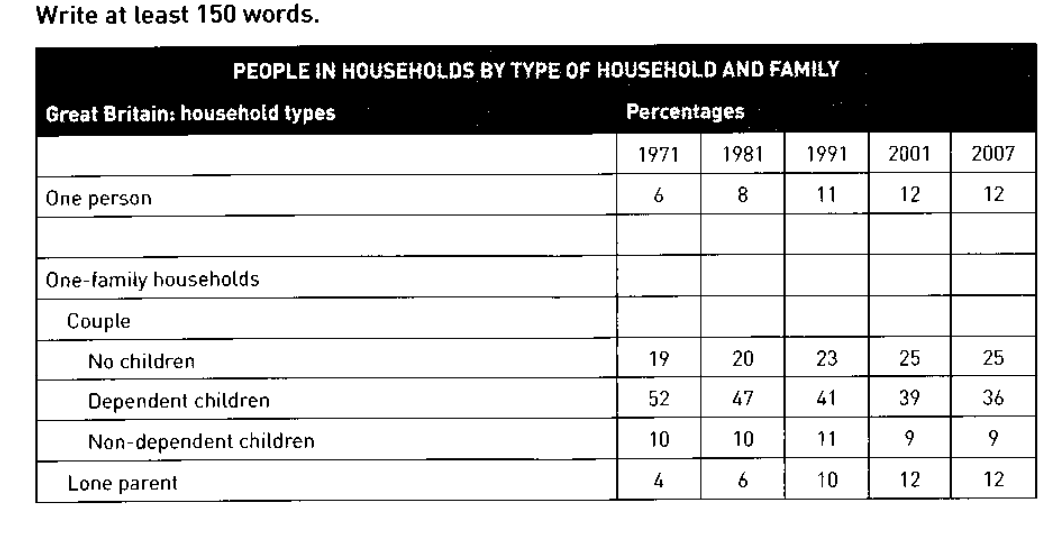
The table below shows the change in some household types in Great Britain from 1971 to 2007.
Summarise the information by selecting and reporting the main features, and make comparisons where relevant.
PEOPLE IN HOUSEHOLDS BY TYPE OF HOUSEHOLD AND FAMILY
Student answer (Band 5.5)
THE TABLE REPRESENT THE CHANGE IN SOME HOUSE HOLD TYPES IN GREAT BRITAIN FREOM 1971 TO 2007
OVREALL, DEPENDENT CHILDREN HAD THE HIGHEST PERCENTAGE IN GREAT BRITAIN HOUSEHOLD TYPES . WHILE NON- DEPENDENT CHILDREN IS THE LOWEST FIGURE. WHILE OTHER TYPE OF HOUSE HOLDS WILL INCREASE BY THE YEAR.
IN 1971, DEPENDENT CHILDREN ACCOUNTED FOR 52% OF HOUSE HOLDS . THE FIGURE GRADUALLY DECREAED AT 36% IN 2007 . MENAWHILE HOUSE HOLDS WITH NO CHILDREN INCREASED FROM 19%TO 25 % OVER THE SAME PERIOD
FURTHERMORE, THE PROPORTION OF ONE - PERSON HOUSEHOLD INCREASED FROM 6% IN 1971 TO 12% IN 2007. SIMILARLY , LONE- PARENT HOUSEHOLDS ROSE FROM 4% TO 12% . IN CONTRAST, THE PERCENTAGE OF NON- DEPENDENT CHILDERN DECREASED SLIGHTLY FROM 10 % TO 9%.
AI examiner evaluation
| Criterion | Band |
|---|---|
| Task Achievement / Task Response | 5.5 |
| Coherence and Cohesion | 6.0 |
| Lexical Resource | 5.5 |
| Grammatical Range and Accuracy | 5.5 |
| Overall | 5.5 |
Task Achievement / Task Response: Band 5.5
You identify the main contrast accurately: dependent-child households were the largest category and fell from 52% to 36%, while several other types increased. You also report the endpoint figures for couples without children, one-person households and lone-parent households correctly. However, the overview is partly unclear: calling non-dependent children the “lowest figure” overlooks that lone-parent households were lower in 1971, and “other type of households will increase” is too broad because non-dependent-child households ended slightly lower. The response also omits useful comparisons across the intervening years and is 23 words below the required minimum. Develop the overview with the main overall trends and add a little more detail to make the summary more complete.
Coherence and Cohesion: Band 6.0
The response has a recognisable structure: an introduction, an overview and two paragraphs reporting figures. The sequence from the largest category to other household types is generally easy to follow, and connectors such as “Meanwhile,” “Furthermore” and “In contrast” help signal relationships. However, the overview repeats “while” and its final generalisation does not clearly connect to the data. Some transitions are mechanical, and the final paragraph groups several categories without explaining their relationship beyond their changes. Use clearer topic sentences and link comparisons more precisely—for example, contrast the decline in dependent-child households with the increases in one-person and lone-parent households. This would make progression more controlled while retaining the clear paragraphing already present.
Lexical Resource: Band 5.5
You use relevant task vocabulary, including “accounted for,” “proportion,” “increased” and “decreased,” and the reader can understand the main trends. However, the range is limited and some word choices or forms are inaccurate, such as “the lowest figure” for non-dependent children and “other type of households will increase,” which is vague and does not accurately describe every category. Spelling errors—including “OVREALL,” “FREOM,” “DECREAED” and “CHILDERN”—are noticeable and reduce the accuracy of the report. Aim for precise terms such as “category” and “share,” and check spelling carefully. More varied, accurate trend language would help you describe the figures with greater precision.
Grammatical Range and Accuracy: Band 5.5
You attempt a mixture of simple statements and more developed comparisons, including “Meanwhile households with no children increased…” and “In contrast, the percentage… decreased slightly…”. Most relationships remain understandable, but errors in sentence construction and agreement are evident. For example, “The table represent” needs a singular verb, and “non-dependent children is” does not agree with its plural subject. The overview fragment beginning “While non-dependent children…” is not a complete sentence, and “will increase by the year” uses an unsuitable future construction for a table covering past data. Improve control of subject–verb agreement, complete sentence structure and past-tense reporting. These corrections would make your comparisons clearer and more reliable.
See this exact question answered at other band scores. The same prompt compared across bands.
Browse more IELTS Writing model answers or get your own writing scored by the same AI examiner.