Band 5.0 IELTS Writing Task 1 Model Answer
Overall Band Score: 5.0 · IELTS Summit Mastery · 2026-11-22
IELTS Writing Task 1 question
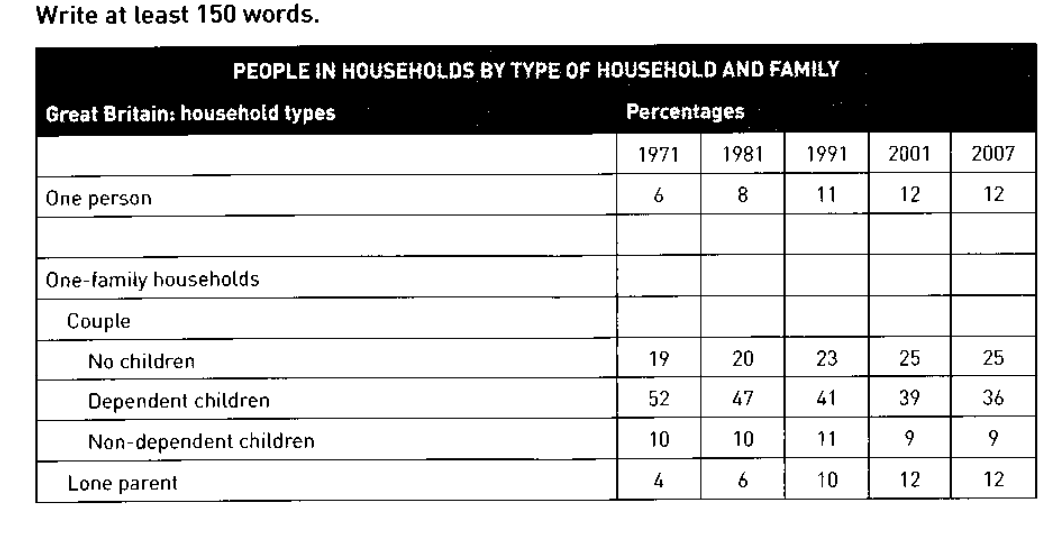
The table below shows the change in some household types in Great Britain from 1971 to 2007.
Summarise the information by selecting and reporting the main features, and make comparisons where relevant.
PEOPLE IN HOUSEHOLDS BY TYPE OF HOUSEHOLD AND FAMILY
Student answer (Band 5.0)
The table chart illustrates the changes in some household types in Great Britain from 1971 to 2007 by familywise.
From the chart,there was several changes happend around those years.In 1971, Dependent children type hold the highest place than other sectors.After almost 35 years later the percentages of this sector was quite decreased but still remaind in the top position.
There were seven type of households family represents Britain household types.In 1971,almost 52% people prefer dependent children type family and it was the top.At the same time,only 4% people was interested in lone parents family.After 10 years later,In 1981 the number of dependent children family decreased slightly and the number was 47.At the same time,the one person and lone parents type increased very low.In 1991,The number of dependent children is quite changed and other types were increased quickely.In 2001,the changes was almost same and and no children type family started to grow rapidly.After a few years,In 2007 the changes number was almost same and it was a balanced situation from the past.
AI examiner evaluation
| Criterion | Band |
|---|---|
| Task Achievement / Task Response | 4.5 |
| Coherence and Cohesion | 4.5 |
| Lexical Resource | 5.0 |
| Grammatical Range and Accuracy | 5.0 |
| Overall | 5.0 |
Task Achievement / Task Response: Band 4.5
You identify the dominant category—households with dependent children—and correctly report its fall from 52% in 1971 to 36% in 2007. You also note the low starting figure for lone-parent households. However, the response only partially summarises the table: several statements are vague or inaccurate, such as saying other types “were increased quickly” and that the situation became “balanced.” The figures show clearer trends that could form an overview: one-person and lone-parent households rose, couples without children increased, and non-dependent-child households changed little. There are five household categories, not seven. To strengthen the response, select the main trends and support them with accurate comparisons across the period rather than general comments about each year.
Coherence and Cohesion: Band 4.5
The response has a basic sequence, moving from an opening statement to comments on 1971 and then through later years. This gives the reader some sense of chronology, and phrases such as “At the same time” attempt to connect comparisons. However, the progression is repetitive and does not organise the information into clear overview and detail sections. Repeated year-by-year openings (“In 1991,” “In 2001,” “In 2007”) are followed by broad statements that do not clearly relate categories to one another. Some links are also awkward or unclear, including “After a few years” and “the changes number.” Group the rising categories together and contrast them with the declining dependent-children figure; use paragraphing and precise references to make the relationships easier to follow.
Lexical Resource: Band 5.0
You use some relevant vocabulary, including “percentages,” “decreased,” “increased,” and “top position,” so the general subject is usually understandable. However, the range is limited and several word choices or collocations are inaccurate, which makes parts of the report unclear. For example, “people prefer” and “people was interested in” describe household statistics as personal choices, while “balanced situation” does not accurately characterise the figures. “Familywise” is also unnatural in this context, and spelling errors such as “remaind” and “quickely” reduce accuracy. Use neutral reporting language and precise terms for the categories and trends. For example, describe a category as “accounting for” a percentage and say that its share “rose” or “fell.”
Grammatical Range and Accuracy: Band 5.0
You attempt both simple statements and longer sentences, and the reader can generally identify the years and categories being discussed. However, grammatical control is inconsistent, particularly in agreement, tense, articles, and sentence construction. Examples include “there was several changes,” “the percentages … was,” and “only 4% people was interested,” where the subject and verb do not agree or the sentence pattern is incomplete. The phrase “After almost 35 years later” also combines two time expressions incorrectly. Punctuation and spacing are uneven, with missing spaces after commas and unnecessary capitals after them. Practise accurate simple comparison sentences first, then combine them with clauses such as “while” or “whereas,” checking agreement and tense in each sentence.
See this exact question answered at other band scores. The same prompt compared across bands.
Browse more IELTS Writing model answers or get your own writing scored by the same AI examiner.