Band 5.0 IELTS Writing Task 1 Model Answer
Overall Band Score: 5.0 · IELTS Summit Mastery · 2026-11-23
IELTS Writing Task 1 question
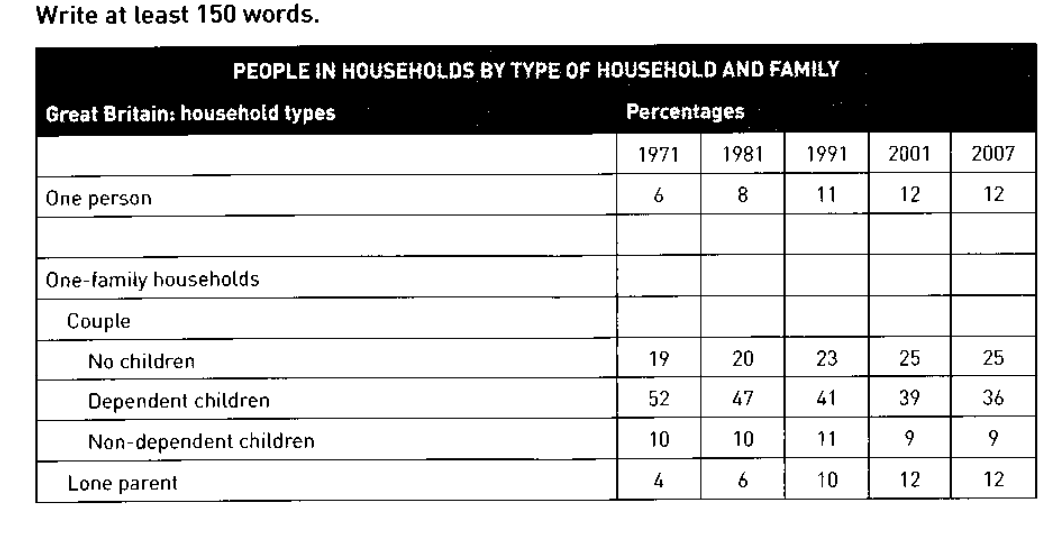
The table below shows the change in some household types in Great Britain from 1971 to 2007.
Summarise the information by selecting and reporting the main features, and make comparisons where relevant.
PEOPLE IN HOUSEHOLDS BY TYPE OF HOUSEHOLD AND FAMILY
Student answer (Band 5.0)
The table illustrate the change and difference of household types in Great Britain from the year 1971 to 2007. There are two types of household that are present in the data: One person household and One-family households.
Firstly, the one person household type experience an increasing number over the years, and reach its highest percentage in 2001 and stay constant until 2007. For the one-family household, there are variety of data changes base on different categories. The no children and lone parent category shows a significant increase from the year 1971 to 2007 of the number of people in the one-family household. However, the one-family household with dependent children tend to experience a major decrease across the years. Non-dependent children category also shows an slightly decrease of percentage people in this household type.
For instance, two type of household in Great Britain from the year 1971 to 2007 shows a lot changes. The one person household type illustrate a positive changes. Moreover, the one-family household experience a variety changes depend on the categories.
AI examiner evaluation
| Criterion | Band |
|---|---|
| Task Achievement / Task Response | 5.0 |
| Coherence and Cohesion | 5.0 |
| Lexical Resource | 5.0 |
| Grammatical Range and Accuracy | 5.0 |
| Overall | 5.0 |
Task Achievement / Task Response: Band 5.0
You identify the broad direction of several trends: one-person households rise, couples without children and lone-parent households increase, and households with dependent children decline. However, the response only partially reports the table’s main features. It gives no figures to show the scale of these changes, and the claim that one-person households reach their highest percentage in 2001 overlooks that the figure remains at 12% in 2007. The overview is also repeated in the final paragraph rather than developed with meaningful comparisons. To strengthen the report, select a few key values—for example, the fall from 52% to 36% for dependent-child households—and compare the largest and smallest categories across the period.
Coherence and Cohesion: Band 5.0
The response has a basic structure, moving from an introduction to trend descriptions and a concluding paragraph. Sequencing words such as “Firstly,” “However,” and “Moreover” help signal relationships between points. Nevertheless, progression is limited: the final paragraph largely repeats the earlier summary (“shows a lot changes” and “a variety changes”) instead of adding a useful comparison or conclusion. Some links are also imprecise, and the opening divides the data into two broad types without clearly explaining how the one-family categories relate to them. Organise the body around contrasting trends, and use each paragraph to add distinct information. Clearer references to the categories would make the relationships between ideas easier to follow.
Lexical Resource: Band 5.0
You use relevant topic vocabulary, including “household,” “category,” “percentage,” “increase,” and “decrease,” so the general meaning is usually clear. However, the range is limited and several phrases are repetitive or imprecise, such as “a lot changes,” “positive changes,” and “a variety changes.” Some word combinations are unnatural, including “increasing number” when describing percentages and “percentage people.” Use more precise reporting language, such as “the proportion rose,” “accounted for,” or “declined steadily,” and vary the terms used for change. Also distinguish “household type” from the people within that household, so the description accurately reflects what the table measures.
Grammatical Range and Accuracy: Band 5.0
You attempt both simple and longer sentences, including a contrast introduced by “However,” and a sentence describing several categories. However, frequent errors in agreement, articles, verb forms, and sentence construction make the writing less controlled. For example, “The table illustrate” should be “The table illustrates,” while “the one person household type experience” needs “experiences.” In “the no children and lone parent category shows,” the plural categories require a plural verb or a restructured sentence. The phrase “an slightly decrease” also has an article and adjective-form error. These patterns sometimes make the reader pause, even though the intended trends can generally be understood. Practise accurate simple sentences first, then combine them using controlled clauses.
See this exact question answered at other band scores. The same prompt compared across bands.
Browse more IELTS Writing model answers or get your own writing scored by the same AI examiner.