Band 5.0 IELTS Writing Task 1 Model Answer
Overall Band Score: 5.0 · IELTS Summit Mastery · 2026-11-23
IELTS Writing Task 1 question
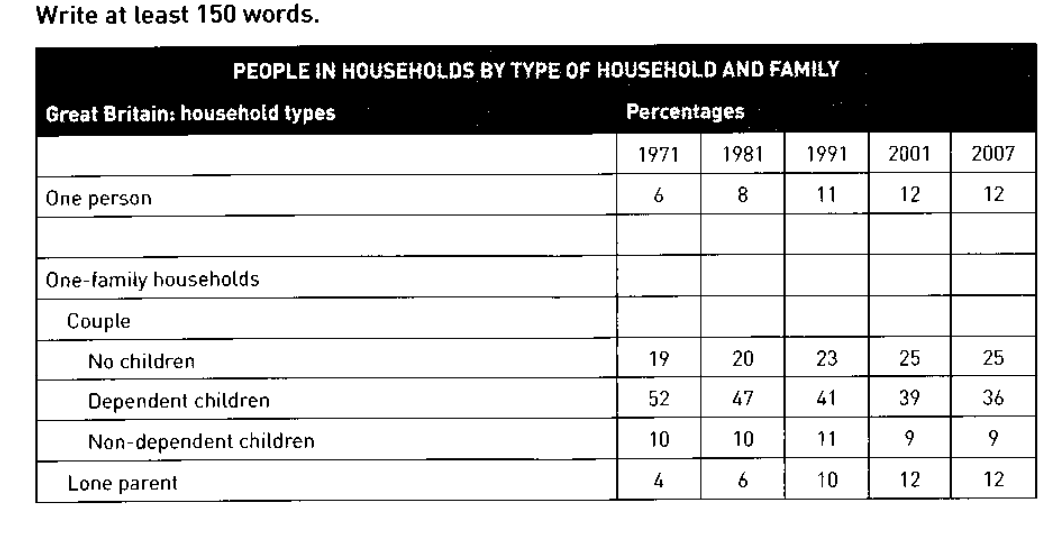
The table below shows the change in some household types in Great Britain from 1971 to 2007.
Summarise the information by selecting and reporting the main features, and make comparisons where relevant.
PEOPLE IN HOUSEHOLDS BY TYPE OF HOUSEHOLD AND FAMILY
Student answer (Band 5.0)
The table demonstrates the variation in specific familiy types in the United kingdom during 1971 and 2007.
overall, there are total 7 types of families are mentioned in the table, whereas the entire groups are consist of fluctuation across the period and the proportion has been increased excepted two categories from 1971 to 2007.
Initially, the one person family percentage was 6% in 1971, and increased 2% in next one decade, and grow upto 11 in 1991, but stay reamin the same from 2001 to 2007, Then there is a constant climb Non dependent children household, the proportion of this was 10% in both periods 1971 and 1981, but declined 1% in the year of 2007 and remain 9%, afterward, the highest share of dependent children was 52% in 1971, but decreased 14% up to the end 2007.
In contrast, the lowest share lone parent was 4% in 1971, and went upto 6%, in next ten years, 5% in next ondecade, while plateaued 12% of the household in the year of 2007, evetually there is no data about one family households and Couple.
AI examiner evaluation
| Criterion | Band |
|---|---|
| Task Achievement / Task Response | 5.0 |
| Coherence and Cohesion | 5.0 |
| Lexical Resource | 5.5 |
| Grammatical Range and Accuracy | 5.0 |
| Overall | 5.0 |
Task Achievement / Task Response: Band 5.0
You identify several relevant trends, including the rise in one-person households from 6% to 12% and the fall in households with dependent children from 52% to 36%. However, the response only partially covers the table: it omits the couple-with-no-children figures, and the claim that there are “7 types” is inaccurate because the table lists five household categories, with one-family households as a heading. Some details are also misreported: non-dependent children do not show a constant climb, and lone-parent households rise from 4% to 12%, not to 5% in the intervening decade. The overview is unclear and does not select the main contrasts effectively. Group the key rises and falls accurately and include the omitted category to make the summary more complete.
Coherence and Cohesion: Band 5.0
There is some organisation: the response begins with an introduction and overview, then reports figures for several categories, using “In contrast” to signal a comparison. However, the overall progression is difficult to follow because multiple trends are packed into one long paragraph, and the overview does not clearly establish the main pattern. Linking expressions such as “Initially,” “but,” and “afterward” are sometimes used in ways that do not clarify the sequence or relationship between data. The final comment about missing data is also confusing, since the table does provide figures for couples with no children. Use separate paragraphs for the overview and grouped details, and organise categories by rising and falling trends.
Lexical Resource: Band 5.5
You use some task-relevant vocabulary, including “proportion,” “share,” “declined,” and “plateaued,” and the reader can generally identify the household categories being discussed. However, the range is limited and several word choices or collocations are inaccurate, which sometimes makes the meaning unclear. For example, “constant climb” does not describe the non-dependent-children figures, which are stable before falling, while “increased 2%” is less precise than describing a rise from 6% to 8%. Spelling errors such as “familiy” and “evetually” are also noticeable. Aim for precise trend language and check spelling; alternatives such as “rose by two percentage points” and “remained stable” would improve clarity.
Grammatical Range and Accuracy: Band 5.0
The response attempts some longer sentences with contrast, for example, “the highest share of dependent children was 52% in 1971, but decreased 14% up to the end 2007.” However, complex sentences are often faulty, and errors in sentence structure, agreement, articles, and tense occur frequently enough to make parts difficult to read. The opening overview, “there are total 7 types of families are mentioned,” contains an incorrect construction, while “the entire groups are consist” has faulty agreement and verb form. Tense and clause control also weaken the trend descriptions. Practise building accurate simple sentences first, then combine them with controlled clauses; check subject–verb agreement and use consistent past-tense reporting for the historical data.
See this exact question answered at other band scores. The same prompt compared across bands.
Browse more IELTS Writing model answers or get your own writing scored by the same AI examiner.