Band 5.5 IELTS Writing Task 1 Model Answer
Overall Band Score: 5.5 · IELTS Summit Mastery · 2026-11-23
IELTS Writing Task 1 question
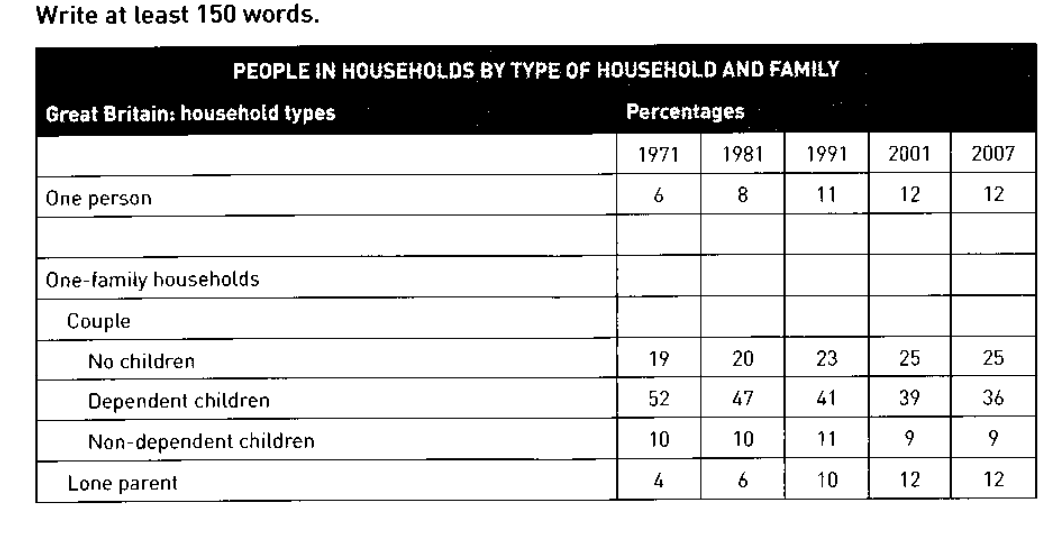
The table below shows the change in some household types in Great Britain from 1971 to 2007.
Summarise the information by selecting and reporting the main features, and make comparisons where relevant.
PEOPLE IN HOUSEHOLDS BY TYPE OF HOUSEHOLD AND FAMILY
Student answer (Band 5.5)
The table demonstrates the alternations in some household types in Great Britain from 1971 to 2007.
Overall, It is clear that couples with dependent children were the most common houdehold type throughout the period, although their proportion declined significantally to some extent. In contrast, the proportion of one person households and lone parent increased steadily.
In 1971,couples with dependent children households accounted for largest proportion, which is 52% of all the total households, followed by No children households at 19% and couples with non- dependent children at 10%.
In contrast, couples with no children increased dramatically from 195 in 1971 to 255 in 2007. The more dramatic increases were seen in one person households, which doubled from 6% in 1971 to 125 in 2007, and lone parent households, which tripled fro
AI examiner evaluation
| Criterion | Band |
|---|---|
| Task Achievement / Task Response | 5.0 |
| Coherence and Cohesion | 5.5 |
| Lexical Resource | 5.5 |
| Grammatical Range and Accuracy | 5.5 |
| Overall | 5.5 |
Task Achievement / Task Response: Band 5.0
You identify the main overall contrast: households with dependent children were the largest category and declined, while one-person and lone-parent households grew. You also include several relevant figures. However, the response is incomplete and does not report the full pattern across the years; the final sentence breaks off at “lone parent households, which tripled fro…”. Some figures are misreported: couples with no children rose from 19% to 25%, not “195” to “255”, and one-person households rose from 6% to 12%, not “125”. The overview also says the increases were steady, although the table shows periods with no change. The response contains 120 words, below the required 150, which limits coverage and development. Add a complete comparison of the categories and check all values.
Coherence and Cohesion: Band 5.5
The response has a recognisable structure, with an introduction, an overview and details about 1971 followed by later comparisons. Linking phrases such as “Overall” and “In contrast” help signal the direction of the discussion. However, the progression is weakened by the abrupt ending in the middle of the final comparison, leaving the account unfinished. The shift from the 1971 figures to the later figures is also not fully developed, and “In contrast” does not clearly express the relationship between the categories being compared. Organise the body around the main trends—for example, declining dependent-child households versus growing categories—and complete each comparison before moving on. This would make the sequence easier to follow.
Lexical Resource: Band 5.5
You use some relevant task vocabulary, including “proportion”, “accounted for” and “increased”, and you attempt to describe trends with words such as “declined” and “doubled”. However, spelling and word-choice errors are noticeable, including “alternations” for changes, “houdehold”, “significantally” and “fro”. Some expressions are also imprecise or awkward: “largest proportion” needs an article, while “increased dramatically” overstates a rise from 19% to 25%. The repeated use of “households” and “proportion” also limits variety. Aim for accurate, restrained trend language and check spelling carefully; terms such as “rose”, “fell” and “remained stable” can describe the data more precisely.
Grammatical Range and Accuracy: Band 5.5
You attempt both simple statements and more complex sentences, such as “Overall, it is clear that…” and the sentence beginning “In 1971, couples with dependent children…”. This shows some range, but errors in sentence construction and punctuation reduce accuracy. For example, “which is 52%” shifts tense within a past-time report, and “accounted for largest proportion” is missing an article. There are also inconsistent spaces and punctuation, such as the space before “couples” and the missing space after the comma in “1971,couples”. The final sentence is incomplete, so its grammatical relationship cannot be followed. Use past tense consistently, check articles, and proofread sentence boundaries and punctuation.
See this exact question answered at other band scores. The same prompt compared across bands.
Browse more IELTS Writing model answers or get your own writing scored by the same AI examiner.