Band 5.0 IELTS Writing Task 1 Model Answer
Overall Band Score: 5.0 · IELTS Summit Mastery · 2026-11-23
IELTS Writing Task 1 question
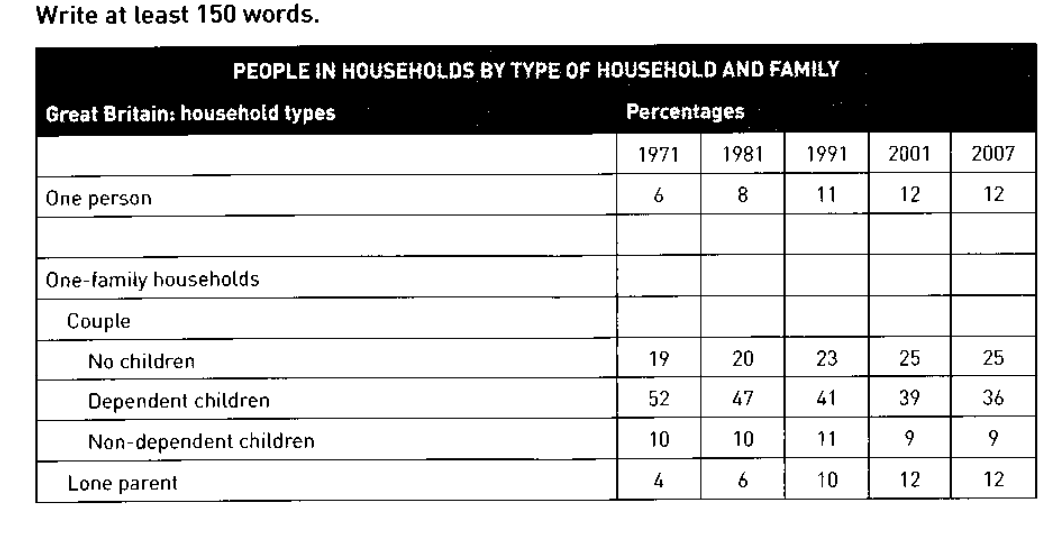
The table below shows the change in some household types in Great Britain from 1971 to 2007.
Summarise the information by selecting and reporting the main features, and make comparisons where relevant.
PEOPLE IN HOUSEHOLDS BY TYPE OF HOUSEHOLD AND FAMILY
Student answer (Band 5.0)
This table demonstrate the proportion of individuals living in 5 different types of houshold from 1971 t0 2007.
This table give us the proportion which indicate that the couple with dependent minors decline as compare to couple which have no offsprings. It also shows the the childern which are not dependent to their parents have a minor loss at in 1971 the proportion was 10 and in 2007 the proportion was 9 its not a major change as we compare it with the percentage of lone parents. The percentage of the lone parents platued at 2001 and remain same till 2007.
The share of single individual living in a house in 2007 is doubled as compare to 1971 and small surge seem in between era. there were no major fluctuation or decline or surge seen in this era.
AI examiner evaluation
| Criterion | Band |
|---|---|
| Task Achievement / Task Response | 5.0 |
| Coherence and Cohesion | 5.0 |
| Lexical Resource | 5.5 |
| Grammatical Range and Accuracy | 5.0 |
| Overall | 5.0 |
Task Achievement / Task Response: Band 5.0
You identify several relevant patterns, including the fall in households with dependent children and the rise in lone-parent households, and you correctly note that the lone-parent figure stays at 12% from 2001 to 2007. However, the response only partly summarises the table: it gives no clear, complete overview of the main changes and omits important comparisons, especially that dependent-child households remain the largest category despite declining from 52% to 36%. The claim that the single-person share “is doubled” is imprecise: it rises from 6% to 12%, exactly doubling, but the wording should identify the years clearly. The response is also 12 words below the required minimum, limiting the detail available to report the key features.
Coherence and Cohesion: Band 5.0
There is some organisation: the response begins by introducing the table and then discusses several household categories. Basic linking phrases such as “It also shows” and “as we compare it” help connect points. However, the ideas do not progress through a clear overview and organised comparisons; categories are introduced in a somewhat scattered way, and the final point about single-person households is not clearly connected to the preceding discussion. Repeated use of “the table” and long, loosely joined sentences also makes the relationships between details harder to follow. Grouping the main increases together and the main decrease separately, with a concise overview first, would create clearer progression.
Lexical Resource: Band 5.5
You use some relevant vocabulary for describing data, including “proportion,” “percentage,” “decline,” “surge,” and “fluctuation.” This gives you a basic range for the task, but several choices are inaccurate or informal and sometimes make the meaning unclear. For example, “dependent minors” and “offsprings” are not suitable labels for the table’s household categories; “dependent children” and “couples without children” would be more precise. “Platued” appears to be a misspelling of “plateaued,” while “small surge” does not accurately describe the gradual rise in the single-person figure. Aim for standard chart language and check spelling and collocations carefully.
Grammatical Range and Accuracy: Band 5.0
The response attempts both simple statements and longer sentences, but control is uneven, and errors occur frequently enough to affect clarity. For example, “This table demonstrate” and “This table give” have subject–verb agreement errors; “as compare to” is an incorrect comparative structure; and “the children … have a minor loss at in 1971” is difficult to interpret because the sentence structure and prepositions are faulty. There are also problems with articles and sentence boundaries, including the run-on sequence beginning “in 1971 the proportion was 10.” Use shorter, complete sentences while checking agreement and comparative forms, then build more complex sentences once those patterns are secure.
See this exact question answered at other band scores. The same prompt compared across bands.
Browse more IELTS Writing model answers or get your own writing scored by the same AI examiner.