Band 6.0 IELTS Writing Task 1 Model Answer
Overall Band Score: 6.0 · IELTS Summit Mastery · 2026-11-24
IELTS Writing Task 1 question
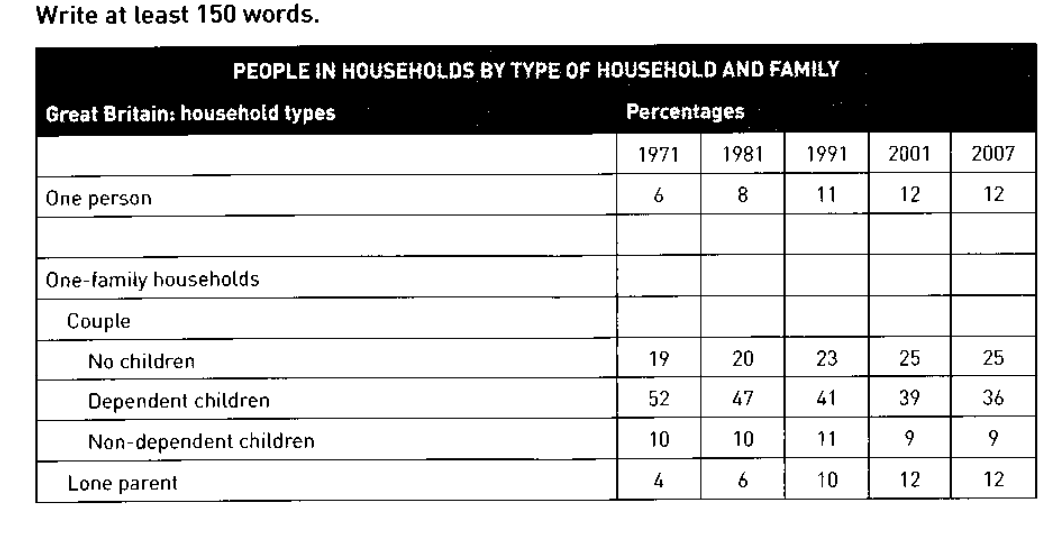
The table below shows the change in some household types in Great Britain from 1971 to 2007.
Summarise the information by selecting and reporting the main features, and make comparisons where relevant.
PEOPLE IN HOUSEHOLDS BY TYPE OF HOUSEHOLD AND FAMILY
Student answer (Band 6.0)
The table outlines the information on changes in some household types in Great Britain starting from 1971 to 2007
Overall, the table is divided into two categories of househld comprising of one person and one family household. Most popular family household were those comprised of dependent children in all the years.
In 1971, One person family accounted for the lowest proportion nearly 6% with gradual increase the subsequent year moreover, it bloomed by double in the year 2001 counting around 12% and remained same for 6 years that is 2007.Whereas, In family household ; dependent children has the highest percentage amongs the other categories however, a pattern of decline was observed internally.
1971 was accounted for the highest fragment of 52% with slight decrease over the years resulting in by 2007. Households comprising of no children rose significantly with 19% in initial year to 25% in 2007. Similarly, lone parents had an increase in the following years. The percentage tripled by 2007. There was no major change observed in non-dependent children,1971 and 1981 had same figure wheres a drop was observed in the subsequent years.
AI examiner evaluation
| Criterion | Band |
|---|---|
| Task Achievement / Task Response | 6.5 |
| Coherence and Cohesion | 6.0 |
| Lexical Resource | 5.5 |
| Grammatical Range and Accuracy | 5.0 |
| Overall | 6.0 |
Task Achievement / Task Response: Band 6.5
You identify the main pattern accurately: dependent-child households were the largest category throughout and declined, while one-person, childless-couple and lone-parent households generally increased. The overview also distinguishes the one-person and one-family groups, and several figures are reported correctly, including 6% rising to 12% and childless couples reaching 25%. This covers the task well, though some details are less fully reported: the dependent-child figure is given as 52% in 1971 but its 2007 endpoint of 36% is omitted, and the non-dependent-child trend is described vaguely rather than with its values. The claim that lone-parent households tripled “by 2007” is imprecise: they rose from 4% to 12%, which is three times the starting level. More precise endpoints and comparisons would strengthen the report.
Coherence and Cohesion: Band 6.0
The response has a recognisable structure: an introduction, an overview and two paragraphs of supporting details. The main categories are generally grouped sensibly, and linking expressions such as “Overall,” “Whereas” and “Similarly” help signal relationships. However, progression within the detail paragraphs is sometimes difficult to follow. For example, “1971 was accounted for the highest fragment” does not clearly identify the household type, and “resulting in by 2007” leaves the outcome unfinished. Some transitions are also awkward or mechanically joined, particularly the long sentence beginning “In 1971, One person family…”. Use clearer topic sentences and connect each trend directly to its category and endpoint; this would make the organisation more consistently easy to follow.
Lexical Resource: Band 5.5
You use a reasonable range of vocabulary for describing trends, including “proportion,” “decline,” “rose significantly” and “remained same.” These choices show an effort to avoid repeating basic terms. However, several word choices or collocations are inaccurate or unnatural, which limits precision: “bloomed by double” is not suitable for a statistical increase, “highest fragment” is unclear, and “pattern of decline was observed internally” is unnecessarily vague. There are also spelling and form errors, such as “househld,” “amongst” misspelled as “amongs,” and “wheres.” Aim for standard chart language and accurate collocations, such as “increased twofold,” “accounted for the largest share,” and “declined steadily.”
Grammatical Range and Accuracy: Band 5.0
You attempt both simple and more complex sentences, including clauses introduced by “whereas” and “however,” but control is uneven. Errors occur in sentence structure and agreement, as in “Most popular family household were those comprised of dependent children,” and in the incomplete construction “with gradual increase the subsequent year.” The sentence “1971 was accounted for the highest fragment” also has a faulty grammatical pattern. Punctuation and capitalisation are inconsistent, with unnecessary capitals after commas and missing spaces after full stops. These problems sometimes make relationships between figures and categories harder to understand. Practise building accurate comparison sentences with clear subjects and verbs, for example, “The proportion of one-person households rose from 6% to 12%.”
See this exact question answered at other band scores. The same prompt compared across bands.
Browse more IELTS Writing model answers or get your own writing scored by the same AI examiner.