Band 6.0 IELTS Writing Task 1 Model Answer
Overall Band Score: 6.0 · IELTS Summit Mastery · 2026-11-24
IELTS Writing Task 1 question
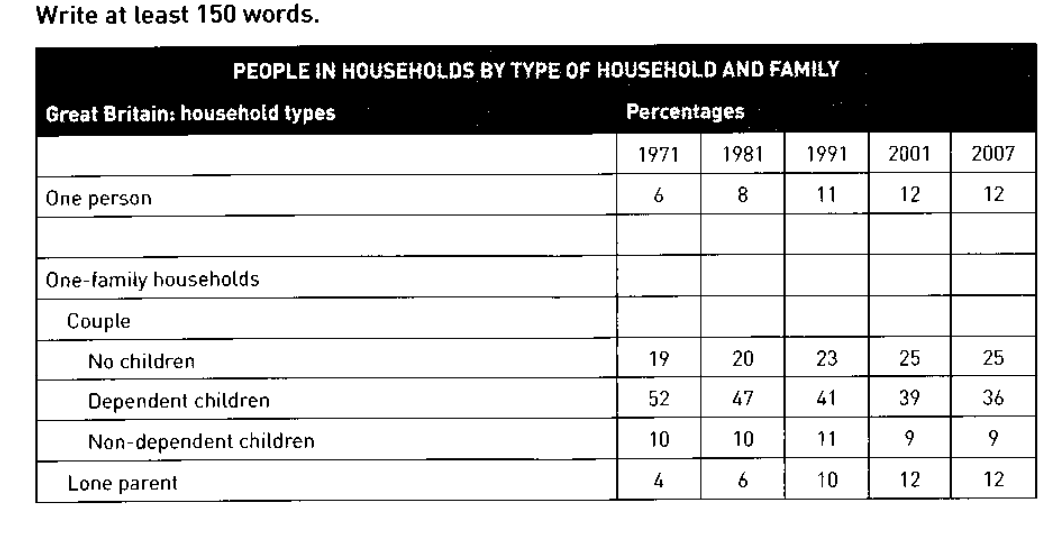
The table below shows the change in some household types in Great Britain from 1971 to 2007.
Summarise the information by selecting and reporting the main features, and make comparisons where relevant.
PEOPLE IN HOUSEHOLDS BY TYPE OF HOUSEHOLD AND FAMILY
Student answer (Band 6.0)
Introduction :
The table illustrates change of percentage in some household types in Great Britain comparing different years from 1971 to 2007.
Overview :
Overall , couple with dependent children holds the majority in every year from 1971 to 2007 but also the only portion declined continuously . The lone parent portion remains the lowest in 1971 but rises constantly.
Paragraph 1 :
In 1971, households with lone parents remained the lowest about 4% , but show constant increase over the time reaching 12% in 2007 while households having one person also start low in 1971 , nearly 6%, but gradullay increased to 12% in 2007.
Paragraph 2 :
According to the table , couples with dependent children hold the highest percentage about 52% in 1971 but show the constant decline reaching its all time low , about 36% in 2007. While couples with no children and non dependent children started at 19% and 10% in 1971 but change to 25% and 9% respectively.
AI examiner evaluation
| Criterion | Band |
|---|---|
| Task Achievement / Task Response | 6.5 |
| Coherence and Cohesion | 6.5 |
| Lexical Resource | 6.0 |
| Grammatical Range and Accuracy | 5.5 |
| Overall | 6.0 |
Task Achievement / Task Response: Band 6.5
You identify the main pattern accurately: households with dependent children are the largest category throughout and fall from 52% to 36%, while lone-parent households rise from 4% to 12%. You also report the increase in one-person households and the final figures for the other categories. This gives the response a relevant overview and covers the key groups. However, the overview’s claim that lone parents remain the lowest applies only to 1971; by 2007 they are level with one-person households. The final category comparison is also underdeveloped: non-dependent children rise slightly to 11% in 1991 before falling to 9%, a notable fluctuation omitted here. More precise comparisons across the years would make the summary more complete.
Coherence and Cohesion: Band 6.5
The response has a clear overall arrangement, moving from an introduction and overview to two paragraphs that group the smaller and larger household categories. This makes the main trends easy to locate. Some linking is effective, particularly the contrast introduced by “but,” although the repeated “but” constructions make relationships between ideas feel somewhat mechanical. The sentence beginning “While couples with no children…” is a subordinate clause without a main clause, so the final comparison feels unfinished. There is also some repetition of “in 1971” and “in 2007.” Use complete sentences and vary the way you connect comparisons—for example, combine the starting and ending figures in a balanced sentence.
Lexical Resource: Band 6.0
You use an adequate range of task-related vocabulary, including “percentage,” “declined,” “increase,” and “reaching,” and the meaning of the trends is generally clear. There are also attempts at more formal reporting language, such as “illustrates” and “according to the table.” However, some word choices and collocations are inaccurate or awkward: “change of percentage” would be more naturally expressed as “changes in the percentages,” and “holds the majority” is not suitable for describing a category’s share. “All time low” is also imprecise for a percentage that declines across the period. Spelling errors such as “gradullay” and “non dependent” reduce accuracy. Aim for precise terms such as “proportion” and “accounted for,” and check spelling and hyphenation.
Grammatical Range and Accuracy: Band 5.5
You attempt both simple and more complex sentence forms, and the overall meaning remains understandable. However, some grammatical errors affect control. For example, “couple with dependent children holds” has a number/agreement problem and an awkward singular subject, while “but show the constant decline” shifts to an incorrect verb form. In “households with lone parents … but show constant increase,” the subject and verb do not agree, and the article is missing before “constant increase.” The final sentence beginning “While couples…” is incomplete because it lacks a main clause. Punctuation spacing is also inconsistent. Practise forming complete comparison sentences, checking subject–verb agreement, and using articles consistently; these corrections would make your varied structures more reliable.
See this exact question answered at other band scores. The same prompt compared across bands.
Browse more IELTS Writing model answers or get your own writing scored by the same AI examiner.