Band 5.5 IELTS Writing Task 1 Model Answer
Overall Band Score: 5.5 · IELTS Summit Mastery · 2026-11-24
IELTS Writing Task 1 question
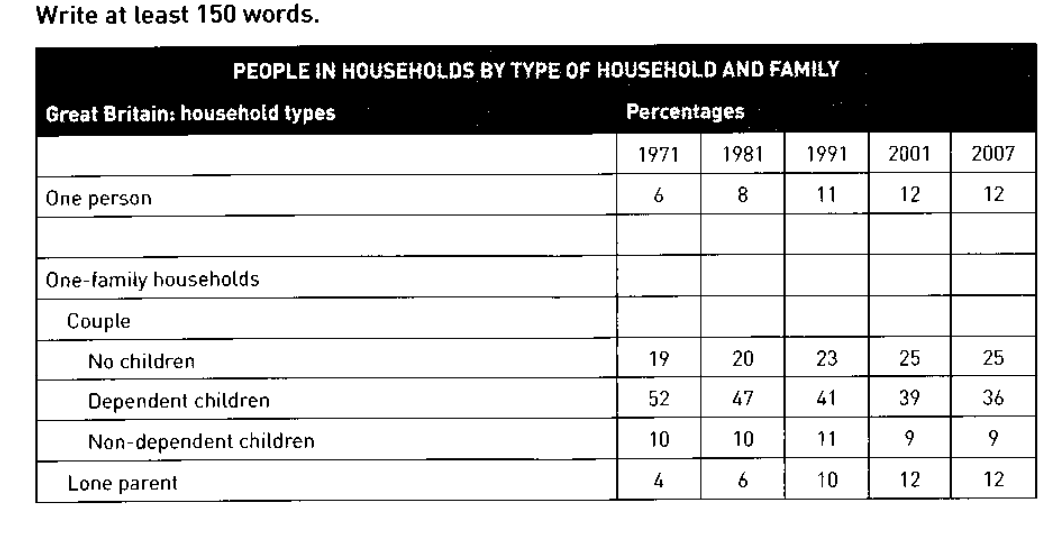
The table below shows the change in some household types in Great Britain from 1971 to 2007.
Summarise the information by selecting and reporting the main features, and make comparisons where relevant.
PEOPLE IN HOUSEHOLDS BY TYPE OF HOUSEHOLD AND FAMILY
Student answer (Band 5.5)
The table Provide information about the the change in some household types in Great Britain Measured in percentage from time period Between 1971 to 2007
Overall the couple living with dependent children are have highest number of proportion throughout five yyear while this figure decreases steadily ,In contrast the percentage of people living with No children and lone-parents all increases in upward trend throught out 1971 to 2007
In 1971 the people living alone have lower proportion of 6 percent but this increases steadily in five year upto 12 percent in 2007 While people living as couple without children have low proportion of 19 percent which also increases upto 25 percent in 2007 and also the couple living alone have 4 percent in 1971 that increases to 12 percent in 2007 The unsual Trend in couple with dependent children have high proportion in 1971 which decrease steadily and reached 9 percent in 2007.
AI examiner evaluation
| Criterion | Band |
|---|---|
| Task Achievement / Task Response | 5.5 |
| Coherence and Cohesion | 5.5 |
| Lexical Resource | 5.5 |
| Grammatical Range and Accuracy | 5.0 |
| Overall | 5.5 |
Task Achievement / Task Response: Band 5.5
You identify the main contrast: households with dependent children remain the largest category while declining, whereas several other categories rise. You also include relevant figures such as 6% to 12% for one-person households and 19% to 25% for couples without children. However, the final comparison is inaccurate: dependent-child households fall from 52% to 36%, not to 9%; 9% is the 2007 figure for non-dependent children. The overview also omits the stable ending for some categories and the rise in lone-parent households. The response is 144 words, six below the required minimum, and the short length contributes to limited coverage and development. Check each figure against its row and report the key trends more fully.
Coherence and Cohesion: Band 5.5
The response has a recognisable structure, moving from an introduction to an overview and then to details, and words such as “Overall,” “In contrast” and “While” help signal relationships. However, progression within the detail paragraph is difficult to follow because several categories are combined in one long sentence, and the final sentence assigns the 9% figure to the wrong household type. Some linking is repetitive, particularly the repeated use of “increases” and “steadily,” while punctuation and spacing make boundaries between ideas unclear. Organise the details into clearer comparisons—for example, rising categories together and the declining dependent-children group separately—and use accurate references to each category.
Lexical Resource: Band 5.5
You use relevant topic vocabulary, including “proportion,” “percentage,” “dependent children” and “lone-parents,” so the reader can generally identify the subject of the report. However, the range is limited and several phrases are unnatural or imprecise, such as “have highest number of proportion,” “increases in upward trend” and “couple living alone” when referring to couples without children. “Unusual Trend” is not an appropriate description of the main decline. Spelling and word-form slips, including “throught” and “yyear,” also reduce accuracy. Aim for concise, conventional data-reporting language and use the table’s category labels consistently; this will make comparisons clearer and more precise.
Grammatical Range and Accuracy: Band 5.0
There are attempts to form longer sentences and to compare trends using “while” and “which,” but control is uneven. The opening is not a complete, well-formed sentence (“The table Provide information…”), and the overview contains agreement and verb-form problems in “the couple … are have highest number.” Other examples include “the people living alone have lower proportion” and “this increases steadily in five year upto 12 percent,” where articles, number and sentence construction are not controlled. Capitalisation and punctuation are also inconsistent, with several ideas joined by commas without clear sentence boundaries. Practise accurate simple comparison sentences first, then add subordinate clauses while checking subject–verb agreement, articles and punctuation.
See this exact question answered at other band scores. The same prompt compared across bands.
Browse more IELTS Writing model answers or get your own writing scored by the same AI examiner.