Band 5.5 IELTS Writing Task 1 Model Answer
Overall Band Score: 5.5 · IELTS Summit Mastery · 2026-11-25
IELTS Writing Task 1 question
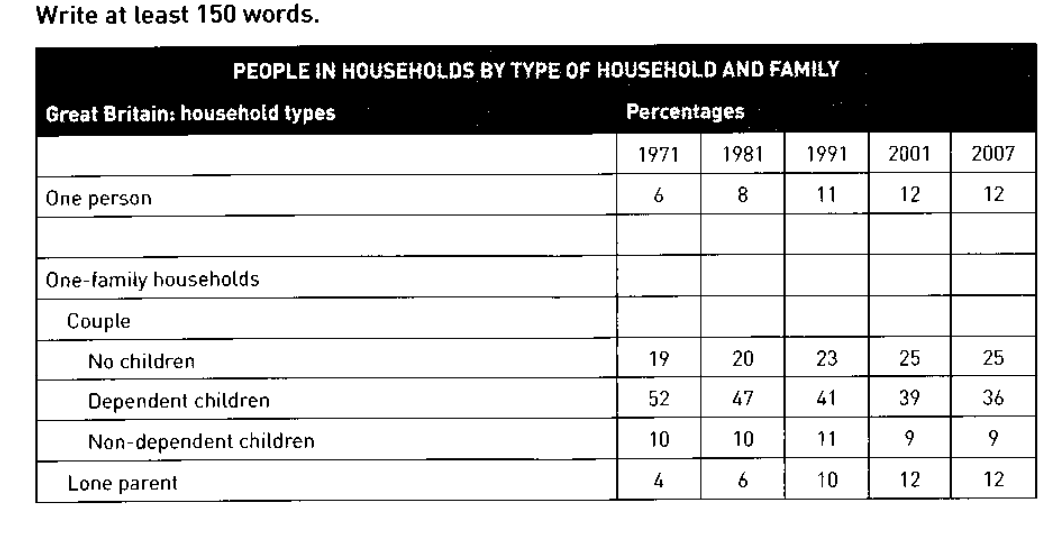
The table below shows the change in some household types in Great Britain from 1971 to 2007.
Summarise the information by selecting and reporting the main features, and make comparisons where relevant.
PEOPLE IN HOUSEHOLDS BY TYPE OF HOUSEHOLD AND FAMILY
Student answer (Band 5.5)
The table illustrates the development in household sector in great bratain from 1971 to 2007.
Overall, there are lot of household type in Great Britain and the one of the higest percentage si 52 percentage in dependent children type in the year of 1971.While in the other hand in the sme year lone parent has the least percentage in the whole table of around 45.
Firstly, household like one person,no children,lone parent catogary has the development in the year from 1971 to 2007. Among the all of them one people and lone parent has the asme percentage of groeath of 12% at last Although in the other hand no childern has the mashive groeath among the all types. Which is from 19 to 25 percentage in the year of 2007.
Secondly, the other two development and non dependent children has opposit line it fall from higer percentage to low from 1971 to 2007. Additonally, development children hsa the mashive down fall which is directly from 52% to 36%. Whiloe, the other part only has the least down fall of one percentage.
AI examiner evaluation
| Criterion | Band |
|---|---|
| Task Achievement / Task Response | 5.5 |
| Coherence and Cohesion | 5.5 |
| Lexical Resource | 5.0 |
| Grammatical Range and Accuracy | 5.0 |
| Overall | 5.5 |
Task Achievement / Task Response: Band 5.5
You identify several relevant patterns, including the fall in households with dependent children from 52% to 36%, and the rises in one-person and lone-parent households to 12%. However, the overview is unclear and includes a major data error: lone-parent households were 4% in 1971, not “around 45,” so they were not the lowest figure in the table; one-person households were lower, at 6%. The response also says “development children” without making clear which category is meant, and the comparison of the two declining categories is not fully accurate: non-dependent children rose slightly before falling to 9%. Select the main trends accurately and state them clearly in the overview before supporting them with figures.
Coherence and Cohesion: Band 5.5
There is an attempt to organise the report into an overview and two body paragraphs, and “Firstly” and “Secondly” signal a sequence. However, the progression is difficult to follow because several sentences contain unclear references or incomplete comparisons. For example, “Among the all of them one people and lone parent has the asme percentage of groeath of 12% at last” does not clearly explain what is being compared, while “the other two development and non dependent children” leaves the categories uncertain. Linking phrases such as “Although in the other hand” are also used inaccurately, which interrupts the flow rather than clarifying relationships. Group the rising categories together and the falling category or categories together, using clear topic sentences and direct comparisons.
Lexical Resource: Band 5.0
The response uses some task-relevant vocabulary, including “percentage,” “household,” “dependent children,” and “down fall,” so the reader can recognise the general subject. However, the range is limited and several word choices, forms, and spelling errors make the meaning difficult to interpret. Examples include “household sector,” “development children,” “opposit line,” and repeated use of “mashive.” Some phrases, such as “the least down fall,” do not express the intended comparison naturally. Use precise category labels from the table and standard trend language, such as “increased,” “declined,” “accounted for,” and “the largest fall.” Check spelling carefully, especially for key terms that carry the report’s meaning.
Grammatical Range and Accuracy: Band 5.0
You attempt both simple statements and longer sentences, but control is inconsistent, particularly when you try to combine comparisons and explanations. Errors in sentence structure and agreement appear in examples such as “there are lot of household type” and “one people and lone parent has.” Several clauses are incomplete or awkwardly joined, including “Which is from 19 to 25 percentage in the year of 2007,” and punctuation is missing after the overview’s first sentence. These problems sometimes make it hard to identify the subject or the relationship between ideas. Practise writing complete sentences with a clear subject and verb, and use straightforward comparison structures—for example, “The proportion rose from 19% to 25%.”
See this exact question answered at other band scores. The same prompt compared across bands.
Browse more IELTS Writing model answers or get your own writing scored by the same AI examiner.