Band 5.0 IELTS Writing Task 1 Model Answer
Overall Band Score: 5.0 · IELTS Summit Mastery · 2026-11-25
IELTS Writing Task 1 question
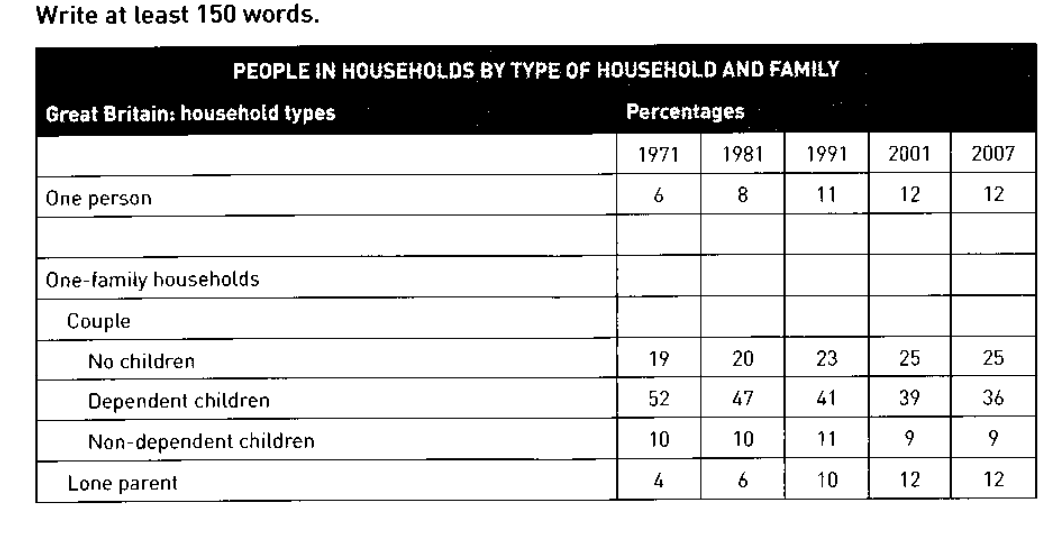
The table below shows the change in some household types in Great Britain from 1971 to 2007.
Summarise the information by selecting and reporting the main features, and make comparisons where relevant.
PEOPLE IN HOUSEHOLDS BY TYPE OF HOUSEHOLD AND FAMILY
Student answer (Band 5.0)
The table illustrates the considerable changes shows in various house hold types in
Great Britian from 1971 till 2007.
Overall, table depicts many changes are occured in that time frame which presented one house hold type from one person to one-family house then later specified by couple house,no children to turned into dependent and non dependent children while in the end catagorised as lone aperent.
Inittially, looking into one person house in 1971 revealed there is just 6% was available and later that figure increased by just doubled teill 2007. Whileas,there is no house hold shown for couples and one-family house hold in all that years.
The propotion of dependent children house hold peak high among all catagories in 1971 that reveals 52% in but it declined throughout all years by 47% in 1981 and later decrease shows in 2007 by likely 36%.Conversely, non-dependent children and lone parent favourably declined by just 10% and4% in 1971 respectively and later in 2007 its ratio was 9% and12%.
In contrast, deoebdent children house hold shows high ration in start but reasonably decrease in later 2007.
AI examiner evaluation
| Criterion | Band |
|---|---|
| Task Achievement / Task Response | 4.5 |
| Coherence and Cohesion | 4.5 |
| Lexical Resource | 5.0 |
| Grammatical Range and Accuracy | 5.0 |
| Overall | 5.0 |
Task Achievement / Task Response: Band 4.5
You identify several relevant patterns, especially the rise in one-person households and the fall in households with dependent children. However, the overview is unclear and partly misrepresents the table: the categories are not stages in which one household type turns into another, and couples without children are recorded throughout, rising from 19% to 25%. The claim that there was “no house hold shown for couples” is therefore inaccurate. Some figures are reported correctly, such as 52% falling to 36% for dependent children, but the account of non-dependent children and lone-parent households is confusing and does not clearly explain their different trends. To improve, give a concise overview of the main increases and decreases, then compare the categories accurately using selected figures.
Coherence and Cohesion: Band 4.5
The response has an attempt at paragraphing, with an introduction, an overview and paragraphs describing figures. It also uses linking expressions such as “Overall,” “Conversely” and “In contrast.” However, the progression is difficult to follow because the overview describes the categories as if they change into one another, and the final sentence repeats the earlier point about dependent-child households without adding information. Some transitions do not express the relationship between the data clearly; for example, “Conversely” introduces two categories whose trends are not accurately distinguished. Organise the report around the main rising and falling patterns, and use each paragraph to develop one comparison. Clearer references to the household categories would also help readers follow the data.
Lexical Resource: Band 5.0
You attempt a range of task-related vocabulary, including “declined,” “increased,” “proportion” and “categories,” and these choices show awareness of the language needed to describe a table. However, spelling and word-choice errors are frequent and sometimes make the meaning difficult to interpret, as in “Britian,” “catagorised,” “aperent” and “ration.” Several phrases are also unnatural or imprecise, such as “house hold type from one person to one-family house” and “peak high.” Use standard forms such as “household” and “proportion,” and choose precise collocations like “the figure rose” or “the percentage fell.” A smaller set of accurately used trend verbs would make the report clearer and more effective.
Grammatical Range and Accuracy: Band 5.0
You attempt both simple and longer sentences, including clauses introduced by “while” and “which,” but complex structures are often faulty and errors occur frequently. For example, “Overall, table depicts many changes are occured” combines structures incorrectly, while “there is just 6% was available” has an inaccurate verb pattern. Tense and agreement are also inconsistent, as in “the proportion … peak high” and “its ratio was.” Punctuation and sentence boundaries need attention, particularly where clauses are joined with “Whileas” or run together after a percentage. Practise building clear sentences with a subject and verb, such as “The proportion rose from 6% to 12%,” before adding subordinate clauses.
See this exact question answered at other band scores. The same prompt compared across bands.
Browse more IELTS Writing model answers or get your own writing scored by the same AI examiner.