Band 5.5 IELTS Writing Task 1 Model Answer
Overall Band Score: 5.5 · IELTS Summit Mastery · 2026-11-25
IELTS Writing Task 1 question
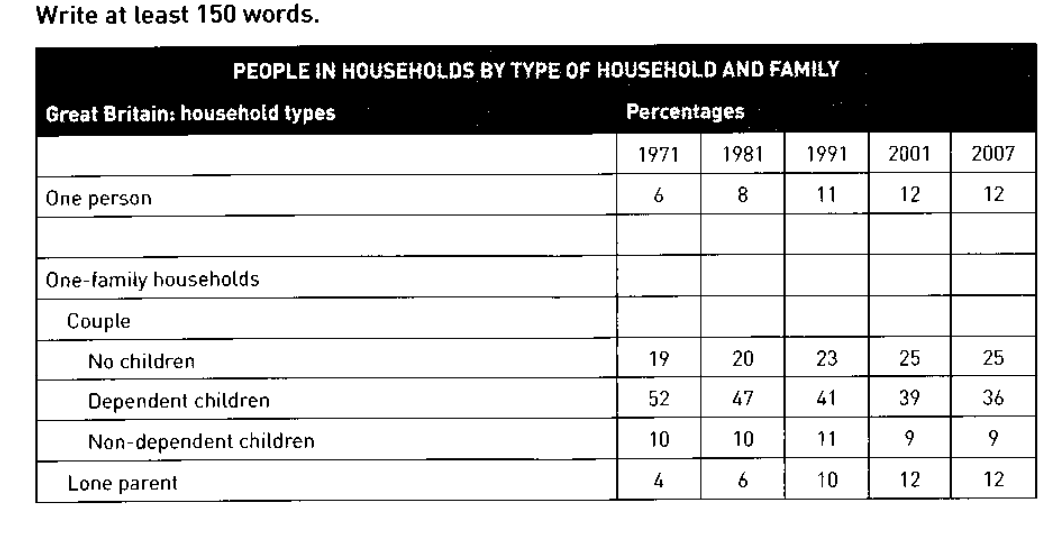
The table below shows the change in some household types in Great Britain from 1971 to 2007.
Summarise the information by selecting and reporting the main features, and make comparisons where relevant.
PEOPLE IN HOUSEHOLDS BY TYPE OF HOUSEHOLD AND FAMILY
Student answer (Band 5.5)
The graph given illustrates data about change in household types in Great Britian from 1971 to 2007. Further i would like to elaborate and discuss.
Overall, it is evident that dependent parents holds the largest ratio yet they showed a drastic declin of total ratio. Whereas, lone parent captive a tiny friction.
To begin with, one person household types , it rise gradually from 1971 to 2007 with a percentage of 6 to 12. Then comes no children household, it also tends to increase over the years from 1971 to 1991, with a ratio around 23 percent. Following next two years it reamains the same, like in steady position of 25 percent in total. Moreover, ratio of dependent children seems to have a decreased ratio.As shown in the graph, its decreased overall from 51 to 36, witha dramatic drops of percentage. Further non-dependent children remain stable for first two year, but then drops as well. At last, lone parent seems to visualize a total of rise but with a lower ratio.
AI examiner evaluation
| Criterion | Band |
|---|---|
| Task Achievement / Task Response | 5.5 |
| Coherence and Cohesion | 5.5 |
| Lexical Resource | 5.0 |
| Grammatical Range and Accuracy | 5.0 |
| Overall | 5.5 |
Task Achievement / Task Response: Band 5.5
You identify several relevant trends, including the rise in one-person households from 6% to 12% and the decline in households with dependent children. However, the overview is unclear and includes a misreading: “dependent parents” is not a table category, and the largest group is couples with dependent children, which fell from 52% to 36%. The claim that lone-parent households had a “tiny” share overlooks their increase from 4% to 12%, matching the one-person figure by 2007. Some details are accurate, such as the rise in couples without children to 25%, but the non-dependent-children trend and lone-parent figures are not clearly reported. A more precise overview and fuller, accurate comparisons would strengthen coverage of the task.
Coherence and Cohesion: Band 5.5
The response has a basic sequence, moving from an introduction and overview to details about household categories, and phrases such as “To begin with” and “Moreover” signal transitions. However, the progression is not consistently clear: “Following next two years” is difficult to connect to the dates, and “At last” introduces a trend without giving its figures. Several linking expressions feel mechanical or do not clarify the relationship between ideas. The overview is also compressed into an unclear contrast, while the body combines multiple categories in one paragraph without a clear comparison structure. Organise the details into logical groups and use transitions that explicitly show whether figures rise, fall, or remain stable.
Lexical Resource: Band 5.0
You attempt a range of trend vocabulary, including “gradually,” “declin,” “stable,” and “dramatic drops,” showing awareness of the language needed for a table summary. However, word choice and collocation are often inaccurate or unclear: “lone parent captive a tiny friction” does not communicate the intended trend, and “visualize a total of rise” is unnatural. There are also spelling errors such as “Great Britian,” “reamains,” and “witha.” Repetition of “ratio” and “percentage” limits precision, and “graph” is not the most accurate label for the table. Use standard terms such as “proportion” or “share,” and choose direct trend phrases that clearly describe the data.
Grammatical Range and Accuracy: Band 5.0
The response attempts both simple and longer sentence forms, including clauses introduced by “Whereas” and “As shown in the graph.” However, grammatical errors occur frequently and sometimes make relationships difficult to follow. For example, “dependent parents holds” has a subject–verb agreement problem, while “it rise gradually” and “its decreased overall” use incorrect verb forms. Sentence fragments and punctuation also affect clarity, as in “Whereas, lone parent…” and “ratio.As shown.” Articles and plural forms are inconsistent, including “one person household types” and “a decreased ratio.” Focus first on complete sentences with accurate subjects and verbs, then check tense consistency and punctuation when editing.
See this exact question answered at other band scores. The same prompt compared across bands.
Browse more IELTS Writing model answers or get your own writing scored by the same AI examiner.