Band 5.0 IELTS Writing Task 1 Model Answer
Overall Band Score: 5.0 · IELTS Summit Mastery · 2026-11-26
IELTS Writing Task 1 question
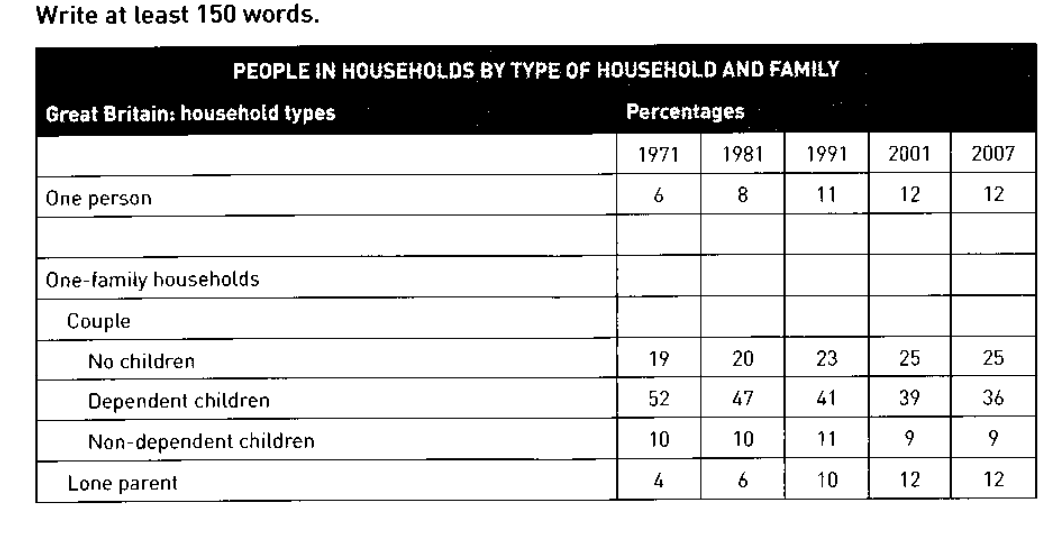
The table below shows the change in some household types in Great Britain from 1971 to 2007.
Summarise the information by selecting and reporting the main features, and make comparisons where relevant.
PEOPLE IN HOUSEHOLDS BY TYPE OF HOUSEHOLD AND FAMILY
Student answer (Band 5.0)
The table illustrates change in some household categories in Britain from 1971 to 2007.
Overall, it can be clearly seen that one person, one family households and lone parent represented the percentage increase in the time period of 1971 to 2007. In constrast, the percentage of dependent children and non dependent children fluctuated.
One person recorded at 6% in 1971 and the percentage rapidly increased day by day. In the year of 2007 one person percentage reached at 12%. Whereas, the percentages of one family household and couple category had not been given in this table during the time period of 1971 to 2007.
Futhermore, no children recorded at 19% in 1971 and percentage witnessed minor rise in the time period of 1971 to 2007 while reached at 25% in 2007. On the other hand, dependent children and non dependent children percentages witnessed minor fluctuations in 1971 to 2007. lone parent percentage in 1971 at 4% and the percentage witnessed minor rose throughout the time period of 1971 to 2007.
AI examiner evaluation
| Criterion | Band |
|---|---|
| Task Achievement / Task Response | 4.5 |
| Coherence and Cohesion | 5.0 |
| Lexical Resource | 5.0 |
| Grammatical Range and Accuracy | 5.0 |
| Overall | 5.0 |
Task Achievement / Task Response: Band 4.5
You identify the broad period and report several relevant figures, including the rise in one-person households from 6% to 12% and in childless couples from 19% to 25%. However, the overview is not accurate enough: dependent-child households fell steadily from 52% to 36%, while non-dependent-child households changed only slightly, rather than both categories fluctuating. The statement that one-family and couple figures “had not been given” is also misleading: the table provides figures for the couple subcategories, including no children, dependent children and non-dependent children. Important trends are therefore missed or misrepresented, and some descriptions remain incomplete, such as the lone-parent rise from 4% to 12%. Select the main trends accurately and support them with clear comparisons.
Coherence and Cohesion: Band 5.0
The response has a basic structure, with an introduction, an overview and two detail paragraphs, and it uses linking expressions such as “Overall,” “Furthermore” and “On the other hand.” These help signal the intended organisation. However, progression is limited because the overview does not accurately group the trends, and the detail paragraphs move between categories without a clear comparison or consistent organising principle. “Whereas” introduces a point that is not clearly connected to the preceding sentence, while “On the other hand” does not establish a meaningful contrast between the two child categories. Repeated use of “percentage” and “the time period” also makes the writing feel repetitive. Grouping rising categories together and declining or stable ones together would make the sequence clearer.
Lexical Resource: Band 5.0
You use some relevant vocabulary for describing data, including “increased,” “rise,” “fluctuations” and “reached,” so the reader can generally recognise that the response concerns changes over time. However, the range is limited and several choices are inaccurate or unnatural, which sometimes makes the intended meaning unclear. For example, “increased day by day” does not suit figures recorded at intervals of several years, and “represented the percentage increase” is not a clear description of a trend. “Minor rose” is an incorrect word form, while “non dependent” should be written as “non-dependent.” Repeated reliance on “percentage” and “witnessed” also reduces precision. Use standard trend language and name the household group directly when reporting its share.
Grammatical Range and Accuracy: Band 5.0
You attempt both simple and more complex sentence forms, including a contrast introduced by “Whereas” and a sentence beginning “On the other hand.” However, control is inconsistent, and errors in sentence construction and verb patterns are frequent enough to affect clarity. For example, “one person recorded at 6%” lacks a suitable subject construction, and “reached at 12%” uses an incorrect verb pattern. The sentence about one-family households and couples is also difficult to follow because its clauses are not joined clearly. Articles and prepositions are often missing or awkward, as in “in the year of 2007” and “in 1971 at 4%.” Aim for complete, direct sentences such as “The proportion of one-person households rose from 6% to 12%.”
See this exact question answered at other band scores. The same prompt compared across bands.
Browse more IELTS Writing model answers or get your own writing scored by the same AI examiner.