Band 6.0 IELTS Writing Task 1 Model Answer
Overall Band Score: 6.0 · IELTS Summit Mastery · 2026-11-26
IELTS Writing Task 1 question
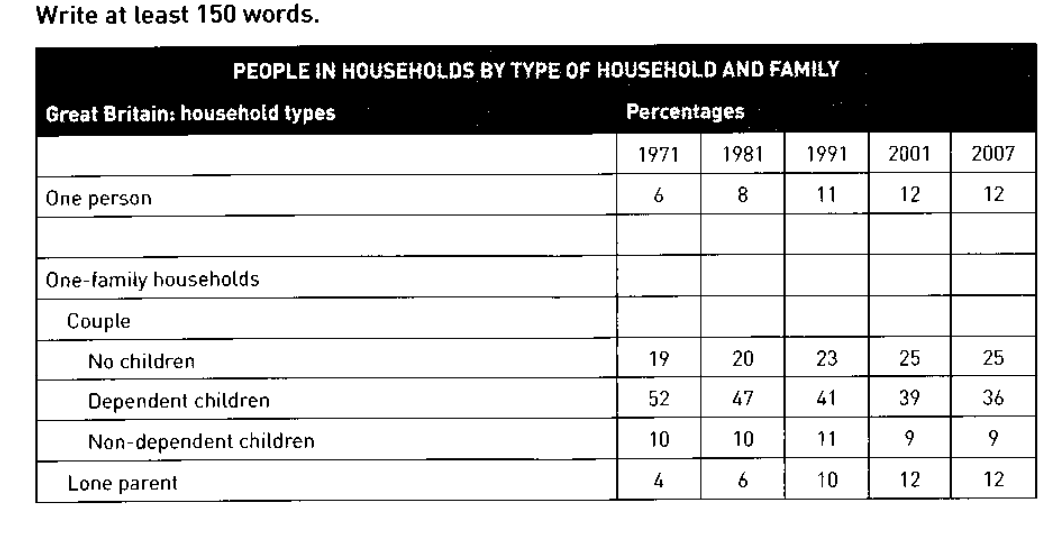
The table below shows the change in some household types in Great Britain from 1971 to 2007.
Summarise the information by selecting and reporting the main features, and make comparisons where relevant.
PEOPLE IN HOUSEHOLDS BY TYPE OF HOUSEHOLD AND FAMILY
Student answer (Band 6.0)
The table illustrates the variation in household types in Great Britain over the period of five decades. Units are given in percentages.
Overall, the proportion of one person, couple without children and lone parent in a household increased from 1971 to 2007. Whereas, the number of couple with dependent children and non-dependent children decreased over the same time period.
In 1971, the percentage of coulpe having dependent children was the highest at 52%, followed by couple without children and non-dependent children at 19% and 10% respectively. In the same year lone parent and one person in a house stood at 4% and 6% respectively. In 1981, the household having couple with dependent children and no children were the highest at 47% and 20%, whereas lone parent made 6%. Couple with dependent children stood at 41% in 1991. in the same year couple without children (23%), lone parent (10%) and one person (11%).
Taking about the household setup in 2001, couple having dependent children leading at 39%, followed by couple with no children at 25%. Also, in the same year household containing lone parent and one person were at same position of 12%. In 2007, couple with dependent children decreased by 16% compared with its 1971 position. Couple with no children at 25% lone parent and one person at same 12% and least was the couple with non dependent children at 9%.
AI examiner evaluation
| Criterion | Band |
|---|---|
| Task Achievement / Task Response | 6.0 |
| Coherence and Cohesion | 6.0 |
| Lexical Resource | 6.0 |
| Grammatical Range and Accuracy | 5.5 |
| Overall | 6.0 |
Task Achievement / Task Response: Band 6.0
You identify the main broad pattern: one-person, childless-couple and lone-parent households generally rose, while households with dependent children declined. You also select relevant figures, including 52% for dependent-child couples in 1971 and 36% in 2007. However, some reporting is incomplete or unclear. The 1991 sentence gives several figures but does not clearly state what the 41% refers to, and the 1981 comparison omits the one-person and non-dependent-child categories. The overview also says non-dependent-child households decreased, although they first rose from 10% to 11% before falling to 9%. A more precise overview and clearer comparisons across the full period would make the key features more fully addressed.
Coherence and Cohesion: Band 6.0
The response has a clear overall arrangement, with an overview followed by chronological detail, and the paragraphs are relevant to the task. Time markers such as “In 1971,” “In 1981,” and “In 2007” help readers follow the data. However, progression within the detail is sometimes mechanical, and some links or references are unclear. For example, “In the same year couple without children (23%), lone parent (10%) and one person (11%)” is a sentence fragment, so the relationship between these figures is not fully expressed. The repeated “same year” and “followed by” constructions also make the account feel list-like. Use complete comparison sentences and group categories by trend to improve cohesion.
Lexical Resource: Band 6.0
You use an adequate range of task-related vocabulary, including “proportion,” “dependent children,” “decreased,” and “followed by,” and the meaning is generally understandable. There are, however, several inaccurate or unnatural choices that reduce precision. “Variation” is less suitable than a term describing changes over time, while “same position” does not clearly mean the same percentage. “Household setup” and “leading at 39%” are also awkward in this context. The spelling error “coulpe” and inconsistent forms such as “non dependent” further affect accuracy. Aim for standard table-reporting collocations and use the category labels consistently, such as “households comprising couples with dependent children.”
Grammatical Range and Accuracy: Band 5.5
You attempt a mix of simple and more complex forms, including the contrast introduced by “Whereas” and comparisons using “followed by.” Most of the intended meaning can be understood, but some grammatical errors and incomplete constructions remain. “Whereas, the number…” is not correctly joined to the preceding sentence, and “In the same year couple without children (23%)…” lacks a main verb. The phrase “couple having dependent children was” also has an agreement problem when referring to a household category, and the lowercase “in” after a full stop shows a punctuation and capitalization lapse. Build complete clauses around each set of figures and check subject–verb agreement and sentence boundaries.
See this exact question answered at other band scores. The same prompt compared across bands.
Browse more IELTS Writing model answers or get your own writing scored by the same AI examiner.