Band 5.0 IELTS Writing Task 1 Model Answer
Overall Band Score: 5.0 · IELTS Summit Mastery · 2026-11-26
IELTS Writing Task 1 question
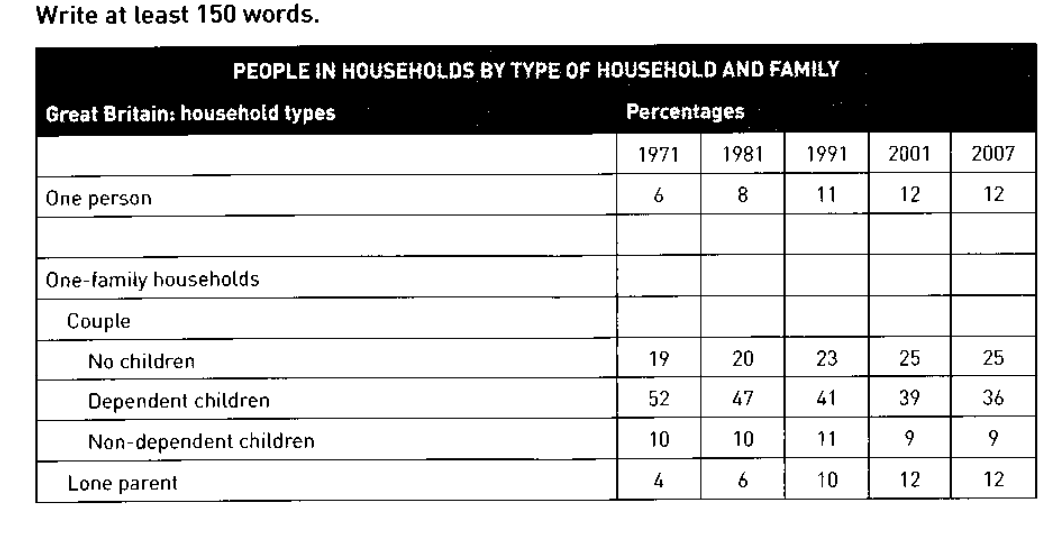
The table below shows the change in some household types in Great Britain from 1971 to 2007.
Summarise the information by selecting and reporting the main features, and make comparisons where relevant.
PEOPLE IN HOUSEHOLDS BY TYPE OF HOUSEHOLD AND FAMILY
Student answer (Band 5.0)
INn The given table we have a table showing relationship between household type in great britian during various years gradually,
The most abundant type of housejold is dependent children overall but it goes on decline in between 1971 to 2007 in 1971 it was on its peak about 52% biut till 2011 it drops to 39 and in 2007 it goes on 365.
Similarly the lone parents goes gradually increase in percentage till 2001 but from 2001 to 2007 it remains same.
Non-dependent children type of household have a some different type of variation through the time it was about 10& from 1971 to 1981 but during next 10 years it goes increases and reach 11%.But it next 10 years it suffers from a decline and it goes on 9% and remains same till 2007.
No children household types and a increasing graphs like its goes on increasing gradually throoghout the era from 1971 to 2001 and remains same as 2001 in 2007.
One person household is a different type it also goes on increasing from 1971 having 6% and on 2001 and 2007 it goes on 12%.
AI examiner evaluation
| Criterion | Band |
|---|---|
| Task Achievement / Task Response | 5.0 |
| Coherence and Cohesion | 5.5 |
| Lexical Resource | 5.0 |
| Grammatical Range and Accuracy | 5.0 |
| Overall | 5.0 |
Task Achievement / Task Response: Band 5.0
You identify several important patterns, especially the fall in households with dependent children and the rise in one-person and lone-parent households. However, the overview is not clearly separated or sufficiently complete, and some figures are inaccurate: dependent-child households fell from 52% to 36%, not to 39% in 2001 and “365” in 2007. The response also says the lone-parent share increased gradually but gives no figures to support this key change, while the one-person category is described only through its starting and ending values. To strengthen the report, give a concise overview of the main contrasts, then select accurate figures across the years. The current coverage is relevant but partial, with limited development of comparisons.
Coherence and Cohesion: Band 5.5
The response has some organisation: it moves through household categories in separate sections and uses connectors such as “Similarly” and “But.” This makes the main subject of each part generally identifiable. However, there is no clear introductory overview, and the sequence feels like a list of individual trends rather than a comparison of the most important features. Linking is also repetitive, particularly the repeated use of “goes on,” and some references are unclear, as in “it goes on 9%.” Grouping the rising categories together and contrasting them with the declining dependent-child figure would create clearer progression. Use a brief overview followed by logically grouped details, with more precise links between comparisons.
Lexical Resource: Band 5.0
You use some relevant terms for describing data, including “percentage,” “decline,” “increasing,” and “variation,” so the reader can recognise the intended trends. However, the vocabulary range is limited and several choices are inaccurate or unnatural, which sometimes makes the meaning difficult to follow. For example, “the most abundant type of household” is not a natural way to describe the largest category, and “it goes on 9%” does not clearly express that the figure fell to 9%. Spelling errors such as “britian,” “housejold,” and “throoghout” also reduce clarity. Build a more precise set of trend phrases and check spelling, especially for key category labels and data descriptions.
Grammatical Range and Accuracy: Band 5.0
You attempt both simple statements and longer sentences with time clauses, such as “but from 2001 to 2007 it remains same.” This shows an effort to describe changes across periods. However, sentence structures are limited, and errors occur frequently enough to make some statements awkward or unclear. Examples include “the lone parents goes,” where subject–verb agreement is incorrect, and “it was about 10% from 1971 to 1981 but during next 10 years it goes increases,” which has faulty verb forms and missing grammatical words. Articles and sentence boundaries are also inconsistent. Practise accurate past-tense reporting, agreement, and complete clause structures; use shorter, controlled sentences before attempting longer comparisons.
See this exact question answered at other band scores. The same prompt compared across bands.
Browse more IELTS Writing model answers or get your own writing scored by the same AI examiner.