Band 5.5 IELTS Writing Task 1 Model Answer
Overall Band Score: 5.5 · IELTS Summit Mastery · 2026-11-27
IELTS Writing Task 1 question
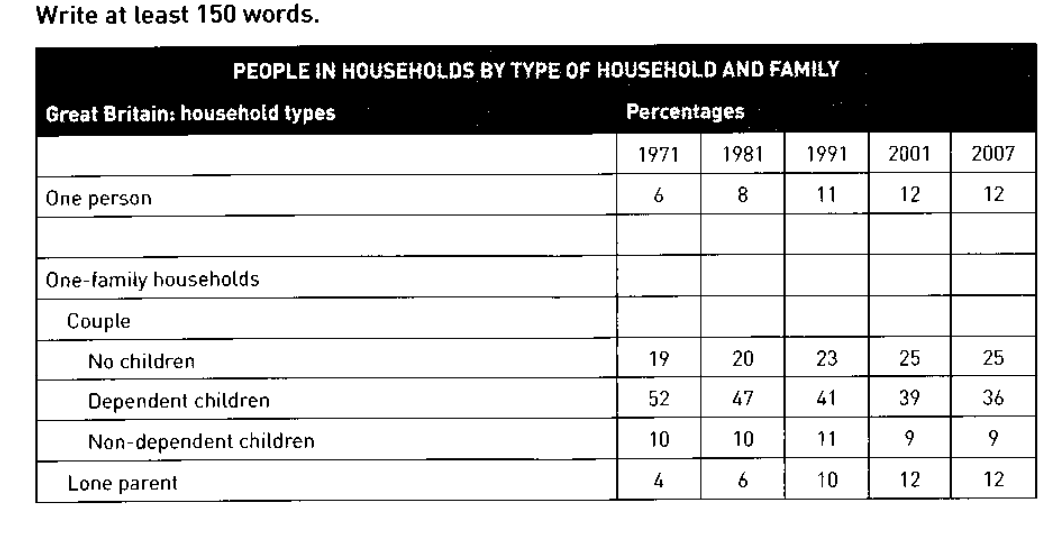
The table below shows the change in some household types in Great Britain from 1971 to 2007.
Summarise the information by selecting and reporting the main features, and make comparisons where relevant.
PEOPLE IN HOUSEHOLDS BY TYPE OF HOUSEHOLD AND FAMILY
Student answer (Band 5.5)
The table given, describes the information regarding variances in household types in Great Britain from the 1971 to 2007.
The table vividly indicates that the dependance of children significantly decreased from being 52% in 1971 to falling at 36% in 2007. While the percentage of non dependent children, striked the highest in 1991 at 11% but overall the percentage of non dependent children was approximately same in the lot- 10, 10, 11, 9 and 9 in the year 1971, 1981, 1991, 2001 and 2007 respectively. The percentage of one person households almost doubled from being 6% in 1971 to becoming 12% in 2007. Though overall, it shows a gradual increase while remained exactly the same between 2001 and 2007 at 12%. The no children household further shows a gradual increase from being 19% in 1971, to 20% in 1981, to 23% in 1991 and hitting the mark of 25% in 2001 and stopped incresing to remain at 25% in 2007 as well. The household with a lone parent has undergone a considerable increase from 4% in 1971 to becoming 12% in 2001 and 2007.
AI examiner evaluation
| Criterion | Band |
|---|---|
| Task Achievement / Task Response | 5.5 |
| Coherence and Cohesion | 5.5 |
| Lexical Resource | 5.5 |
| Grammatical Range and Accuracy | 5.5 |
| Overall | 5.5 |
Task Achievement / Task Response: Band 5.5
You report several accurate and relevant figures, including the fall in households with dependent children from 52% to 36%, and the rises in one-person and no-children households. You also identify that some categories level off by 2007. However, the response lacks a clear, separate overview of the main patterns, so the reader must infer the overall picture from the details. The non-dependent-children figures are described as approximately unchanged, which is fair, but the account gives this minor pattern substantial space while not clearly comparing the largest category with the others. The lone-parent figure reaches 12% in 2001 and remains there in 2007; this is accurate. A concise overview highlighting the dominant decline and the general rises would make the summary more complete.
Coherence and Cohesion: Band 5.5
The response follows a broadly understandable sequence, moving through the household categories, and time references help readers follow the figures. However, it is presented as one long paragraph, with no distinct overview to establish the main trends before the detailed comparisons. Several sentences begin with similar patterns such as “The percentage…” or “The household…,” making the progression feel list-like rather than clearly grouped. The opening “While” clause is not smoothly connected to a main clause, and “Though overall” also creates an awkward transition. Grouping the rising categories together and contrasting them with the declining dependent-children category, using clear paragraphing and more precise links, would improve the flow.
Lexical Resource: Band 5.5
You use some suitable task vocabulary, including “gradual increase,” “considerable increase,” and “approximately same,” and the meaning of most comparisons is clear. However, several word choices and collocations are inaccurate or unnatural: “dependance of children” does not describe the household category, “striked the highest” is unsuitable for a percentage, and “in the lot” is unclear. There are also spelling errors such as “dependance,” “incresing,” and “non dependent.” Repeated use of “percentage” and “increase” limits the range. Use the table’s category labels consistently and choose precise reporting verbs such as “rose,” “fell,” “peaked,” and “remained stable” to make the description more natural and exact.
Grammatical Range and Accuracy: Band 5.5
The response attempts a mixture of simple and complex sentences, including clauses introduced by “while” and “though,” but control is uneven. The opening sentence has an unnecessary comma between the subject and verb: “The table given, describes.” The sentence beginning “While the percentage…” is a dependent clause without a complete main clause, and “Though overall, it shows…” is also awkwardly formed. Some long sentences combine several figures and clauses, which makes punctuation and sentence boundaries harder to manage. There are also inconsistent constructions, such as “from being 6% … to becoming 12%.” Aim for complete sentences with a clear subject and verb, and separate detailed comparisons when a sentence becomes overloaded.
See this exact question answered at other band scores. The same prompt compared across bands.
Browse more IELTS Writing model answers or get your own writing scored by the same AI examiner.