Band 5.5 IELTS Writing Task 1 Model Answer
Overall Band Score: 5.5 · IELTS Summit Mastery · 2026-11-27
IELTS Writing Task 1 question
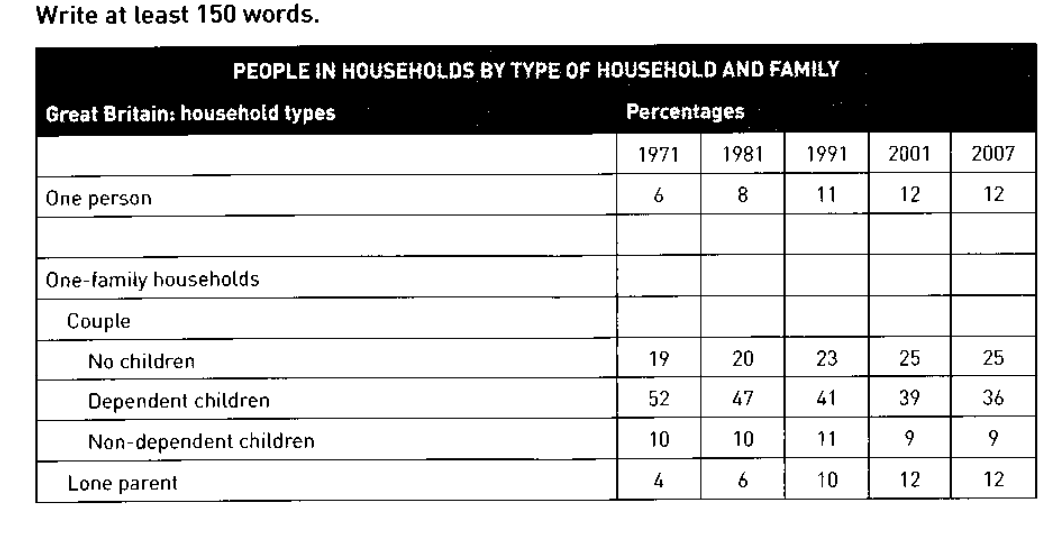
The table below shows the change in some household types in Great Britain from 1971 to 2007.
Summarise the information by selecting and reporting the main features, and make comparisons where relevant.
PEOPLE IN HOUSEHOLDS BY TYPE OF HOUSEHOLD AND FAMILY
Student answer (Band 5.5)
Given table illustrates the change in percentage of people in households of Great Britain based on the type of household and family from the year 1971 to 2007.
Overall there has been a significant increase in the percentage of families in all household types,excluding the familes with dependent children and non-dependent children where the proportion has declined,but still dependent children households remain the highest throughtout the years.
In 1971, most of the household types in Great Britain were dependent children households,with a proportion of 52%, which declined to 36% in 2017. Household types with one family and couples were not observed among all the years.
Househols types with one person increased from 6% in 1971 to 17% in 2007. Simillarly the percentage of lone parent households have increased from 4% to 12% over the years. The non-dependent children households has flactuated fron 10% in 1971 to onny 9% in 2007.
AI examiner evaluation
| Criterion | Band |
|---|---|
| Task Achievement / Task Response | 5.0 |
| Coherence and Cohesion | 5.5 |
| Lexical Resource | 5.5 |
| Grammatical Range and Accuracy | 5.5 |
| Overall | 5.5 |
Task Achievement / Task Response: Band 5.0
You identify the main decline in households with dependent children and note that this remained the largest category, which gives the response a relevant central feature. However, several key details are inaccurate or unclear: the dependent-children figure fell to 36% in 2007, not 2017, and one-person households rose to 12%, not 17%. The claim that couple households “were not observed” is also incorrect: the table includes couples both with and without children, and the no-children category increased from 19% to 25%. The overview overgeneralises by saying all other household types increased, although non-dependent children ended lower. More accurate selection and reporting of the categories would make the summary more complete and reliable.
Coherence and Cohesion: Band 5.5
The response has a recognisable structure: an introduction, an overview, and paragraphs reporting figures. Linking expressions such as “Overall” and “Similarly” help signal relationships between points. However, progression is weakened by placing the inaccurate statement about couple households between the dependent-children trend and the remaining categories. The overview also groups trends imprecisely, so the reader has to work out which categories rose or fell. Some connections are mechanical, and the final paragraph lists figures without clearly comparing them. Organise the body around rising categories and declining categories, and use clear references to the table’s categories to make the progression easier to follow.
Lexical Resource: Band 5.5
You use relevant task vocabulary, including “proportion,” “declined,” “increased,” and “fluctuated,” and the meaning is generally understandable. There is some repetition of “household types” and “percentage,” while several word choices are inaccurate or unnatural: “families in all household types” does not describe the table precisely, and “were not observed” wrongly suggests the categories are absent. Spelling errors such as “familes,” “Househols,” “Simillarly,” “flactuated,” and “onny” are noticeable and reduce the accuracy of the vocabulary. Aim for precise category labels and standard spelling, and vary reporting language without sacrificing clarity.
Grammatical Range and Accuracy: Band 5.5
You attempt both simple and more complex sentence forms, including a contrast in the overview (“excluding…”) and comparisons using “from…to…”. Most sentences remain understandable, but errors in agreement and sentence construction are evident. For example, “The non-dependent children households has fluctuated” has a plural subject with a singular verb, and “Household types with one family and couples were not observed among all the years” is awkwardly formed. The opening phrase would be more natural as “The table illustrates changes in the percentages…”. There are also punctuation and spacing problems, such as missing spaces after commas and an unnecessary space before the overview. More consistent control of agreement and sentence phrasing would improve accuracy.
See this exact question answered at other band scores. The same prompt compared across bands.
Browse more IELTS Writing model answers or get your own writing scored by the same AI examiner.