Band 5.5 IELTS Writing Task 1 Model Answer
Overall Band Score: 5.5 · IELTS Summit Mastery · 2026-11-28
IELTS Writing Task 1 question
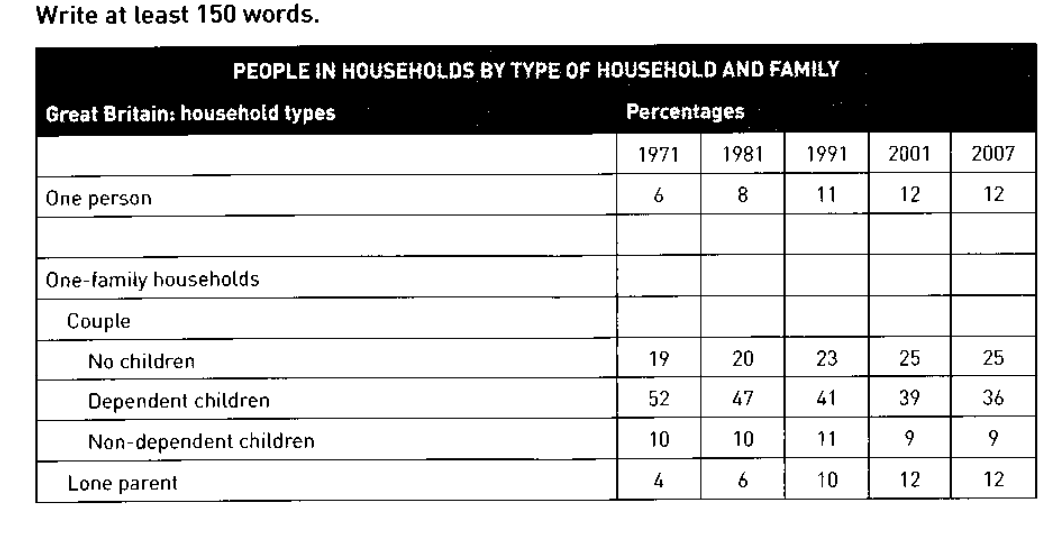
The table below shows the change in some household types in Great Britain from 1971 to 2007.
Summarise the information by selecting and reporting the main features, and make comparisons where relevant.
PEOPLE IN HOUSEHOLDS BY TYPE OF HOUSEHOLD AND FAMILY
Student answer (Band 5.5)
The provided table illustrates how types of families changed from 1971 to 2007 in Great Britain.
Overall, the number of independents increased as compared to dependent ones while, the ratio of parents without children as well as single parent also showed an increase.
The percentage of single individuals showed a gradual increase from 6% to upto 12% in 2007. The data of couples and one-family households is not listed yet. The percetage of child less couples being only 9% also rised and reached 25% which remained same in 2001 and 2007.
A significant drop has been noticed in the number of dependent children as they were more than half in 1971 and decreased to 36% which is quite prominent. On the other hand, independent children showed a fluctuation from 10% to reach upto 11% in 1991 and them decrease again and be 9% in the remaining years. At last, the ratio of single parents raising children increased and reached 12%
AI examiner evaluation
| Criterion | Band |
|---|---|
| Task Achievement / Task Response | 5.5 |
| Coherence and Cohesion | 5.5 |
| Lexical Resource | 6.0 |
| Grammatical Range and Accuracy | 5.5 |
| Overall | 5.5 |
Task Achievement / Task Response: Band 5.5
You identify several important trends, including the rise in one-person households from 6% to 12% and the fall in households with dependent children from 52% to 36%. You also note that childless couples reached 25% and then remained stable, and that lone-parent households increased. However, the overview is imprecise: “independents” and “dependent ones” do not clearly identify household categories, and the table reports percentages, not numbers of people. The statement that “the data of couples and one-family households is not listed yet” is inaccurate, since the table includes several one-family categories. Some trends are reported without all useful comparisons, so the main features are only partly and unevenly covered.
Coherence and Cohesion: Band 5.5
The response has a recognisable structure: an introduction, an overview, and paragraphs describing individual categories. This helps the reader follow the broad direction of the report. However, progression between points is sometimes unclear, particularly in the overview, where “while” joins trends without making their relationship clear. The sentence about data not being listed interrupts the description of childless couples and conflicts with the information that follows. Linking phrases such as “On the other hand” and “At last” are used, but the latter is not a natural way to introduce the final data point, and the categories could be grouped more logically—for example, rising household types together and declining ones together. Clearer paragraph focus and more precise referencing would improve cohesion.
Lexical Resource: Band 6.0
You use a reasonable range of vocabulary for describing trends, including “gradual increase,” “significant drop,” “fluctuation,” and “remained same.” These choices make the main movements understandable, and the response generally uses relevant terms for household categories. However, some wording is imprecise or unnatural: “independents” does not clearly mean people living alone, “the ratio of parents” is not the best description of a percentage, and “child less couples” is awkward. There are also spelling and word-form slips, such as “percetage” and “rised.” Aim for standard statistical collocations and consistent category labels; this would make the description more precise without requiring a much wider vocabulary.
Grammatical Range and Accuracy: Band 5.5
You attempt both simple and more complex sentences, including a contrast with “On the other hand” and a clause beginning “as they were more than half in 1971.” The overall meaning is usually recoverable, but some grammatical errors remain. For example, “while, the ratio” has incorrect punctuation, and “reached 12%” lacks a clear subject in the final sentence. In “which remained same,” an article is missing, while “and them decrease again and be 9%” has faulty verb forms and tense. The sentence about the percentage of childless couples also combines ideas in an awkward structure. Check articles, subject–verb links, and consistent past-tense reporting, and revise longer sentences to ensure each clause is complete.
See this exact question answered at other band scores. The same prompt compared across bands.
Browse more IELTS Writing model answers or get your own writing scored by the same AI examiner.