Band 4.5 IELTS Writing Task 1 Model Answer
Overall Band Score: 4.5 · IELTS Summit Mastery · 2026-11-05
IELTS Writing Task 1 question
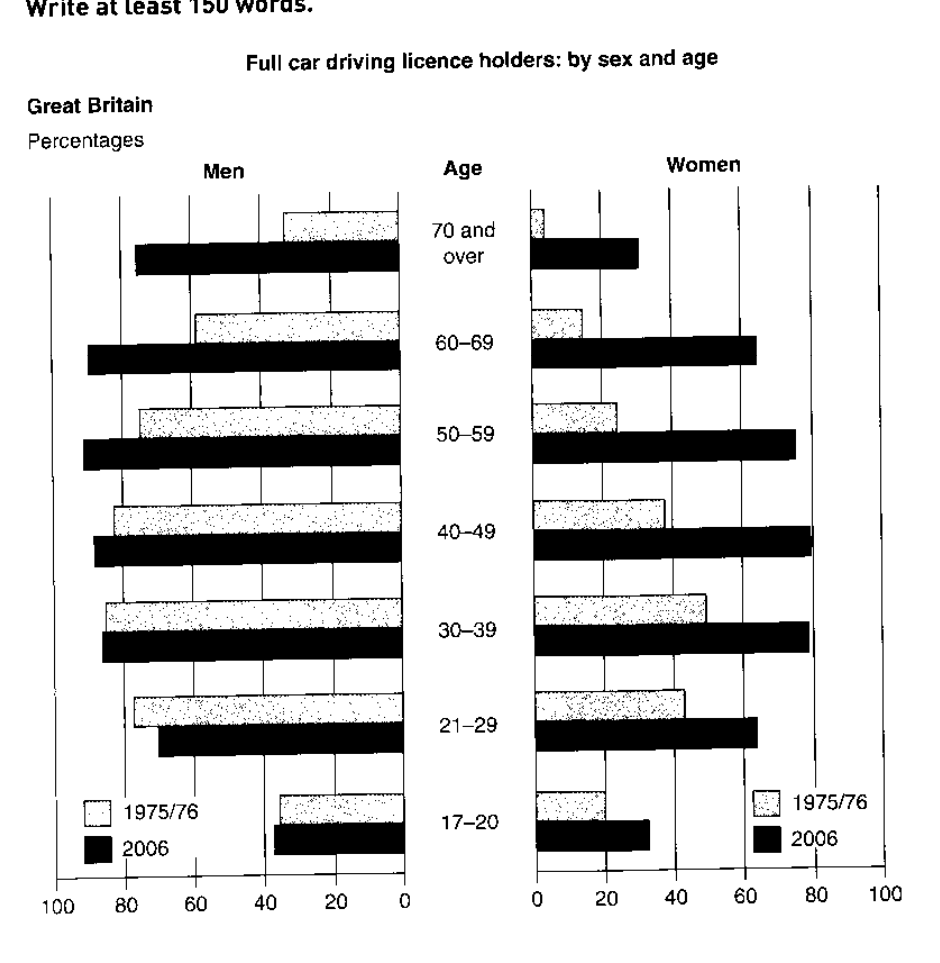
The graphs below show the percentage of people holding full driving licences in Great Britain by age and sex.
Summarise the information by selecting and reporting the main features, and make comparisons where relevant.
Full car driving licence holders: by sex and age
Student answer (Band 4.5)
The bar graphs illustrate the percentage of people holding full driving licences in Britain by gender and age.
Looking the data in detail, there are 2 bar ghraph, in men fom age 50 to 59 had majority in 2006 and in women, from 40 to 49 had majority.
Reporting the data in detail, from youngers they had only 38%, 36% in 1975 and 2006 respectively very less then others. It was rise up with increase ages from 21 to 29 it increase upto 78% the both year had simliar rate. From 30 to 49 they was almost similar and 50 to 69 they was also same but from over 70 it was decrease and it had 75% only.
Glancing the remaining data, in females they had only 20%,30% from 1975 to 2006 respectively. From 21 to 39 it was rise up continuely to 59 age 65 approximately then start down fall upto 70 they had only 30%.
AI examiner evaluation
| Criterion | Band |
|---|---|
| Task Achievement / Task Response | 4.0 |
| Coherence and Cohesion | 5.0 |
| Lexical Resource | 5.0 |
| Grammatical Range and Accuracy | 4.5 |
| Overall | 4.5 |
Task Achievement / Task Response: Band 4.0
You identify the topic and make some relevant comparisons, including the higher figures for men and the rise in women’s licence holding across age groups. However, the overview is unclear and several key details are inaccurate: the youngest men’s figures are about 36% and 37%, not 38% and 36%, while the 21–29 figures were not similar (78% in 1975/76 versus 70% in 2006). The claim that men over 70 had “75% only” also misses the earlier figure of about 35%. Women’s peak is around 40–49 in 2006, but the description of a steady rise to age 59 and subsequent fall does not match the chart. The response is 148 words, below the 150-word minimum, and the overview needs clearer, accurate main trends.
Coherence and Cohesion: Band 5.0
The response has separate paragraphs and uses basic signposts such as “Looking the data in detail,” “Reporting the data in detail,” and “Glancing the remaining data.” This gives the reader some indication of how the answer is organised. However, the progression is not consistently clear: the first detail paragraph moves between age groups and years without explaining which series is being compared, and the final paragraph’s age sequence is difficult to follow. Linking phrases such as “from youngers” and “from 21 to 39” do not make the relationships between figures precise. Organise the response into a concise overview followed by one paragraph comparing men and another comparing women, and use clear references to the years and age bands.
Lexical Resource: Band 5.0
You use some task-relevant vocabulary, including “percentage,” “majority,” “increase,” and “decrease,” so the general subject is understandable. However, the range is limited and several word choices, collocations, and spelling errors make parts of the account difficult to interpret. Examples include “bar ghraph,” “youngers,” “rise up,” “continuely,” and “down fall.” Phrases such as “had majority” and “they had only” are also imprecise for describing chart data. Use standard chart language consistently, for example “the proportion of licence holders,” “rose,” “peaked,” and “fell,” and check spelling and word forms. More precise vocabulary would also help distinguish a rise over time from differences between age groups.
Grammatical Range and Accuracy: Band 4.5
The response attempts longer sentences and comparisons, but grammatical control is weak and errors frequently affect clarity. For example, “Looking the data in detail” lacks a suitable preposition, while “in men fom age 50 to 59 had majority” has an unclear sentence structure. There are recurring problems with subject–verb agreement and verb forms in “they was almost similar” and “it increase upto 78%.” The sentence beginning “It was rise up with increase ages” also shows difficulty forming a clear passive or active construction. Most sentences rely on simple patterns, and attempts to connect several ideas often become difficult to follow. Practise accurate past-tense reporting and build shorter, complete sentences before adding more complex comparisons.
See this exact question answered at other band scores. The same prompt compared across bands.
Browse more IELTS Writing model answers or get your own writing scored by the same AI examiner.