Band 5.5 IELTS Writing Task 1 Model Answer
Overall Band Score: 5.5 · IELTS Summit Mastery · 2026-11-05
IELTS Writing Task 1 question
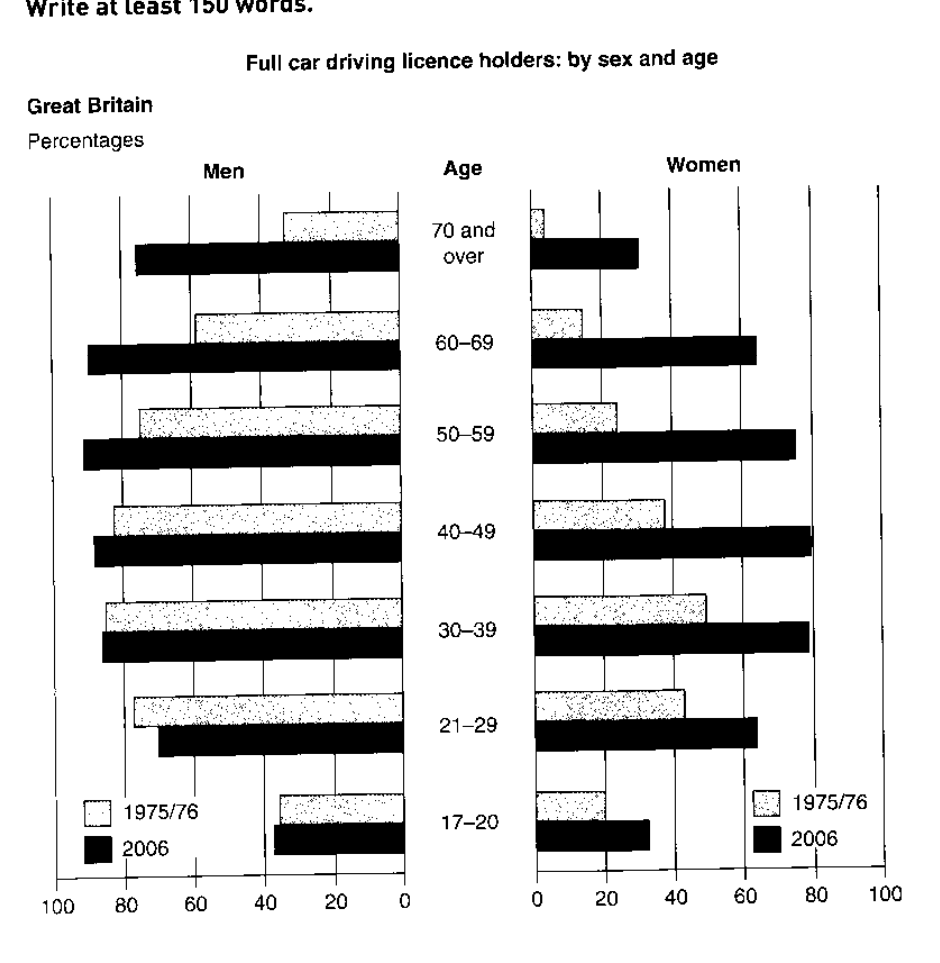
The graphs below show the percentage of people holding full driving licences in Great Britain by age and sex.
Summarise the information by selecting and reporting the main features, and make comparisons where relevant.
Full car driving licence holders: by sex and age
Student answer (Band 5.5)
If we talk about the driving licence holders in great britian , the men has increased comparatively less than womens but still they have improved. The most license holders group of men is of 50-59 age in 2006 as compared to 1976 , however in 1976 the most highest licence holder age group of men was of age 30-39. If we see the most lowest percent of licence holder is of age 17-20 in 2006 somehow same in 1976.
The rate of driving licence holder in women has increased dirastically in 2006 as comapred to 1976. The highest percent of women licence holder is of age group 40-49 which is of 79 percent . however if we talk about the lowest percent of licence holder in womens is of age group 70 and over which 28 years of age . Morever the womens age group of 50-59 has increased the most from 1976 to 2006 .
As a result we can see the rate of licence holder of womens are low as compared to man in both 2006 and 1976 but they their rate of licence holder has increased more than mens for example the womens in 1976 of age group of 50-59 had the rate if 22 percent but with the time they increased to 76 percent.
AI examiner evaluation
| Criterion | Band |
|---|---|
| Task Achievement / Task Response | 5.5 |
| Coherence and Cohesion | 5.5 |
| Lexical Resource | 5.0 |
| Grammatical Range and Accuracy | 5.0 |
| Overall | 5.5 |
Task Achievement / Task Response: Band 5.5
You identify the broad pattern that women’s licence-holding rose substantially and remained below men’s, and you include some relevant age-group comparisons. However, several key details are inaccurate or unclear: men’s highest figure in 2006 was for ages 50–59 (about 92%), but the 1975/76 peak was ages 40–49 (about 81%), not 30–39. Women’s lowest group in 2006 was indeed those aged 70 and over, but “which 28 years of age” confuses the age category with a percentage. The claim that women aged 50–59 rose to 76% is also slightly high, and this was not the largest increase; the 60–69 group rose more. A clearer overview and more accurate selection of comparisons are needed.
Coherence and Cohesion: Band 5.5
The response has three paragraphs and generally moves from men to women and then to a comparison, so there is some organisation. However, the progression is not consistently clear: the opening begins conversationally with “If we talk about,” and the final paragraph repeats earlier points rather than drawing together the main trends. Linking words such as “however,” “as a result,” and “moreover” are used, but some do not clearly express the relationship between the ideas that follow them. References such as “they” and “their rate” are also sometimes ambiguous. Group the overview first, then compare the main age patterns, using clear references and transitions that show contrast or change.
Lexical Resource: Band 5.0
You use relevant topic vocabulary, including “driving licence holders,” “age group,” “percent,” and “increased,” so the subject is generally understandable. However, the range is limited and several word choices or collocations are inaccurate or repetitive. “Most highest” and “most lowest” are not natural forms, while “the rate of driving licence holder” is repeated instead of using more precise expressions such as “proportion of licence holders.” There are also spelling errors, including “great britian,” “dirastically,” and “comapred,” which reduce accuracy. Aim for concise, standard chart language and check spelling and word forms carefully.
Grammatical Range and Accuracy: Band 5.0
The response attempts longer sentences and comparisons, but the range of structures is limited and errors occur frequently enough to make some statements difficult to follow. Subject–verb agreement is problematic in “the men has increased” and “the rate … are low”; articles and plural forms are also inconsistent, as in “in womens” and “the most lowest percent.” Sentence boundaries and punctuation need attention, particularly where “however” begins a new idea after a full stop or comma. Some clauses are incomplete or confusing, such as “which 28 years of age.” Practise building accurate simple comparison sentences first, then add subordinate clauses while checking agreement, articles, and punctuation.
See this exact question answered at other band scores. The same prompt compared across bands.
Browse more IELTS Writing model answers or get your own writing scored by the same AI examiner.