Band 5.5 IELTS Writing Task 1 Model Answer
Overall Band Score: 5.5 · IELTS Summit Mastery · 2026-11-06
IELTS Writing Task 1 question
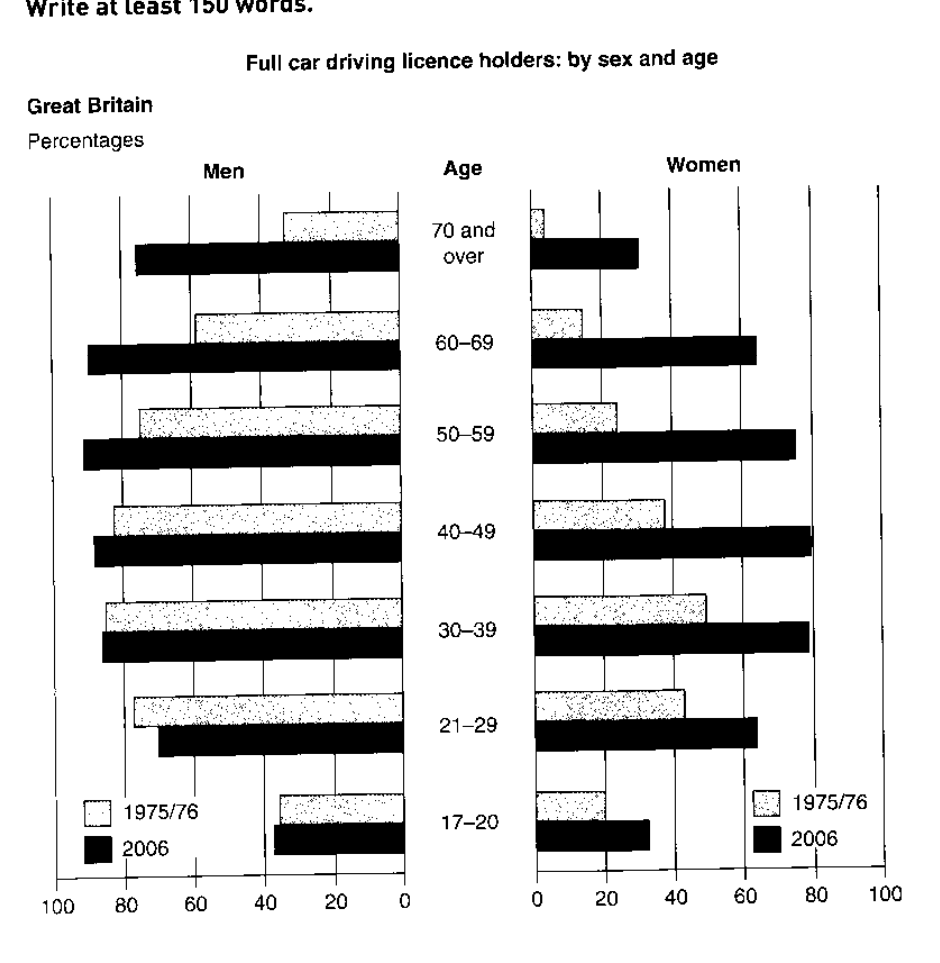
The graphs below show the percentage of people holding full driving licences in Great Britain by age and sex.
Summarise the information by selecting and reporting the main features, and make comparisons where relevant.
Full car driving licence holders: by sex and age
Student answer (Band 5.5)
The bar graph illustrates the proportion of men and women that holded full driving licences in the UK by age in 1975/76 and 2006.
Overall, people had the highest holding fully liceances in 2006, compared with 1975/76. Men had higer percentage of full driving liceances than those for women. people aged between 30-60 holding more liceances.
In 1975/76, more than 80 percentage of men holding liceances by aged 30-49 , while aged 17-20 and 70 and over was the fewest, at arpproximately 38%. In additionally, aged 21-29 accounted for just under 80%. This was followed by aged 60-69, at around 60% of people's liceances. By comparison with women, aged 30-39 represented at about 50%, while elderly had the minimal at only 4%. Although aged 40-40, 50-59, 60-69 increased, linceance decreased at rought 38%, 25%, 15%, respectively.
By 2006, people of all aged holding liceance increased, excepted aged 21-29 at around 75%, while women inceased twice at all aged groups comparison with 1975/76. For men, aged 70 and over double incease to almost 80%, wherease for women, those aged reach around 25%. aged between 30 to 70 inceased to more than 80% of liceance holding.
AI examiner evaluation
| Criterion | Band |
|---|---|
| Task Achievement / Task Response | 5.5 |
| Coherence and Cohesion | 5.5 |
| Lexical Resource | 5.0 |
| Grammatical Range and Accuracy | 5.0 |
| Overall | 5.5 |
Task Achievement / Task Response: Band 5.5
You identify the two years, compare men and women, and give an overview that men’s licence-holding was generally higher and that rates rose by 2006. Several relevant details are also included, such as the low figures for older women in 1975/76 and the rise among older men. However, the overview is too broad: “people had the highest holding” does not identify which age groups led, and “aged between 30-60” is not consistently the peak across both sexes and years. Some data are inaccurate or unclear: men aged 30–49 were not all above 80% in 1975/76, and the sentence about women’s rates “decreased” gives figures that actually describe increases across age groups. The 2006 comparison also overstates that women’s rates doubled in every group. Select and report the main patterns more precisely.
Coherence and Cohesion: Band 5.5
The response has a recognisable structure: an introduction, an overview, and separate paragraphs for the two years. This gives the reader a basic route through the information. However, progression within the detail paragraphs is uneven, and some comparisons are difficult to follow. For example, “Although aged 40-40, 50-59, 60-69 increased” does not clearly connect the age groups to the figures that follow, while “By comparison with women” introduces a comparison without clearly stating the corresponding male figures. Linking phrases such as “In additionally” and “This was followed by” are either inaccurate or do not clarify the relationship between points. Organise details consistently by sex or age group, and use clear references and transitions to show whether figures are rising, falling, or being compared.
Lexical Resource: Band 5.0
You use some task-relevant vocabulary, including “proportion,” “accounted for,” “approximately,” and “compared with,” so the topic is generally identifiable. However, the range is limited and several word-choice, collocation, and spelling errors recur, sometimes making the data hard to interpret. Examples include “holding fully liceances,” “the fewest,” “minimal,” and “women inceased twice.” The repeated misspelling of “licences” is especially noticeable, and “aged” is often used where “people aged” or “the age group” is needed. Aim for accurate, natural phrases such as “the proportion holding a licence,” “the lowest figure,” and “the rate rose.” Check spelling carefully and avoid forcing formal-sounding expressions when a simpler, precise phrase is available.
Grammatical Range and Accuracy: Band 5.0
You attempt a mixture of simple statements and longer comparisons, and the overall meaning can often be recovered. However, grammatical errors are frequent, and complex sentences are not reliably controlled. In the opening, “men and women that holded” has an incorrect verb form and an awkward relative clause; “people aged between 30-60 holding more” lacks a finite verb. Other examples include “aged 17-20 and 70 and over was,” where the subject and verb do not agree, and “those aged reach around 25%,” which has an incomplete sentence structure. Tense and clause construction also become unclear in the final paragraph. Practise complete sentences with an explicit subject and verb, check singular/plural agreement, and use past-tense forms consistently when describing the chart.
See this exact question answered at other band scores. The same prompt compared across bands.
Browse more IELTS Writing model answers or get your own writing scored by the same AI examiner.