Band 4.5 IELTS Writing Task 1 Model Answer
Overall Band Score: 4.5 · IELTS Summit Mastery · 2026-11-09
IELTS Writing Task 1 question
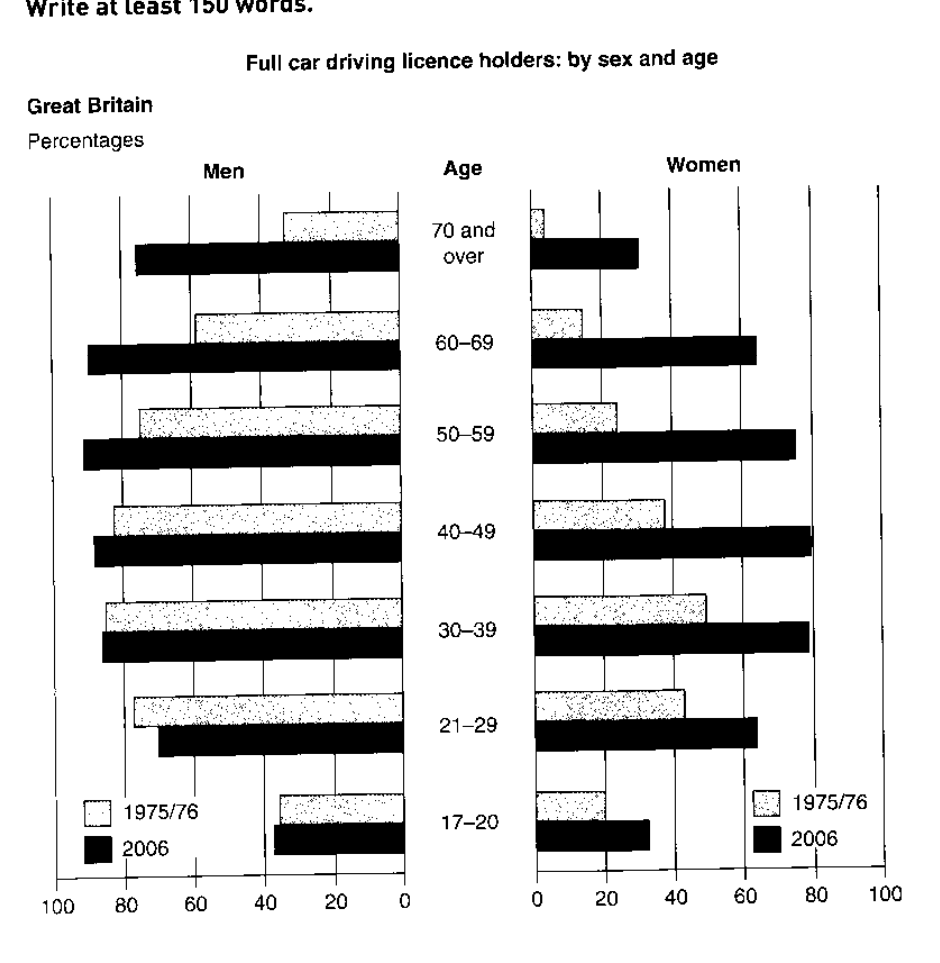
The graphs below show the percentage of people holding full driving licences in Great Britain by age and sex.
Summarise the information by selecting and reporting the main features, and make comparisons where relevant.
Full car driving licence holders: by sex and age
Student answer (Band 4.5)
The given graphs describes the proportion of people holding full driving permits in Great britain by age and gender and two types of gender are shown into the diagram.
Overall, in the beginning start from the men percentage and men's proportion higher than the women's percentage, In addition then men's percentage high with the timeframes of 70 and over and the women's high percentage in the period of 40 to 49. The percentage are increase and decrease with the timeframe.
AI examiner evaluation
| Criterion | Band |
|---|---|
| Task Achievement / Task Response | 3.5 |
| Coherence and Cohesion | 4.5 |
| Lexical Resource | 5.0 |
| Grammatical Range and Accuracy | 4.5 |
| Overall | 4.5 |
Task Achievement / Task Response: Band 3.5
You identify the chart’s subject and attempt an overview, noting that men generally had higher licence-holding rates and that the figures changed over time. However, the overview is unclear and includes a key misreading: the highest male figure is among men aged 50–59 in 2006, not men aged 70 and over; women’s peak is around ages 40–49 in 2006, which you partly identify. There is almost no supporting detail or comparison between the two years and age groups, so the main features are not adequately reported. The response also contains only 80 words, well below the required 150, leaving the task minimally addressed. To improve, give a clear overview and support it with accurate comparisons and selected figures.
Coherence and Cohesion: Band 4.5
The response has a basic two-part structure: an opening sentence introduces the chart, followed by an attempted overview beginning with “Overall.” This gives the reader a simple starting point, but there is no progression into detailed comparisons, and the ideas in the overview are difficult to follow. The phrase “In addition then” does not clearly show how the next point relates to the first, while the repeated use of “percentage” makes the short response feel repetitive. The sentence about figures increasing and decreasing is too general to connect specific age groups or years. Organise the response into an introduction, a concise overview, and paragraphs comparing the data, using clear links such as “whereas” and “by contrast.”
Lexical Resource: Band 5.0
You use some relevant vocabulary, including “proportion,” “holding,” “percentage,” and “timeframes,” so the topic is recognisable. However, the range is limited and several choices are inaccurate or unnatural for describing this chart. “Driving permits” is not the usual term here; “full driving licences” is more precise. “Two types of gender” is an awkward way to refer to men and women, and “men’s percentage high” does not express the intended comparison clearly. There is also a spelling error in “Great britain,” where the country name needs capital letters. Use precise chart language such as “licence holders,” “the proportion of men,” “rose,” and “was highest among.”
Grammatical Range and Accuracy: Band 4.5
You attempt both a complex opening sentence and an overview, but grammatical control is inconsistent, and the sentence structures are mostly basic or incomplete. In “The given graphs describes,” the plural subject requires a plural verb; “two types of gender are shown into the diagram” also has faulty sentence construction. The overview contains a run-on structure and unclear clauses: “In addition then men's percentage high with the timeframes of 70 and over.” The final sentence, “The percentage are increase and decrease,” has errors in agreement and verb form. These problems make several ideas difficult to interpret. Practise forming complete sentences with accurate subject–verb agreement and past-tense verbs, and use punctuation to separate distinct comparisons.
See this exact question answered at other band scores. The same prompt compared across bands.
Browse more IELTS Writing model answers or get your own writing scored by the same AI examiner.