Band 6.0 IELTS Writing Task 1 Model Answer
Overall Band Score: 6.0 · IELTS Summit Mastery · 2026-11-09
IELTS Writing Task 1 question
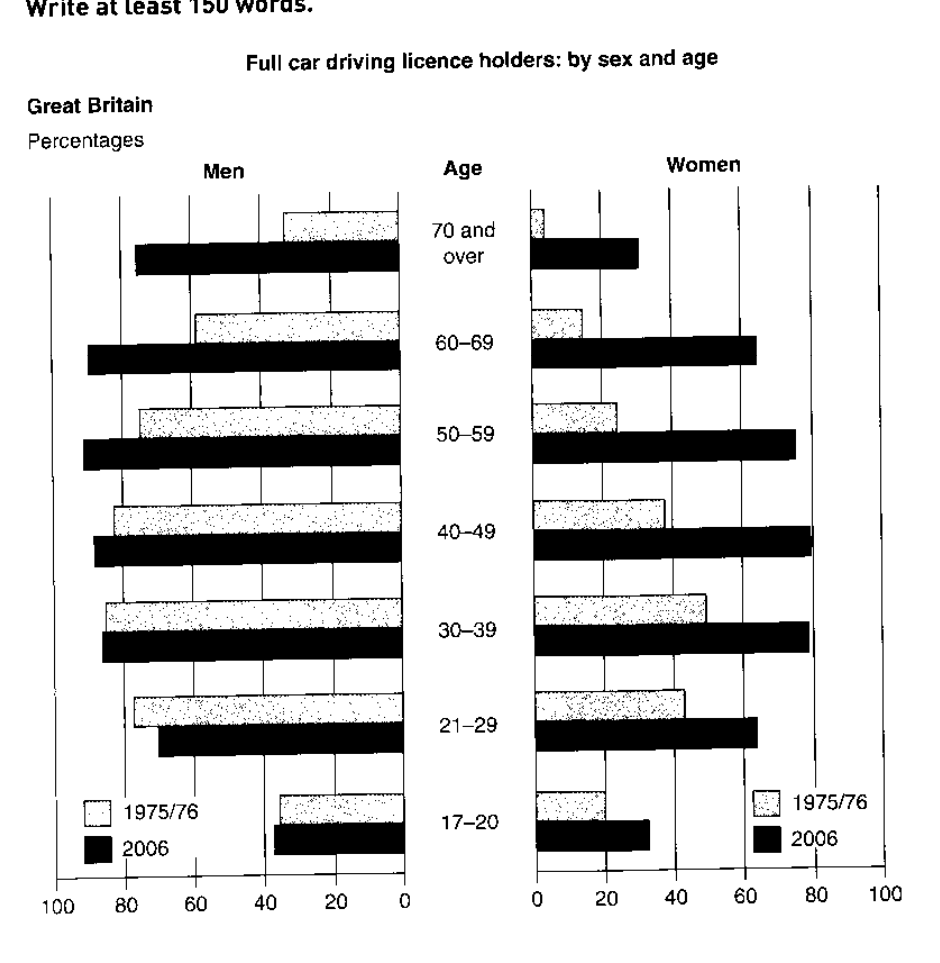
The graphs below show the percentage of people holding full driving licences in Great Britain by age and sex.
Summarise the information by selecting and reporting the main features, and make comparisons where relevant.
Full car driving licence holders: by sex and age
Student answer (Band 6.0)
The chart illustrates the number of people in Great Britain who possess full driving license in terms of age and sex.
Overall, by the age of 30-50 almost 80% of both men and women gets their driving license done. This trend was visible since 1975 for men but was not that much popular among women of that period.
Almost 40% of men and women tries to get their license within their 20s. Where this number dramatically increases by the next 10 years and more than half of the both population gets their license by the age of 30. In case of men, the highest proportion that holds a license are aged between 50-60. But for women there is a different scenario. Womens who are aged between 40-50 possessed the most driving license.
There is a different trend on owning a driving license for elderly person and men strongly distincts from women in this case. Over 60% of men aged 70 and over still capable of driving and holds a licenser whereas only 30% of women are able to drive in that age and have a license.
AI examiner evaluation
| Criterion | Band |
|---|---|
| Task Achievement / Task Response | 6.0 |
| Coherence and Cohesion | 6.5 |
| Lexical Resource | 5.5 |
| Grammatical Range and Accuracy | 5.5 |
| Overall | 6.0 |
Task Achievement / Task Response: Band 6.0
You identify relevant age and sex patterns and provide an overview, noting that licence holding was more established among men in 1975/76 and that women’s figures rose substantially by 2006. The comparison for people aged 70 and over is also broadly grounded in the chart: the 2006 figures are about 77% for men and 29% for women. However, several details are inaccurate or unclear. The claim that almost 40% of both sexes obtained licences in their twenties does not reflect the age bands consistently: in 2006, the figures are about 70% for men and 63% for women aged 21–29, while the 17–20 figures are much lower. The stated peaks also overlook that men’s highest 2006 figure is around 92% among 50–59-year-olds, while women peak at about 79% among 40–49-year-olds. Report the two years more explicitly and compare the main changes across them.
Coherence and Cohesion: Band 6.5
The response has a clear overall shape: an introduction, an overview, and two paragraphs describing age-related comparisons. This makes the information reasonably easy to follow, and transitions such as “Overall,” “In case of men,” and “But for women” help signal shifts in focus. The organisation is not fully effective, however, because the discussion moves between age groups and years without consistently identifying which year a figure refers to. For example, “Almost 40%” is followed by a change “by the next 10 years,” although the chart compares 1975/76 with 2006. Some linking is also awkward or incomplete, as in “Where this number dramatically increases.” To strengthen progression, group comparisons by age band and state the year alongside each key figure, using clearer links between the two sexes and periods.
Lexical Resource: Band 5.5
You use relevant topic vocabulary, including “proportion,” “aged,” “elderly,” and “holds a license,” and you attempt some variation rather than repeating one basic term throughout. However, several word choices and collocations are inaccurate or unnatural, which limits precision. “Gets their driving license done” and “tries to get their license” describe obtaining a licence rather than the chart’s measure of people who hold one. “Distincts from women” is not an appropriate expression, and “driving license” should be used consistently with the British context as “driving licence.” There are also forms such as “Womens” that reduce accuracy. Prefer precise chart language such as “the proportion holding a full driving licence,” “licence holders,” and “was considerably higher than.”
Grammatical Range and Accuracy: Band 5.5
You attempt a mixture of simple statements and longer comparative sentences, and the main meaning is generally recoverable. Some grammatical errors remain, particularly with subject–verb agreement, sentence construction, and articles. For example, “both men and women gets” should use a plural verb, while “the highest proportion that holds a license are aged” mismatches the singular subject and verb. The fragment-like construction “Where this number dramatically increases” does not form a complete sentence, and “more than half of the both population” has an incorrect article pattern. In the final paragraph, “men aged 70 and over still capable” is missing a verb, and the sentence shifts between singular and plural forms. Check each sentence for a clear subject and finite verb, and keep agreement consistent when describing proportions or groups.
See this exact question answered at other band scores. The same prompt compared across bands.
Browse more IELTS Writing model answers or get your own writing scored by the same AI examiner.