Band 5.5 IELTS Writing Task 1 Model Answer
Overall Band Score: 5.5 · IELTS Summit Mastery · 2026-11-11
IELTS Writing Task 1 question
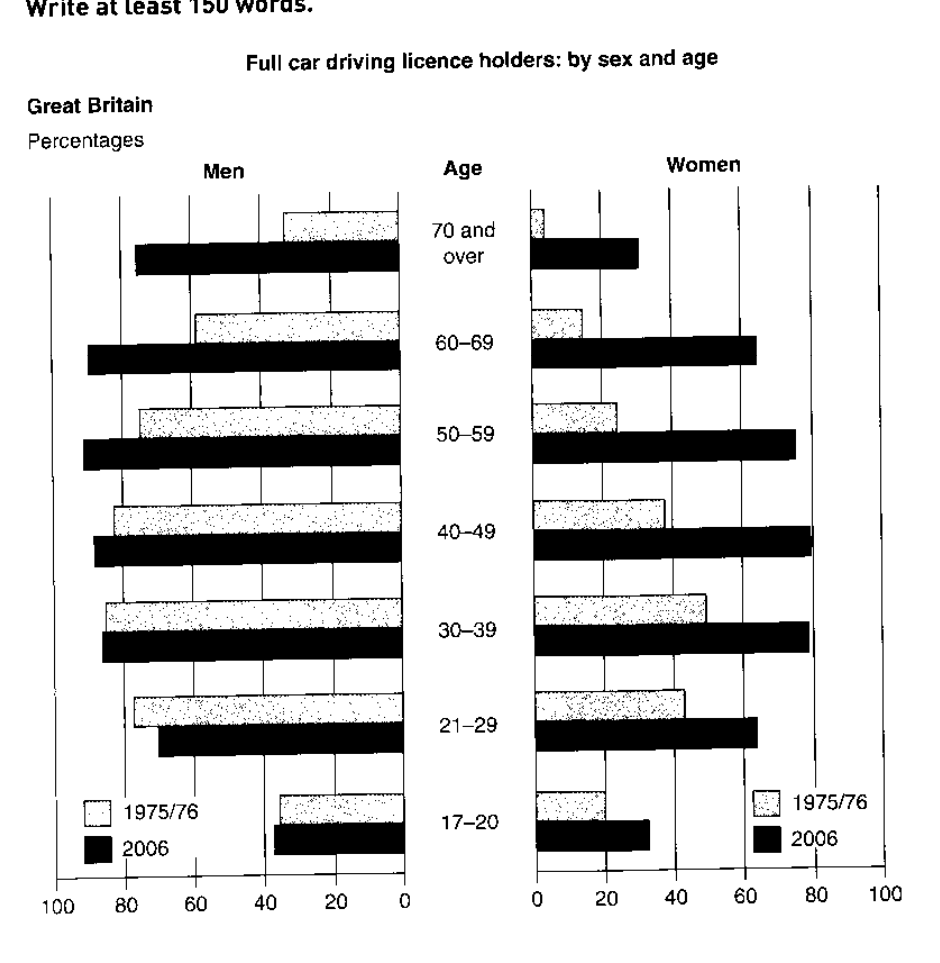
The graphs below show the percentage of people holding full driving licences in Great Britain by age and sex.
Summarise the information by selecting and reporting the main features, and make comparisons where relevant.
Full car driving licence holders: by sex and age
Student answer (Band 5.5)
The bar graphs compare the proportion of full car driving licences by the UKs men and women and seven different age groups from 1975 to 2006.
Overall, it is evident that the largest proportion of car licence was dominated by male, while women obtaining car licence was increased by the period. meanwhile, the percentages of car driving licence incresed with increasing age.
Looking at the graph in more detail, it is clear that for 50 to 59 years old male, the share of car driving licence was 75% in 1975, which incresed by 15% in 2006, was the highest figure of all-time. About 8% ( 82% in 1975 and 90% in 2006) increased of share for 40 to 49 years age group. Similarly, 32% and 40% increased showed for 60 to 69 and over 70 years old groups. However, 30 to 39 years groups remained unchaged at 88%.
Turning to the remaining category, for female, the highest increasing pattern accounted at 50% for 50 to 59 years group, while the lowest growth occurred in 17 to 20 years group, about 15% incresed f
AI examiner evaluation
| Criterion | Band |
|---|---|
| Task Achievement / Task Response | 5.5 |
| Coherence and Cohesion | 6.0 |
| Lexical Resource | 5.5 |
| Grammatical Range and Accuracy | 5.0 |
| Overall | 5.5 |
Task Achievement / Task Response: Band 5.5
You identify the broad pattern that men had higher licence-holding rates and that women’s rates rose over time, and you include several relevant age-group comparisons. However, the overview is partly inaccurate: licence ownership did not generally increase with age, since the youngest groups were often below middle-aged groups and the oldest groups varied considerably. Some figures are also misinterpreted. For example, the 50–59 male rate rose from about 76% to 92%, not by 15 percentage points to a stated peak of 90%; and the 30–39 male rate increased from about 77% to 87%, rather than remaining unchanged. The female discussion is incomplete and ends mid-sentence. Select the clearest overall trends, report changes accurately, and compare both sexes across the age groups.
Coherence and Cohesion: Band 6.0
The response has a recognisable structure: an introduction, an overview, and separate paragraphs for men and women. Phrases such as “Looking at the graph in more detail” and “Turning to the remaining category” help signal the shift between sections. However, progression within the detail paragraph is sometimes difficult to follow because changes are expressed in compressed or unclear forms, such as “About 8% … increased of share.” The overview also makes a broad age-related claim that does not clearly connect to the data. Most importantly, the final paragraph stops abruptly, leaving the female comparisons unfinished. Organise the details around clear comparisons—such as the largest rises and the age groups with similar or contrasting rates—and complete each paragraph with a full, connected point.
Lexical Resource: Band 5.5
You use relevant task vocabulary, including “proportion,” “share,” “age group,” and “highest figure,” and you attempt to describe change with terms such as “increased” and “remained.” However, several word choices and collocations are inaccurate or awkward, including “largest proportion … was dominated by male,” “car licence was 75%,” and “increased pattern accounted at 50%.” Repeated use of “increased” also limits precision, while spelling errors such as “incresed” and “unchaged” are noticeable. Use standard chart language consistently: people “held” licences, a percentage “rose” or “increased,” and a group “recorded” a rate. Check spelling and choose wording that distinguishes a percentage-point change from a final percentage.
Grammatical Range and Accuracy: Band 5.0
You attempt a mix of simple and more complex sentences, including clauses beginning with “while” and “which,” but control is inconsistent. Errors in sentence construction make some comparisons hard to interpret, as in “About 8% … increased of share” and “32% and 40% increased showed.” There are also problems with articles, plurals, and agreement in phrases such as “the largest proportion of car licence” and “for 50 to 59 years old male.” The final sentence is incomplete, which further disrupts meaning. Build each comparison around a clear subject and verb—for example, “The proportion among men aged 50–59 rose from about 76% to 92%”—and check agreement, articles, and sentence completion.
See this exact question answered at other band scores. The same prompt compared across bands.
Browse more IELTS Writing model answers or get your own writing scored by the same AI examiner.