Band 4.5 IELTS Writing Task 1 Model Answer
Overall Band Score: 4.5 · IELTS Summit Mastery · 2026-11-11
IELTS Writing Task 1 question
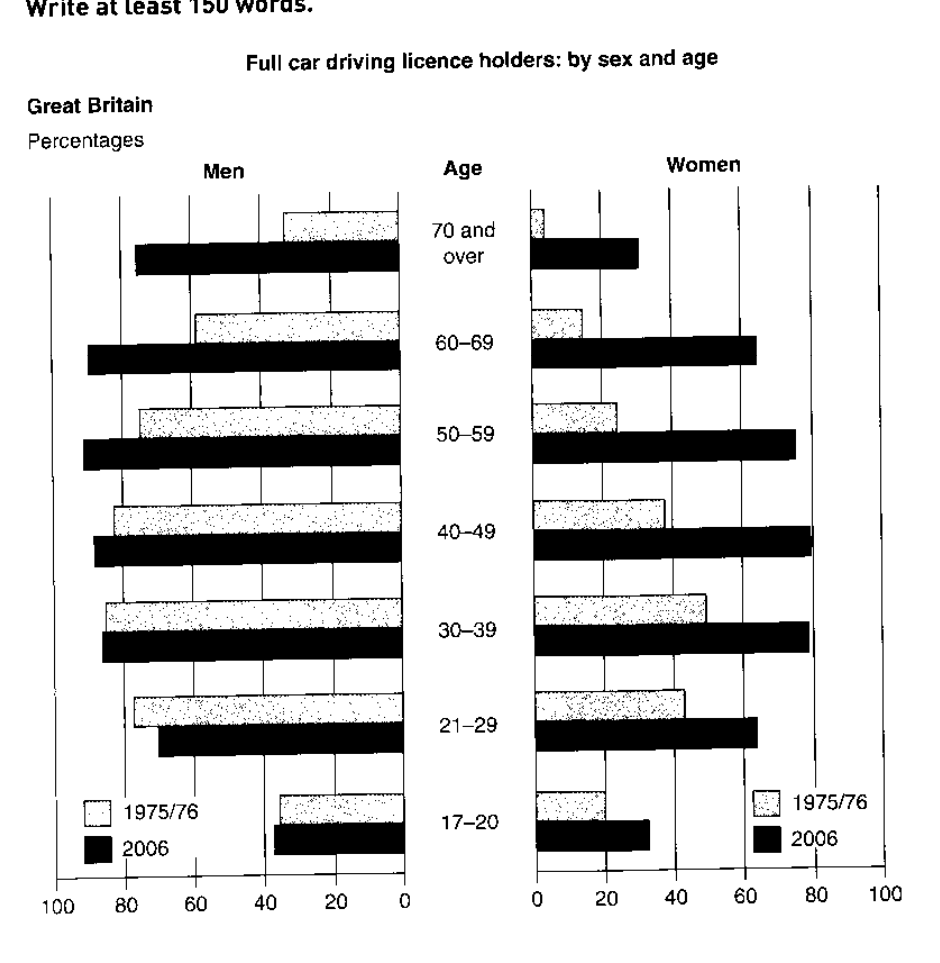
The graphs below show the percentage of people holding full driving licences in Great Britain by age and sex.
Summarise the information by selecting and reporting the main features, and make comparisons where relevant.
Full car driving licence holders: by sex and age
Student answer (Band 4.5)
The given graph illustrates the proportion of the public having driving licences and their age and gender in the given period.
Overall it is explicitly observed that, the men of age group between 50-59 have licences in greater proportion in 2006 whereas women having age group between 40-49 had larger quantity which have full driving licences as compared to all other age groups.
By further exploring the graph, 60-69 men age group had large number of driving licences as compared to the women which had only 65% in 2006 with men had 60%in 1975 to1976 and women had only 20% respectively.30-39
AI examiner evaluation
| Criterion | Band |
|---|---|
| Task Achievement / Task Response | 3.0 |
| Coherence and Cohesion | 4.0 |
| Lexical Resource | 5.5 |
| Grammatical Range and Accuracy | 5.0 |
| Overall | 4.5 |
Task Achievement / Task Response: Band 3.0
The response identifies the chart’s subject and attempts an overview, noting that men aged 50–59 had a high figure in 2006 and that women aged 40–49 were prominent. However, the overview is unclear and partly inaccurate: women aged 40–49 did not have the highest rate among women in 2006; the 30–39 group was slightly lower, while 40–49 was highest. The comparison of 60–69-year-olds also mixes years and gives figures that do not match the chart. Most age groups and the broad rise in licence holding among women are not reported, and the response ends mid-thought. It is also 49 words below the required minimum, leaving the task only partially addressed. Select the main trends, compare both sexes across the two years, and support them with accurate figures.
Coherence and Cohesion: Band 4.0
There is a basic attempt to organise the response: an opening sentence is followed by an overview beginning “Overall” and a further-detail paragraph beginning “By further exploring the graph”. This gives the reader some indication of the intended structure. However, the progression is difficult to follow because the overview combines several comparisons in one unclear sentence, and the next paragraph shifts between age groups, sexes and years without a consistent pattern. The isolated “30-39” at the end leaves the response unfinished. Use separate paragraphs for the overview and key comparisons, and organise details consistently—for example, compare men and women within each year or describe the main changes between years. Clearer links between sentences would also help.
Lexical Resource: Band 5.5
The response shows some useful task-related vocabulary, including “proportion”, “age group”, “gender” and “full driving licences”, and the meaning is generally recoverable. There are also attempts at more formal phrasing, such as “By further exploring the graph”. However, several choices are unnatural or imprecise: “larger quantity” is unsuitable for a percentage, “men of age group” is awkward, and “had licences in greater proportion” is not idiomatic. Repetition of “age group” and “driving licences” also limits flexibility. Prefer precise chart language such as “the percentage of licence holders”, “the highest proportion” and “the figure for men aged 60–69”. This would make comparisons clearer and more natural.
Grammatical Range and Accuracy: Band 5.0
The response attempts both simple and more complex sentence forms, including a comparison introduced by “as compared to”. However, control is inconsistent, and several sentences contain errors that make relationships between figures difficult to understand. For example, “it is explicitly observed that, the men…” has faulty punctuation and sentence construction, while “women having age group between 40-49 had larger quantity which have…” has problems with clause structure and verb agreement. The long sentence beginning “60-69 men age group…” also lacks clear grammatical links between the figures, and spacing and punctuation are inconsistent. Practise writing shorter, complete comparison sentences with accurate subject–verb agreement and clear past-tense reporting, then combine ideas only when the relationships remain easy to follow.
See this exact question answered at other band scores. The same prompt compared across bands.
Browse more IELTS Writing model answers or get your own writing scored by the same AI examiner.