Band 5.5 IELTS Writing Task 1 Model Answer
Overall Band Score: 5.5 · IELTS Summit Mastery · 2026-11-11
IELTS Writing Task 1 question
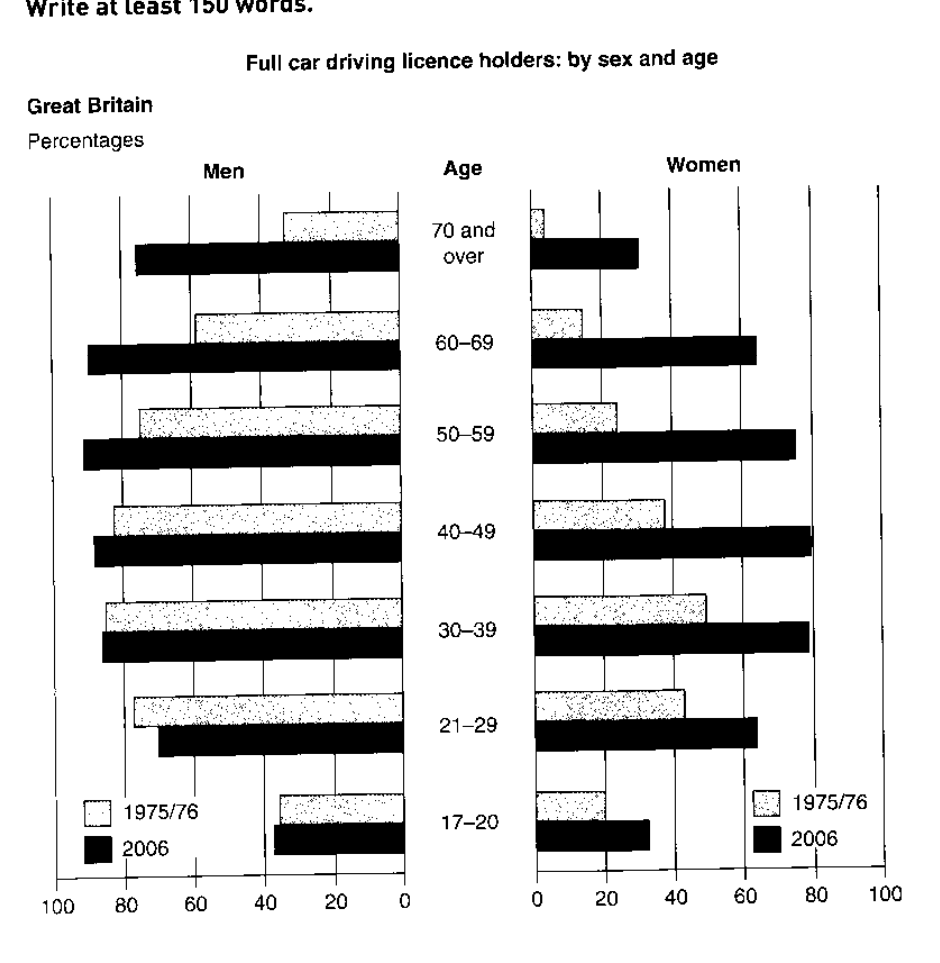
The graphs below show the percentage of people holding full driving licences in Great Britain by age and sex.
Summarise the information by selecting and reporting the main features, and make comparisons where relevant.
Full car driving licence holders: by sex and age
Student answer (Band 5.5)
The bar graphs compare the proportion of citizens of the great britian having a full driving licence by age and genders.
Overall, the number of both genders having a licence increased with the passage of time. Initially, men aged from 21 to 69 contributed the most as compared to women. In contrast, both genders experienced a significant growth by the end of the time.
To begin with, in 1975/76 men aged 30 to 39 and 40 to 49 accounted for the most with over 80% and experienced a minimal growth and reached to nearly 90% while, the proportion of women of the same age groups stood nearly at 50% and 40% and reached to almost 80% by 2006. Followed by aged 51 to 29 where nearly 80% of boys had a full driving licence which is almost of that of girls and fell marginally almost 70% where that figure rose sharply to over 60 % in case of females. Males aged 60 to 69 figure stood at 60% and levelled that of aged 50 to 59.Females of the same ages exhibited less than 20% and rose significantly to over 60% by 2002.
Furthermore, middle aged boys has the lowest number of full driving licence at nearly 40% and remained unchanged untill 2002 while thatrr figure fell sharply to 20% in case of girls and extented to nearly 35% which is still a low figure as compared to boys. In contrast men aged over 70 reached from 35% to over 70% while only 10% of women had full driving licence and reached to almost 30% by the end of the time.
AI examiner evaluation
| Criterion | Band |
|---|---|
| Task Achievement / Task Response | 5.5 |
| Coherence and Cohesion | 5.0 |
| Lexical Resource | 5.5 |
| Grammatical Range and Accuracy | 5.0 |
| Overall | 5.5 |
Task Achievement / Task Response: Band 5.5
You identify the chart’s broad message—that licence holding generally rose between 1975/76 and 2006—and make relevant comparisons between men and women. Several figures are also broadly accurate, such as women aged 30–39 rising from about 49% to 78%, and men aged over 70 increasing from roughly 35% to 77%. However, the overview is imprecise: it does not clearly identify the persistent male advantage or the especially large gains among older women. Some details are misreported or unclear. For example, “aged 51 to 29” appears to refer to ages 21–29, and the chart shows women aged 17–20 rising from 20% to 33%, not falling to 20%. The reference to 2002 should be 2006. Select the main age-group patterns and report them accurately.
Coherence and Cohesion: Band 5.0
The response has an introduction, an overview and two body paragraphs, so there is a basic attempt to organise the information. However, the progression within the body paragraphs is difficult to follow because several age groups and comparisons are compressed into long sentences. Phrases such as “Followed by aged 51 to 29” and “Males aged 60 to 69 figure stood at 60% and levelled that of aged 50 to 59” do not make the relationships between figures clear. Linking expressions including “To begin with,” “Furthermore” and “In contrast” are used, but sometimes do not accurately signal the comparison that follows. Group the data by age bands or by sex, and give each comparison a clear subject and reference point.
Lexical Resource: Band 5.5
You use some relevant chart vocabulary, including “proportion,” “accounted for,” “remained unchanged” and “rose significantly,” and you attempt to describe changes rather than simply list figures. However, the range is limited and several choices are inaccurate or unnatural, which sometimes makes the intended meaning hard to follow. “Boys” and “girls” are unsuitable for adult age groups; use “men” and “women.” “Reached to” is not the natural collocation, while “levelled that of” does not clearly express a comparison. There are also spelling and word-form errors, such as “britian,” “untill” and “extent ed” (intended as “extended”). Aim for precise, consistent terms such as “licence holders,” “percentage” and “increased by.”
Grammatical Range and Accuracy: Band 5.0
You attempt longer sentences with clauses linked by “while” and “where,” but these structures are often faulty, and sentence boundaries are not consistently controlled. For example, “the proportion of women of the same age groups stood nearly at 50% and 40% and reached to almost 80%” has an unclear subject for the final verb, while “Males aged 60 to 69 figure stood at 60%” lacks a possessive or a clearer grammatical construction. There are also agreement and tense problems, as in “middle aged boys has,” and punctuation is missing in places where ideas run together. Use shorter, complete sentences first, then add subordinate clauses only when their subjects and comparisons remain clear.
See this exact question answered at other band scores. The same prompt compared across bands.
Browse more IELTS Writing model answers or get your own writing scored by the same AI examiner.