Band 5.5 IELTS Writing Task 1 Model Answer
Overall Band Score: 5.5 · IELTS Summit Mastery · 2026-11-11
IELTS Writing Task 1 question
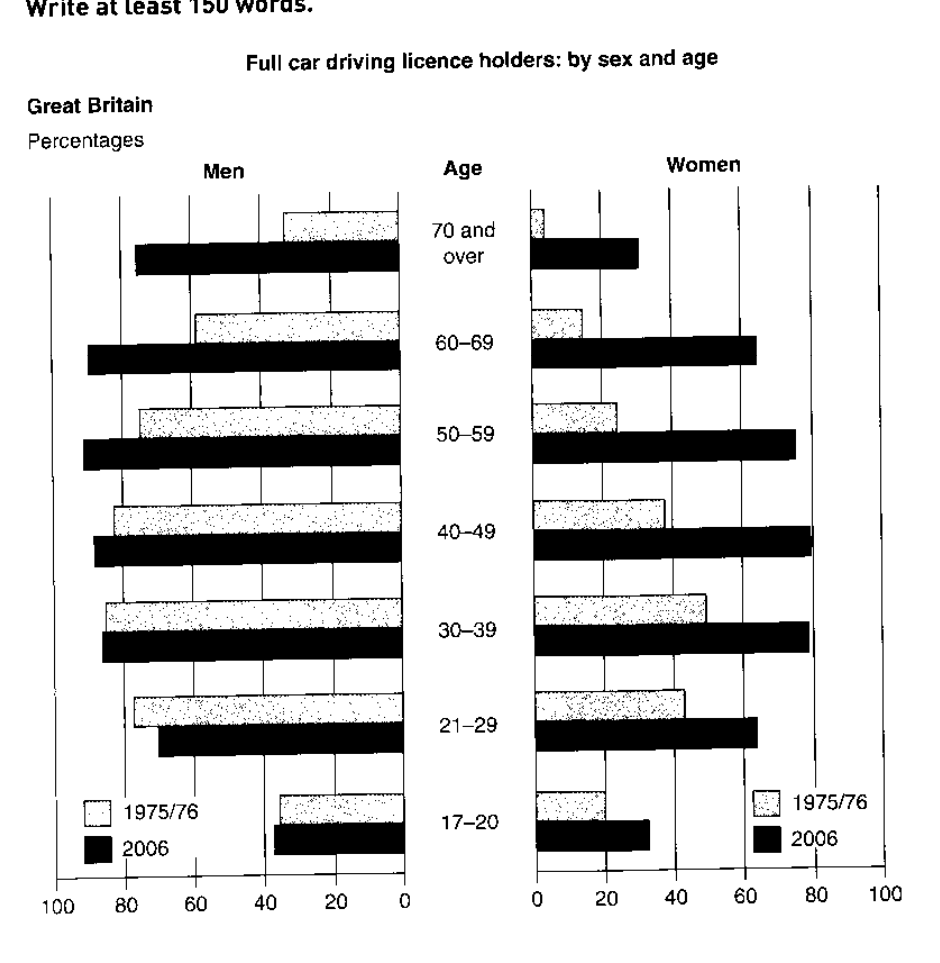
The graphs below show the percentage of people holding full driving licences in Great Britain by age and sex.
Summarise the information by selecting and reporting the main features, and make comparisons where relevant.
Full car driving licence holders: by sex and age
Student answer (Band 5.5)
The barchart illustrates the comparison between the men and women having full car driving licence by their age from 1975-76 to 2006 in great britain measured in percentage.
Overall, the smallest number of individuals holding license were of age 17 to 20 in both genders. While, there was a constant trend in men of ages 21 to 60 in both varaible year. On the other there was a significant rise in women holding lisence in 2006 as compared to 1975/76.
The trend for men seeking the driveng certificate of all ages was nearly same in both time frames under discussion. Approximately, 38-39% citizens got license in 1975/76 and similar for 2006.The trend has been the same relative to other age groups from 21 to 29 reaching around 80%. fage groups from 30 to 59 contributed for nearly 90% and the inetrest of gettiing license become significant in high age groups from 60 to over 70 in 2006 than 1976/76.
women starting from 20% in 1975 reached to value of 30% in 2006 and subsequentl rise to 60 % among ages 21 to 29.
AI examiner evaluation
| Criterion | Band |
|---|---|
| Task Achievement / Task Response | 5.5 |
| Coherence and Cohesion | 5.5 |
| Lexical Resource | 5.5 |
| Grammatical Range and Accuracy | 5.0 |
| Overall | 5.5 |
Task Achievement / Task Response: Band 5.5
You identify the two years and both sexes, and your overview correctly notes a substantial rise in women’s licence holding by 2006. However, the overview is not fully accurate: the lowest figures are not consistently for ages 17–20, since women aged 70 and over had only about 3% in 1975/76. The claim that men aged 21–60 showed a “constant trend” is also unclear and overlooks the marked increases among older men. Some figures are reported imprecisely or attached to the wrong age groups, and the final sentence gives only a partial account of women’s results. To strengthen the response, select the main contrasts accurately and compare the age groups systematically, including the high rates among middle-aged men and the rise among women.
Coherence and Cohesion: Band 5.5
The response has a recognisable structure: an introduction, an overview and separate discussion of men and women. This gives the reader some organisation, and phrases such as “Overall” and “On the other” attempt to signal relationships. However, progression is uneven and several links are unclear. The overview’s “constant trend” is not explained, while the men’s paragraph moves from the youngest group to ages 21–29, then 30–59 and older groups without a clear comparison framework. The women’s paragraph is very brief and does not develop the comparison. Some transitions are also awkward or incomplete. Organise the details by age bands or by year, and use clear linking phrases to show increases, contrasts and exceptions.
Lexical Resource: Band 5.5
You use some relevant task vocabulary, including “percentage,” “age groups,” “significant rise” and “compared to,” so the topic is generally understandable. However, the range is limited and several word choices or collocations are inaccurate, such as “seeking the driveng certificate,” “the interest of getting license,” and “smallest number” when describing percentages. Spelling errors—including “varaible,” “lisence,” “inetrest” and “gettiing”—are noticeable and reduce precision. Use standard chart language consistently, such as “held a full driving licence,” “the proportion of licence holders,” and “increased from … to …”. Check spelling carefully and avoid expressions that do not naturally describe the data.
Grammatical Range and Accuracy: Band 5.0
You attempt a mixture of simple and more complex sentences, including a contrast with “While” and a comparison using “as compared to.” However, complex structures are often faulty, and errors sometimes make relationships difficult to follow. For example, “While, there was a constant trend in men…” is an incomplete or awkwardly joined construction, and “The trend for men … was nearly same” is missing an article. There are also problems with agreement and sentence boundaries, as in “the interest … become significant,” and punctuation is inconsistent, particularly around “2006.The trend.” Practise forming complete sentences with clear subjects and verbs, and check articles, verb forms, and punctuation when editing.
See this exact question answered at other band scores. The same prompt compared across bands.
Browse more IELTS Writing model answers or get your own writing scored by the same AI examiner.