Band 4.5 IELTS Writing Task 1 Model Answer
Overall Band Score: 4.5 · IELTS Summit Mastery · 2026-11-11
IELTS Writing Task 1 question
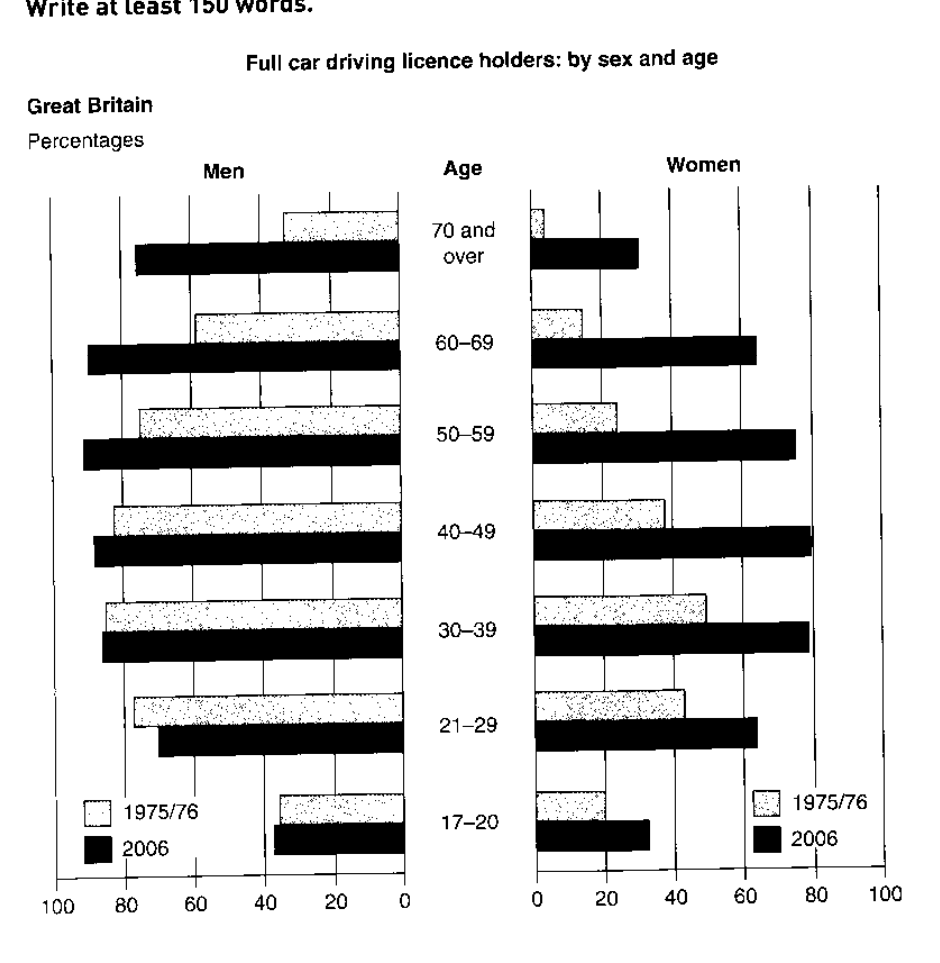
The graphs below show the percentage of people holding full driving licences in Great Britain by age and sex.
Summarise the information by selecting and reporting the main features, and make comparisons where relevant.
Full car driving licence holders: by sex and age
Student answer (Band 4.5)
The graphs shows the percentages of people holding full driving licences in great Britain by age and sex.The higesting number of people have licence by men, in britain most of men have, The women perccentages is low in the 1975 but increase in the 2006.in the age of 17 to 20 men and women percentages is low. in the age of 21to29 is high in both gender is percentages men is80% and women is60%.The higesting number of licence is men is age is 50 to 59 in women is 65%. in the age of 40 to 49 in the men and women this number is same. 1975 some people have licence most of the old ages. 1975 momen is very low of car driving and some of the women have licence. 2006 the of the driving in the men and women is same and most of the women have liscence.
AI examiner evaluation
| Criterion | Band |
|---|---|
| Task Achievement / Task Response | 4.5 |
| Coherence and Cohesion | 4.0 |
| Lexical Resource | 4.5 |
| Grammatical Range and Accuracy | 4.5 |
| Overall | 4.5 |
Task Achievement / Task Response: Band 4.5
You identify the chart’s subject and make relevant comparisons, including that women’s licence-holding rose by 2006 and that the youngest group had relatively low figures. However, several key details are inaccurate or unclear: for example, men aged 50–59 in 2006 had about 92%, not the stated women’s 65%, and the figures for men and women aged 40–49 were not the same. The claim that most men held licences in 1975 also overlooks the much lower rates among older and youngest men. There is no clear, accurate overview of the main changes across the age groups. The response is 138 words, below the required 150, so it also needs fuller development and more precise reporting.
Coherence and Cohesion: Band 4.0
The response contains relevant points, but they are presented as one continuous sequence rather than in clearly organised paragraphs. Ideas move abruptly between the overall pattern, individual age groups and the two years—for instance, the discussion shifts from ages 21–29 to 50–59 and then back to 1975 without a clear organising principle. Repeated sentence openings such as “in the age of” do not establish a strong progression, and some links between claims are difficult to follow. Group the information into an introduction and overview, followed by comparisons organised by year or age group. Use clear linking phrases to show contrasts and changes, while avoiding repetition.
Lexical Resource: Band 4.5
Your vocabulary is sufficient to identify the topic and make basic comparisons, using terms such as “percentages,” “age,” “men,” “women” and “increase.” However, the range is limited and several word choices or forms make the meaning difficult to interpret. “Higesting number” is not an appropriate expression, while “the driving in the men and women is same” does not clearly describe the data. There are also spelling errors, including “perccentages,” “momen” and “liscence.” Use precise chart language such as “proportion,” “licence holders,” “rose” and “was higher than,” and check spelling and word forms before submitting.
Grammatical Range and Accuracy: Band 4.5
Most sentences rely on basic patterns, and frequent errors in sentence formation and agreement sometimes obscure the intended comparisons. For example, “The graphs shows” has a subject–verb agreement error, and “The women perccentages is low in the 1975 but increase in the 2006” contains problems with agreement, tense and article use. The sentence about ages 21–29 combines several ideas without a clear grammatical structure. Punctuation is also missing after the opening sentence, and spacing around age ranges is inconsistent. Practise writing complete, controlled sentences with a clear subject and verb, and use past-tense forms consistently when describing the two chart years.
See this exact question answered at other band scores. The same prompt compared across bands.
Browse more IELTS Writing model answers or get your own writing scored by the same AI examiner.