Band 6.0 IELTS Writing Task 1 Model Answer
Overall Band Score: 6.0 · IELTS Summit Mastery · 2026-11-11
IELTS Writing Task 1 question
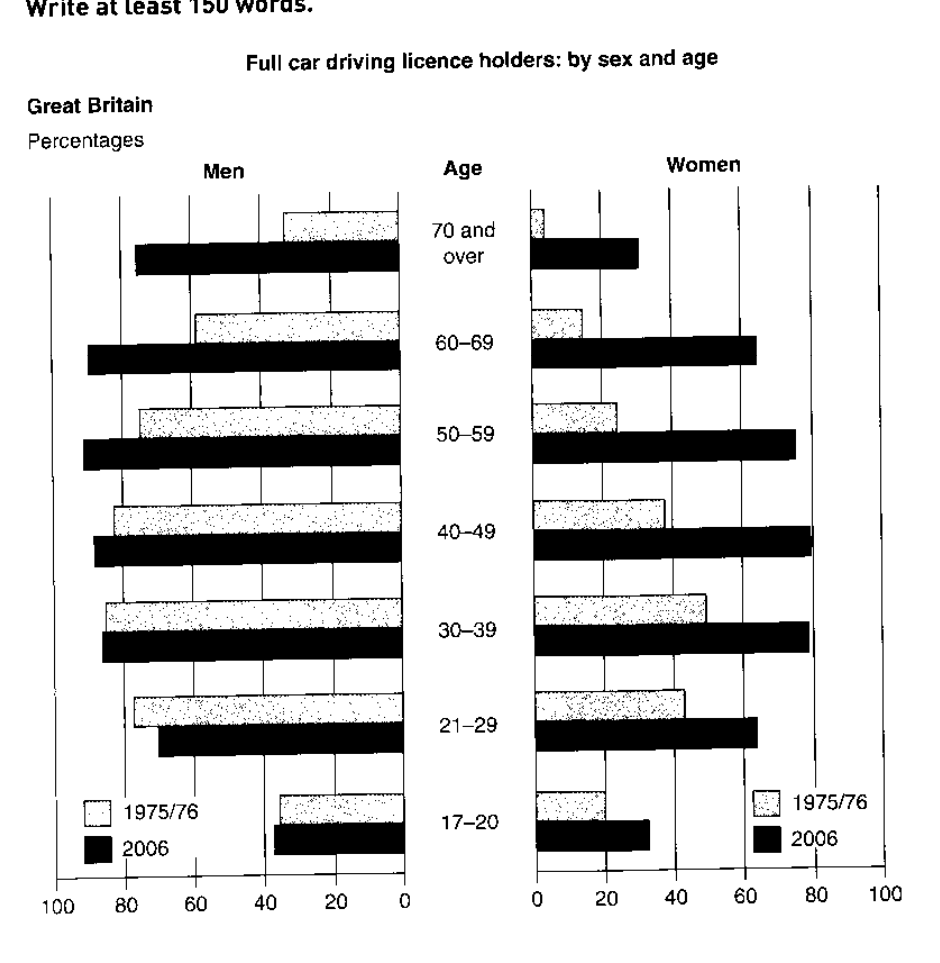
The graphs below show the percentage of people holding full driving licences in Great Britain by age and sex.
Summarise the information by selecting and reporting the main features, and make comparisons where relevant.
Full car driving licence holders: by sex and age
Student answer (Band 6.0)
The bar graphs illustrate the percentage of full car driving licence holders by sex and age in Great Britain in the years 1975/1976 and 2006.
Overall, men are hold the biggest percentages in all age groups for both period, however the women percentage significantly improved in the 2006 compared to the previous ones.
The portion of women holding car licence markedly increased for all ages especially adults in their 40s where it went from under 40% in 1975/76 to about 80% in 2006, in the ones in their 50s the percentage rose from over 20% to nearly 80%. The age group of 60 to 69 years old, that was well under 20% in 1975/76 grew to more than 60% in 2006. However the aged 70 and more holders was nearly nul in 1975 but reached around 30% in 2006.
The percentage of young men in the age between 17 and 20 years slightly grew through the years, but the for the ones in their 20s is declined from close to 80% in 1975 to around 70% in 2006. Only around 70% of adults in the age group of 50 to 59, but it hit a high of around 90% with being the biggest percentage of licence holder in all ages in both sex.
AI examiner evaluation
| Criterion | Band |
|---|---|
| Task Achievement / Task Response | 6.0 |
| Coherence and Cohesion | 6.0 |
| Lexical Resource | 6.0 |
| Grammatical Range and Accuracy | 5.5 |
| Overall | 6.0 |
Task Achievement / Task Response: Band 6.0
You identify the main overall pattern: licence holding rose among women between the two periods, while men generally had higher rates. Several comparisons are relevant and reasonably accurate, including women aged 40–49 rising from under 40% to about 80%, and the increase among women aged 70 and over. However, the overview is broad, and some important features are not fully reported. For example, men aged 50–59 were around 76% in 1975/76 and 92% in 2006, rather than “only around 70%” in the earlier period; the final comparison is also unclear about which group reached the high. Include a clearer overview of the age patterns and compare both sexes across the periods more systematically.
Coherence and Cohesion: Band 6.0
The response has a recognisable structure: an introduction, an overview, and separate discussion of women and men. This gives the reader a coherent overall route through the information. Linking words such as “Overall,” “However,” and “but” help signal contrast, and the women’s figures are grouped together effectively. Some progression is less clear in the final paragraph, where the discussion moves from young men to men in their twenties and then to those aged 50–59 without a clear organising pattern. The phrase “Only around 70% of adults…” also makes the comparison difficult to follow. Grouping figures by age range or by period, and using clearer references to each group, would make the comparisons easier to track.
Lexical Resource: Band 6.0
You use an adequate range of task-related vocabulary, including “percentage,” “increased,” “declined,” and “reached,” and the meaning is generally clear. There are also attempts at more descriptive phrasing, such as “markedly increased” and “hit a high.” However, some word choices and collocations are inaccurate or unnatural: “the biggest percentages,” “the women percentage,” and “the aged 70 and more holders” do not express the data smoothly. “Nearly nul” is also an incorrect spelling and form. Aim for precise chart language and natural combinations, such as “the highest proportions,” “the proportion of women,” and “licence holders aged 70 and over.” This would improve clarity without requiring more elaborate vocabulary.
Grammatical Range and Accuracy: Band 5.5
You attempt a mix of simple and complex sentences, including clauses introduced by “where” and “however,” and most of the intended comparisons can be understood. Some grammatical errors remain, though they rarely prevent communication. For example, “men are hold” has an incorrect verb form, while “for the ones in their 20s is declined” has faulty structure and tense. In “the women percentage significantly improved,” the noun phrase and verb pattern are not well formed. The final sentence also lacks a clear grammatical connection between its clauses. Practise accurate subject–verb patterns and past-tense reporting, for example, “the proportion of men aged 21–29 declined” and “the figure for men aged 50–59 rose to a peak of about 92%.”
See this exact question answered at other band scores. The same prompt compared across bands.
Browse more IELTS Writing model answers or get your own writing scored by the same AI examiner.