Band 4.5 IELTS Writing Task 1 Model Answer
Overall Band Score: 4.5 · IELTS Summit Mastery · 2026-11-12
IELTS Writing Task 1 question
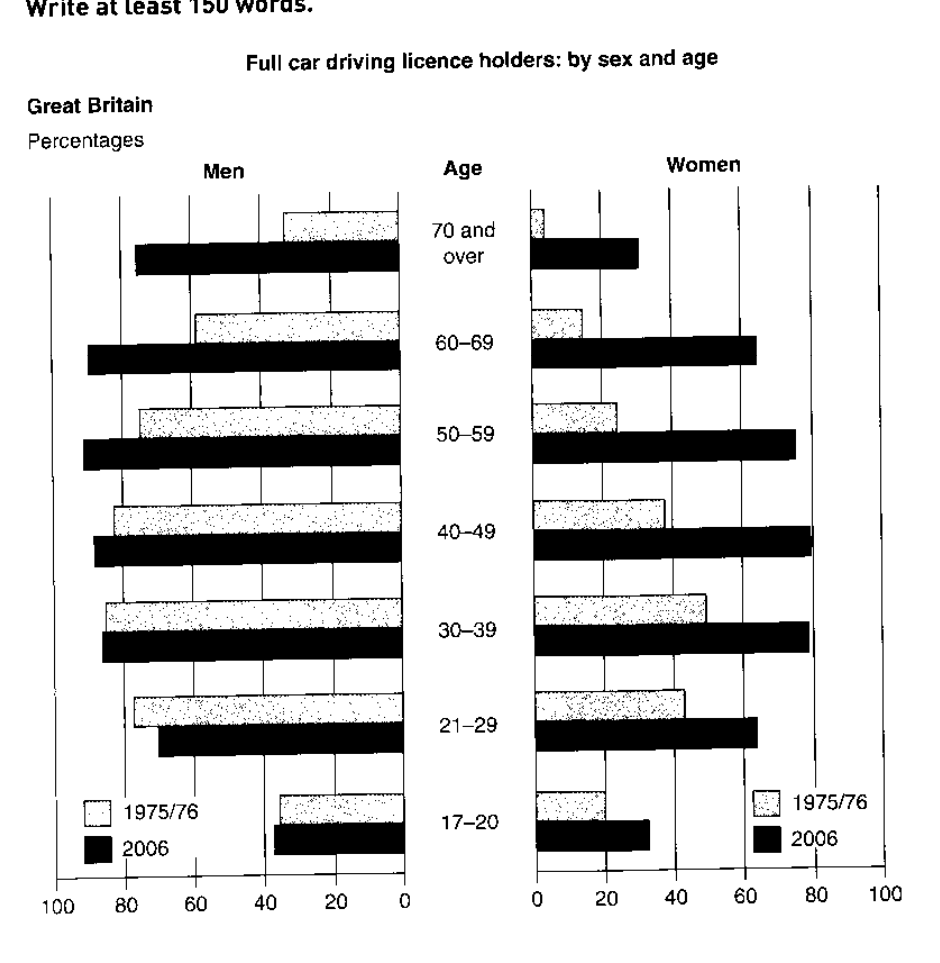
The graphs below show the percentage of people holding full driving licences in Great Britain by age and sex.
Summarise the information by selecting and reporting the main features, and make comparisons where relevant.
Full car driving licence holders: by sex and age
Student answer (Band 4.5)
The two bar chat compare the people holding full driving licences in Great Britain by male and female in percentage from 1975 to 2006.
Overall, the percentage of younge male and female increased however, the teenaged limit lower poient in both chart.Furthermore,the male in the old age were highest then the woman.
In the begning , 1957/76 femals teenaged to youngsters strength were rosely grow up therefore the male gredually riced in thi aged. In the age of young old both were slowly downed . However, the old aged poople steadly decreasrd.
In the 2006, the youth male and female were increased whereas in the age of old young woman and man also decresed . in the age of old male people upward trend however the old female slowly decresed. in t
AI examiner evaluation
| Criterion | Band |
|---|---|
| Task Achievement / Task Response | 4.0 |
| Coherence and Cohesion | 4.5 |
| Lexical Resource | 4.5 |
| Grammatical Range and Accuracy | 4.5 |
| Overall | 4.5 |
Task Achievement / Task Response: Band 4.0
You identify the broad topic and attempt an overview, noting that licence holding generally increased and that younger groups had lower figures. However, several comparisons are unclear or inaccurate: for example, the oldest men did not have the highest rate in 2006, and the youngest group was not the lowest for both sexes in both years. The account also gives no clear, reliable figures or age-by-age comparisons, so the main features are only minimally reported. The response is 123 words, below the required 150, which leaves important information undeveloped. To improve, state the major contrasts accurately, support them with selected percentages, and complete the summary with a clear comparison of the two years and sexes.
Coherence and Cohesion: Band 4.5
There is an attempt to organise the response into an introduction, an overview and later paragraphs about the two periods. Linking expressions such as “Overall,” “Furthermore” and “However” show an effort to connect ideas. However, the progression is difficult to follow because the age groups and trends are not presented in a consistent order, and some references are unclear, such as “young old” and “old young.” The final sentence is cut off, and the paragraphing does not create a complete, coherent account. Organise the details by year or by age group, use clear references such as “men aged 70 and over,” and ensure each paragraph develops one identifiable comparison.
Lexical Resource: Band 4.5
You use some relevant task vocabulary, including “percentage,” “increased,” “decreased” and “trend,” and you attempt to describe change rather than simply list categories. However, the range is basic and several word choices or spellings make the meaning hard to understand, including “bar chat,” “rosely grow up,” “slowly downed” and “old aged poople.” Some phrases, such as “teenaged limit lower poient,” do not communicate a clear chart feature. Use accurate terms for age groups and licence rates, and choose standard verbs such as “rose,” “fell” and “remained stable.” Proofreading spelling and using natural collocations will make your comparisons much clearer.
Grammatical Range and Accuracy: Band 4.5
You attempt a few longer sentences, including “Overall, the percentage … increased however,” and use time references to distinguish the periods. However, sentence structures are limited and errors in sentence boundaries, agreement, articles and tense frequently make relationships between ideas unclear. For example, “The two bar chat compare the people” lacks correct subject–verb agreement, while “In the 2006, the youth male and female were increased” has an incorrect article and verb construction. Punctuation is also inconsistent, with missing spaces after full stops and commas and an unfinished final sentence. Practise accurate simple comparison sentences first, then combine them with “while” or “whereas,” checking verb forms and punctuation.
See this exact question answered at other band scores. The same prompt compared across bands.
Browse more IELTS Writing model answers or get your own writing scored by the same AI examiner.