Band 5.0 IELTS Writing Task 1 Model Answer
Overall Band Score: 5.0 · IELTS Summit Mastery · 2026-11-13
IELTS Writing Task 1 question
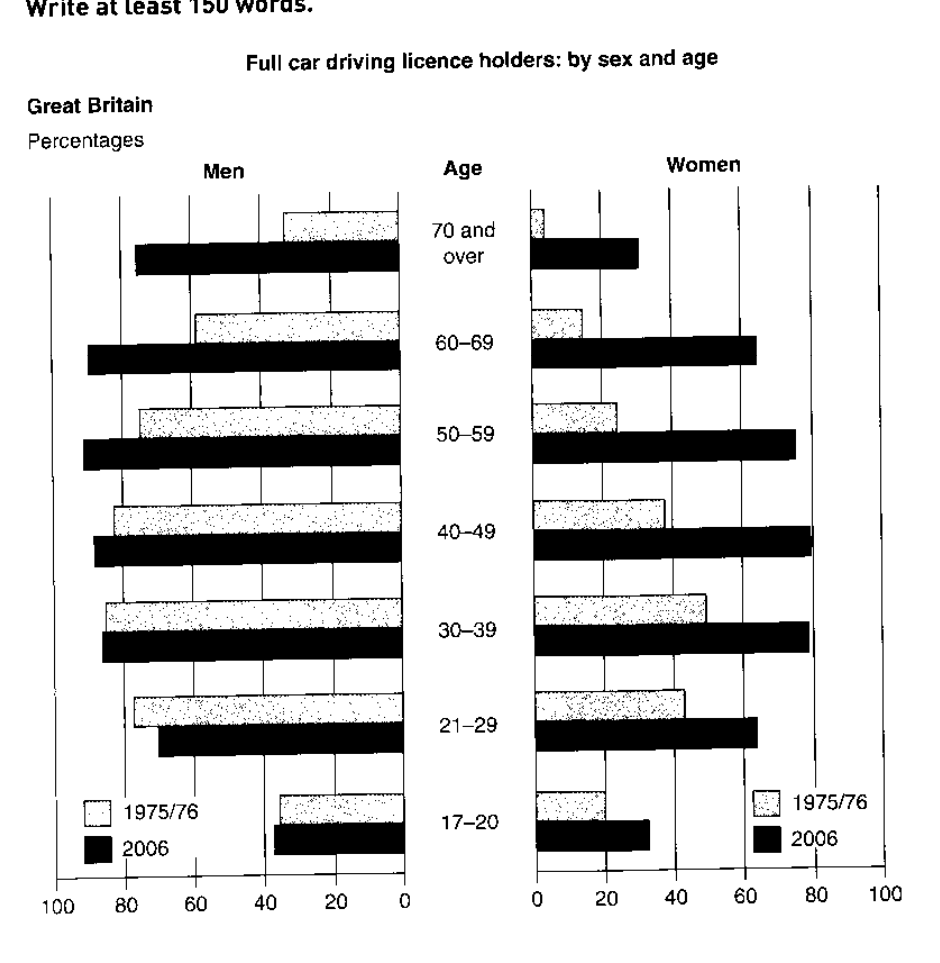
The graphs below show the percentage of people holding full driving licences in Great Britain by age and sex.
Summarise the information by selecting and reporting the main features, and make comparisons where relevant.
Full car driving licence holders: by sex and age
Student answer (Band 5.0)
The graphs present the information about the propertion of people holding full driving licences in Great Britain by age and gender.
Overall, 40-49 age group of women holded large percentages of licences, while 17-20 and 70 to over age group of female took less. On the other hand, 50 to 69 men received hight percentages of licences, however 17 to 20 age group of male holded lowest percentages.
in 2006,The age group of 17 to 20 and 70 to over women driving licences was less around 36%, while 30 to 39 and 40 to 49 female had highest propertion of driving licences about 79 to 80 %. Furtheremore, the age group of 12 to 29 and 50 to 69 women had same amount of driving licences.
In 1975/76 the age group of 17 to 20 and 70 to over man had the lowest percentages compared to others, while 30 to 39 and 40 to 49 age group of male holdes large popertion of licences. However, 21 to 29 and 50 to 59 age grope experienced same propertion of licences.
AI examiner evaluation
| Criterion | Band |
|---|---|
| Task Achievement / Task Response | 4.5 |
| Coherence and Cohesion | 5.0 |
| Lexical Resource | 5.0 |
| Grammatical Range and Accuracy | 5.0 |
| Overall | 5.0 |
Task Achievement / Task Response: Band 4.5
You identify the two years and make some relevant comparisons, including the higher figures for women aged 30–49 in 2006 and the relatively low figures among older women in 1975/76. However, the overview is not consistently accurate: women aged 40–49 were not the highest group overall, and men aged 17–20 were not the lowest in 1975/76, since men aged 70 and over had a slightly lower figure. Several details are also unclear or incorrect: “12 to 29” is not an age category, and the claim that women aged 21–29 and 50–69 had the same figures is too broad. The response gives limited coverage of the main changes between years. Select accurate key comparisons and report them clearly.
Coherence and Cohesion: Band 5.0
The response has a basic structure, with an introduction, an overview and separate paragraphs for 2006 and 1975/76. This helps the reader recognise the intended organisation. However, progression within the paragraphs is limited: several age groups are listed together without a clear comparison or a consistent order, and the final paragraph does not connect the two years. Linking words such as “while,” “on the other hand” and “furthermore” are used, but some do not express the relationship accurately; for example, “furthermore” introduces a claim about similar figures that is difficult to follow. Use a clearer sequence, such as comparing the broad age patterns first and then highlighting the largest changes, with precise references to each group.
Lexical Resource: Band 5.0
You use some task-relevant vocabulary, including “proportion,” “percentages,” “age group” and “licences,” so the topic is generally recognisable. However, the range is limited and several noticeable spelling, word-form and collocation errors reduce clarity: “propertion,” “hight,” “Furtheremore,” “popertion” and “grope.” Phrases such as “received high percentages of licences” and “holded large percentages” are not natural ways to describe the chart. Prefer accurate reporting expressions such as “the proportion of licence holders was higher” or “the figure stood at.” Also use standard age-band labels consistently, rather than unclear wording such as “70 to over” or “12 to 29.” Proofreading spelling and choosing natural chart vocabulary would make the comparisons easier to understand.
Grammatical Range and Accuracy: Band 5.0
You attempt some longer sentences using contrast clauses, for example, “while 30 to 39 and 40 to 49 female had highest…” This shows an effort to connect ideas, but control is inconsistent, and errors occur frequently enough to make some sentences difficult to interpret. Examples include “women holded,” “female had,” and “age group … was less,” which show problems with verb forms, agreement and sentence construction. Articles and plural forms are also often missing, as in “had highest propertion” and “17 to 20 age group.” Capitalisation and punctuation are inconsistent, particularly “in 2006,The.” Build accuracy with straightforward comparative sentences first, checking subject–verb agreement, past-tense forms, articles and plural nouns before adding more complex clauses.
See this exact question answered at other band scores. The same prompt compared across bands.
Browse more IELTS Writing model answers or get your own writing scored by the same AI examiner.