Band 5.5 IELTS Writing Task 1 Model Answer
Overall Band Score: 5.5 · IELTS Summit Mastery · 2026-11-13
IELTS Writing Task 1 question
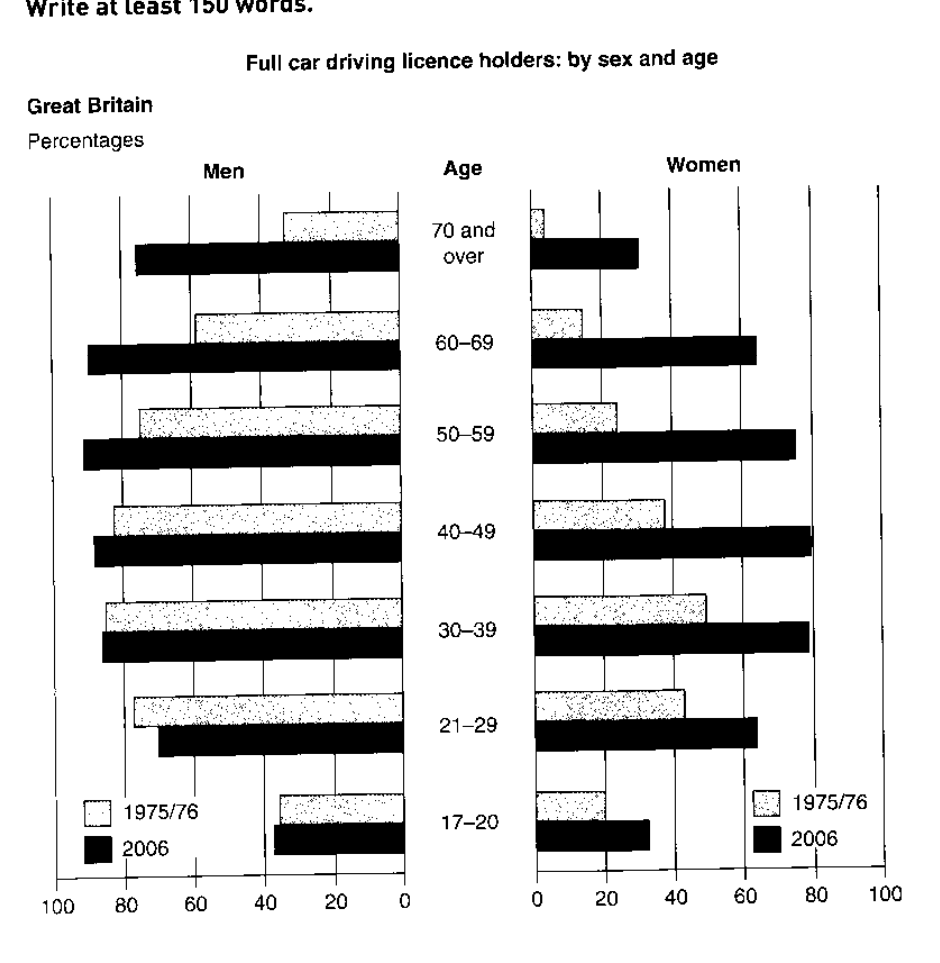
The graphs below show the percentage of people holding full driving licences in Great Britain by age and sex.
Summarise the information by selecting and reporting the main features, and make comparisons where relevant.
Full car driving licence holders: by sex and age
Student answer (Band 5.5)
The table graphs illustrate the comparison of uk car driving licence holder by gender and by age over a period of 30 years.
overall,it is clear that in majorities 40 plus years ages of peoples in great britain hold car driving licences by age.since if we consider by gender mens was more than the womens aquired licences in percentage.
Firstly,we can see females from ages of tewenty one to fourty years are enjoying licence benefits consistantly between in 2006.whearas in 1975/76 numbers of licence holders decreases significantly.
secondly,however mens as compared to womens was twice higher by the age starting from 17 to till over 70 either it is in 1975 to till 2006.mens reached near 100 percentage while womens remained under 80 percent during the whole time period of the gragh.
finally,it is concluded that the number of car driving licence by gender or by ages mens are greater than womens in great britain.
AI examiner evaluation
| Criterion | Band |
|---|---|
| Task Achievement / Task Response | 5.5 |
| Coherence and Cohesion | 5.5 |
| Lexical Resource | 5.0 |
| Grammatical Range and Accuracy | 5.0 |
| Overall | 5.5 |
Task Achievement / Task Response: Band 5.5
You identify the broad comparison that men held licences at higher rates than women, and you attempt to describe changes across the two years. However, the overview is not sufficiently accurate: the claim that most people aged 40 and over held licences overlooks the much lower figures for women in 1975/76, especially those aged 70 and over. Some details are also unclear or misleading. For example, women aged 21–40 did not show a consistent pattern in 2006: the figures were about 63% for ages 21–29, 78% for 30–39 and 79% for 40–49. The statement that men were “twice higher” across every age group and year is not supported. Select key peaks, lows and changes, and report them precisely.
Coherence and Cohesion: Band 5.5
The response has a recognisable introduction, overview and sequence of points, with signposts such as “Firstly,” “secondly” and “finally.” This gives it some organisation. However, the progression is difficult to follow because the body points do not clearly group the data or explain comparisons in a consistent order. The first point shifts between age groups and years, while the next makes a broad claim about all ages without supporting it with specific comparisons. Some linking words, particularly “however,” do not show a clear contrast between the ideas that follow. Use separate paragraphs for the overview and the main comparisons, and organise details by year or by age pattern. Clearer references to the figures would make the relationships between sentences easier to follow.
Lexical Resource: Band 5.0
You use some task-related vocabulary, including “percentage,” “licence holders,” “gender” and “time period,” so the topic is generally recognisable. However, the range is limited and several word choices or collocations are inaccurate, which sometimes makes the meaning unclear. For instance, “the table graphs” is not an appropriate description of the visual, “enjoying licence benefits” is informal and imprecise, and “twice higher” does not express a clear comparison. There are also spelling and word-form errors, such as “tewenty,” “aquired” and “gragh.” Aim for precise chart language such as “the proportion of licence holders,” “rose to” and “was higher than,” and check spelling and collocations carefully.
Grammatical Range and Accuracy: Band 5.0
You attempt both simple and more complex sentences, including clauses beginning with “since” and “while,” but control is inconsistent. Errors in agreement and sentence construction occur frequently: “mens was more than the womens” and “the number … mens are greater” do not form grammatically accurate comparisons. The opening also lacks appropriate articles and plural forms (“uk car driving licence holder”), while “in majorities 40 plus years ages” is difficult to interpret. Punctuation and capitalisation are inconsistent, including the lowercase “overall” and “uk.” Practise building clear comparison sentences with accurate subjects and verbs—for example, “Men’s figures were higher than women’s in every age group”—and use a wider range of structures only when you can control them.
See this exact question answered at other band scores. The same prompt compared across bands.
Browse more IELTS Writing model answers or get your own writing scored by the same AI examiner.