Band 6.0 IELTS Writing Task 1 Model Answer
Overall Band Score: 6.0 · IELTS Summit Mastery · 2026-11-13
IELTS Writing Task 1 question
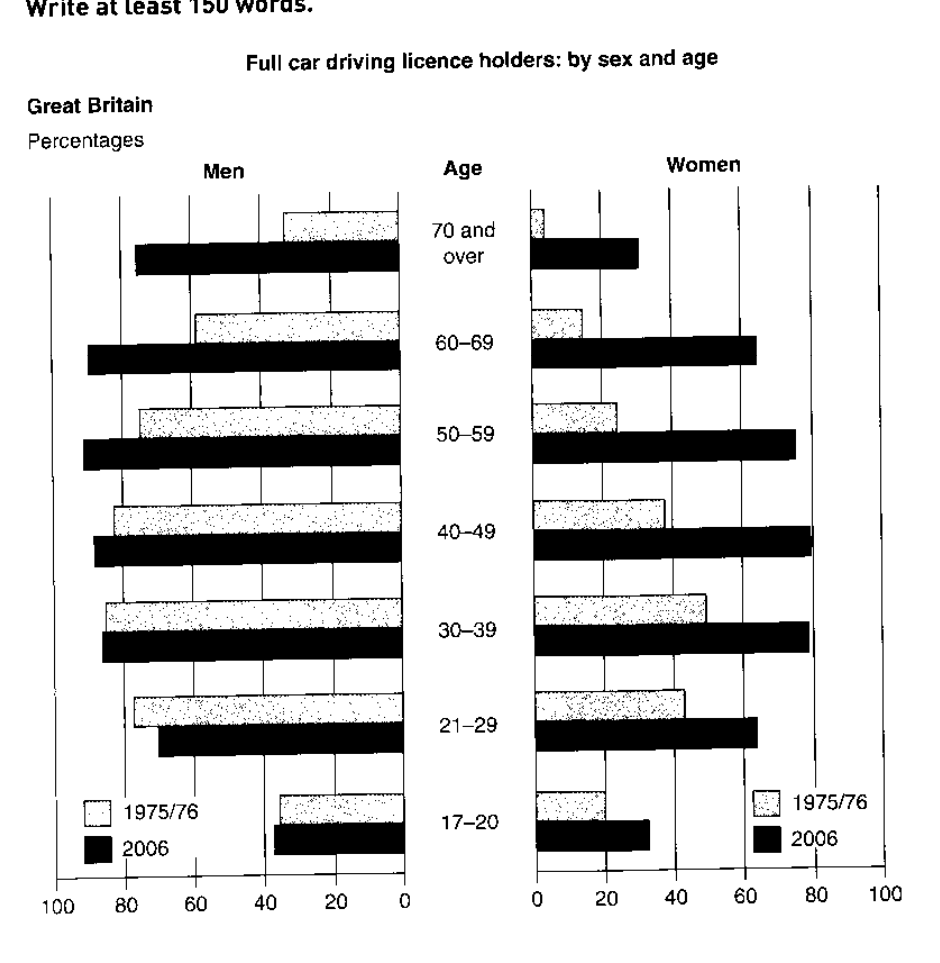
The graphs below show the percentage of people holding full driving licences in Great Britain by age and sex.
Summarise the information by selecting and reporting the main features, and make comparisons where relevant.
Full car driving licence holders: by sex and age
Student answer (Band 6.0)
The bar chart illustrates the percentage of full car driving licence holders in the United Kingdom.
Overall, the bar graph shows a comparison between the data from 1975/76 and 2006 in terms of gender and age. Almost all age groups in both genders hold higher percentage of driving licences as compared to 1975. In terms of sex, men have superiority in all age groups over women in 1975/76 as well as 2006. From the age point of veiw more drivers lie in the middle age group from 30 to 69 years old.
In the year 1975/76, as compared to female, the number of male having full driving licence is high. In relation to the age factor, men and women both in the age group 30-39 have a higher ratio of licences. Among women first trend is increasing constantly with the increase in age but after 40's there is a constant decline. In men the trend is the same as women.
In the year 2006, data shows that popularity of holding full car driving license has increased to double among all age groups regardless of gender. There is an exception for men of ages 21-29 whose number has decreased as compared to the year 1975/6.However, males are still dominating in overall percentage of car licence holders. Whereas, in terms of age highest number of women license holders stand in age group 40-49 but more men drivers are in age group 50-59.
AI examiner evaluation
| Criterion | Band |
|---|---|
| Task Achievement / Task Response | 6.5 |
| Coherence and Cohesion | 6.5 |
| Lexical Resource | 6.0 |
| Grammatical Range and Accuracy | 5.5 |
| Overall | 6.0 |
Task Achievement / Task Response: Band 6.5
You identify the chart’s main comparisons: licence holding is generally higher in 2006, men exceed women in every age group, and the strongest figures are concentrated among middle-aged adults. You also correctly note the exception for men aged 21–29, whose share fell. These points provide a relevant overview and address the task. However, some details are inaccurate or too broad: the figures did not “increase to double among all age groups,” since men aged 17–20 changed little and men aged 21–29 declined. The claim that both sexes had their highest 1975/76 figures at ages 30–39 is also incorrect; men peaked at 40–49, while women peaked at 30–39. More precise comparisons and selected figures would make the report more fully supported.
Coherence and Cohesion: Band 6.5
The response has a clear overall structure, moving from an introduction and overview to separate discussion of 1975/76 and 2006. This makes the main time comparison easy to follow, and phrases such as “In the year 2006” help signal the shift. The overview also groups information by sex and age. However, some progression is weakened by repeated general statements about male dominance and increases, while the body paragraphs do not consistently organise comparisons around the most informative age groups. Linking words such as “Whereas” are used in a fragment-like way at the end. To strengthen cohesion, group related figures together, use clearer references to the relevant year and age group, and avoid repeating points already made in the overview.
Lexical Resource: Band 6.0
You use a sufficient range of chart-related vocabulary, including “percentage,” “age group,” “increased,” “decline,” and “exception,” so the reader can understand the comparisons. There are also attempts at more formal phrasing, such as “in terms of sex.” However, several choices are unnatural or imprecise: “men have superiority” is less suitable than saying men had higher proportions, and “popularity of holding” does not accurately describe the data. “Number” is also used where the chart reports percentages, and “ratio” is not the right term here. Spelling slips such as “veiw” and inconsistent forms of “licence/license” reduce accuracy. Aim for precise terms such as “proportion” and “share,” and check spelling and collocations.
Grammatical Range and Accuracy: Band 5.5
You attempt a mix of simple and complex sentences, including comparisons and subordinate clauses, as in “There is an exception for men of ages 21-29 whose number has decreased.” Most of the message remains understandable, but some grammatical errors and awkward constructions recur. For example, “the number of male having” needs a plural noun and a suitable verb form, while “Among women first trend is increasing” is missing an article and has an unclear structure. The sentence beginning “Whereas” is incomplete, and punctuation is missing after “1975/6.” There are also inconsistent tense choices when describing chart data. Use complete sentences, check articles and agreement, and keep the past-tense reporting consistent.
See this exact question answered at other band scores. The same prompt compared across bands.
Browse more IELTS Writing model answers or get your own writing scored by the same AI examiner.