Band 5.0 IELTS Writing Task 1 Model Answer
Overall Band Score: 5.0 · IELTS Summit Mastery · 2026-11-15
IELTS Writing Task 1 question
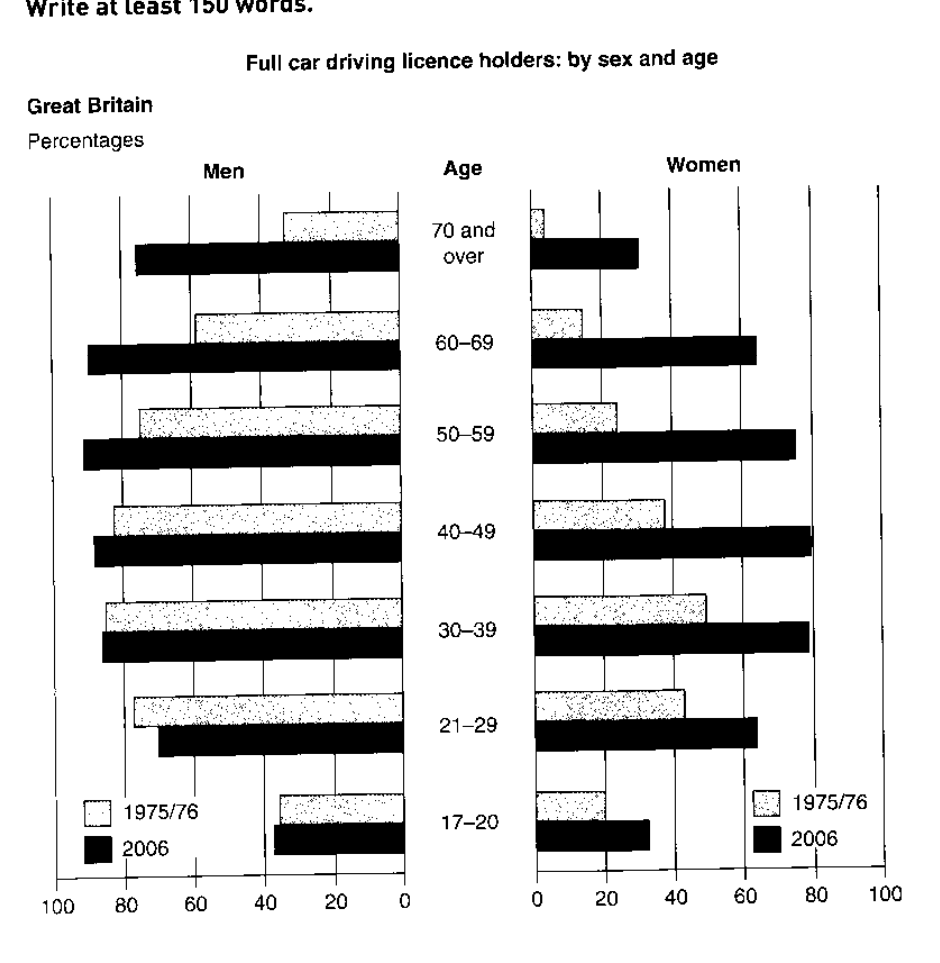
The graphs below show the percentage of people holding full driving licences in Great Britain by age and sex.
Summarise the information by selecting and reporting the main features, and make comparisons where relevant.
Full car driving licence holders: by sex and age
Student answer (Band 5.0)
The bar chart shows a percentage of men and women who can use full driving licences in Great Britain.In 1975 men used lincences at the age of 30-39 were the highest, which was 80%,on the other hand women were used driving lincences only 45%.At the age of 50-59 men also hold this lincences 75%,but at this same age women were the lowest point only 25%.Further,in 2006 men which age were 50-59 they also used lincences was the highest point rather than women.Their using point was 75%.At the age of 40-49 men and women holding this lincences was quite similar, which was 82%,80%.In 2006 at the age of 70 and over men and women has huge differences about holding this lincences, between their comparison shows a point which was men also 75%,and the women were using the car driving licences was only 35%.overall,this ratio prove men were more involved rather than women using driving lincences.
AI examiner evaluation
| Criterion | Band |
|---|---|
| Task Achievement / Task Response | 5.0 |
| Coherence and Cohesion | 4.5 |
| Lexical Resource | 5.0 |
| Grammatical Range and Accuracy | 5.0 |
| Overall | 5.0 |
Task Achievement / Task Response: Band 5.0
You identify the chart’s subject and make relevant comparisons, including the high figures for men aged 50–59 in 2006 and the gap between older men and women. However, the response only partially summarises the main features: it gives no clear overview of the broad rise in licence holding between the two periods, especially among women, and it does not systematically compare the age groups. Some details are inaccurate: women aged 50–59 were not at their lowest in 1975/76 (the figure was about 23%, while the youngest group was about 20%); in 2006, women aged 70 and over were about 29%, not 35%. The claim that men aged 30–39 were highest in 1975/76 also overlooks higher figures for men aged 40–49. Select the main trends and report figures more carefully.
Coherence and Cohesion: Band 4.5
The response follows a broadly chronological pattern, moving from 1975/76 to 2006, and uses linking expressions such as “on the other hand” and “Further.” This gives the reader some sense of how the comparisons relate. However, the information is presented as one continuous paragraph, with no clear overview or grouping of the main trends. Several transitions are awkward or do not clarify the relationship between points, and repeated references to “at the age of” make the progression feel list-like. Organise the response into a brief introduction, an overview, and two comparison paragraphs, grouping related age bands or changes together. Use clear references to the two years and the sexes so that each comparison is easy to follow.
Lexical Resource: Band 5.0
You use relevant topic vocabulary, including “percentage,” “highest,” “differences,” and “holding,” so the general subject is understandable. However, the range is limited and several repeated or inaccurate expressions make the description less precise. “Use full driving licences” and “used licences” are not natural ways to describe the chart; people hold licences. The phrase “using point” is unclear, and “this ratio” does not accurately refer to the figures. There are also spelling errors in “lincences,” repeated throughout. Aim for precise chart language and vary it appropriately, for example, “the proportion of licence holders,” “stood at,” and “the largest gap.” Check spelling carefully and avoid repeating the same wording in each comparison.
Grammatical Range and Accuracy: Band 5.0
You attempt longer sentences and comparisons, for example, “At the age of 40-49 men and women holding this lincences was quite similar,” but complex structures are often faulty and can make the meaning difficult to follow. There are frequent problems with verb forms and agreement: “men used lincences … were the highest,” “women were used,” and “men and women has huge differences.” Articles and sentence boundaries are also inconsistent, as in “shows a percentage” and the run-together opening “Britain.In.” Use a reliable pattern such as “Among men aged 50–59, the figure was…” and ensure the verb agrees with its subject. Shorter, accurately punctuated sentences would help you communicate the comparisons more clearly while you build control of complex forms.
See this exact question answered at other band scores. The same prompt compared across bands.
Browse more IELTS Writing model answers or get your own writing scored by the same AI examiner.