Band 6.5 IELTS Writing Task 1 Model Answer
Overall Band Score: 6.5 · IELTS Summit Mastery · 2026-11-15
IELTS Writing Task 1 question
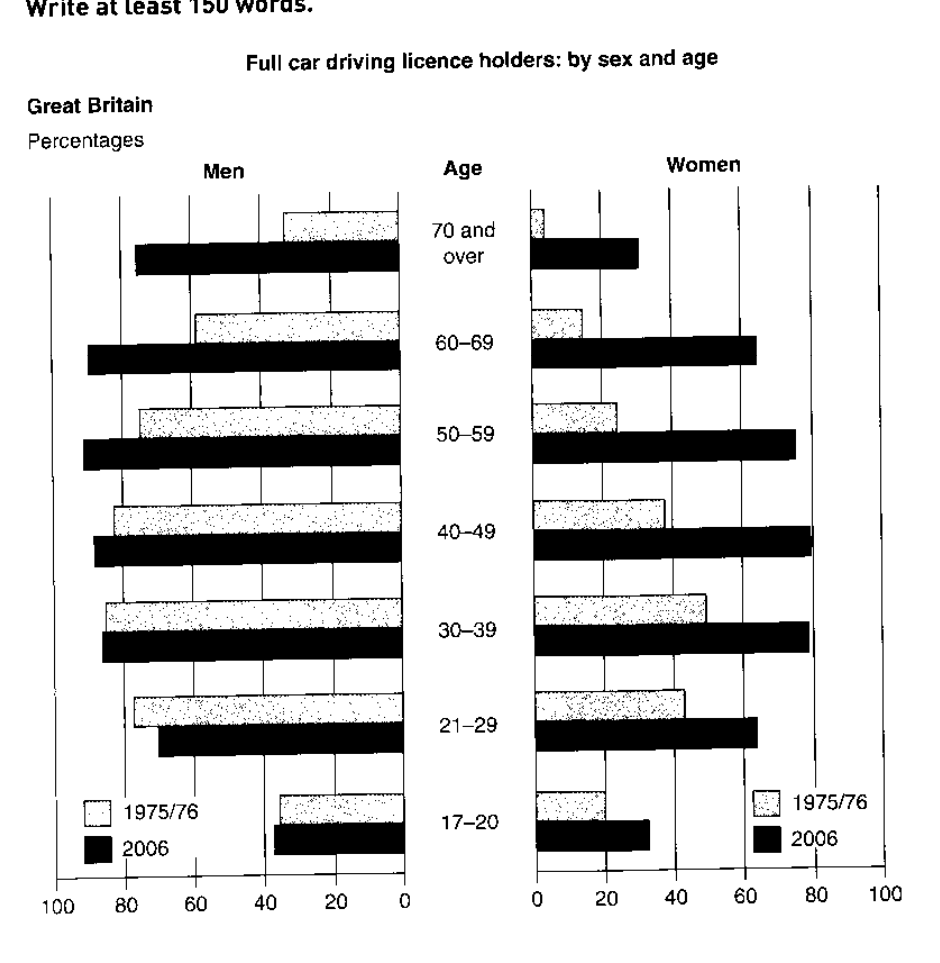
The graphs below show the percentage of people holding full driving licences in Great Britain by age and sex.
Summarise the information by selecting and reporting the main features, and make comparisons where relevant.
Full car driving licence holders: by sex and age
Student answer (Band 6.5)
The graphs illustrate the percentage of men and women in Great Britain, who held a full driving licence in 1975/76 and 2006, by age group.
Overall, men were more likely than women to hold a licence in both years and in every age group. However, the proportion of female licence holders rose sharply in 2006, particularly among older women, while the figure for men relatively stable.
In 1975/76, the percentage of men with a licence was high in most age groups, ranging from around almost 80% for age groups of 21-29 and 50-59 and over 80% of men held full licence in the age gropup of 30-39 and 40-49. In contrast, the figures for women were much lower in those years, just young women in the age groups of 20 to 40 held full licence, with the highest figure of over 40%.
By 2006, the situation had changed considerably. The percentage of male licence holders rose slightly in older age groups, reaching about 90% for men aged 50 to 70. For women, the increase was far more significant. The proportion rose almost 80% for women aged 30-39 and 40-49.
AI examiner evaluation
| Criterion | Band |
|---|---|
| Task Achievement / Task Response | 6.5 |
| Coherence and Cohesion | 7.0 |
| Lexical Resource | 6.5 |
| Grammatical Range and Accuracy | 6.0 |
| Overall | 6.5 |
Task Achievement / Task Response: Band 6.5
You identify the main overall contrast accurately: men had higher licence-holding rates in every age group, while women’s rates rose substantially by 2006, especially among older groups. You also include relevant comparisons, such as women reaching nearly 80% in the 30–39 and 40–49 groups. However, some details are unclear or inaccurate: in 1975/76, women aged 17–20 also held licences (about 20%), so saying “just young women” in the 20–40 groups is misleading. The claim that male figures were “relatively stable” overlooks the large rises among older men, and the 2006 increase among men aged 21–29 is not mentioned. More precise age-group comparisons and a clearer account of the contrasting changes would strengthen the summary.
Coherence and Cohesion: Band 7.0
The response is organised in a clear sequence: an introduction, an overview, a paragraph on 1975/76, and a final paragraph on 2006. Time markers such as “In 1975/76” and “By 2006” help the reader follow the comparisons, and the contrast between men and women is generally easy to track. The progression is logical, though some information is grouped broadly rather than compared systematically across age bands. For example, the final paragraph discusses older men and then women aged 30–49, leaving other groups unaddressed. A more deliberate structure—such as comparing the largest changes by age, or covering both sexes within each period—would make the progression more complete. Cohesive links are effective overall, if somewhat predictable.
Lexical Resource: Band 6.5
You use a suitable range of task vocabulary, including “proportion,” “percentage,” “licence holders,” “rose sharply,” and “increased considerably.” These choices communicate the main trends and show some flexibility beyond basic repetition. However, several phrases are imprecise or awkward: “ranging from around almost 80%” combines two approximations, while “the proportion rose almost 80%” does not clearly distinguish reaching 80% from increasing by 80%. “The figure for men relatively stable” also needs a more natural expression. There are spelling and word-form slips, including “age gropup,” which reduce accuracy. Aim for precise trend language and check collocations and spelling; for example, state that a figure “rose to nearly 80%” when describing its final level.
Grammatical Range and Accuracy: Band 6.0
You use a mix of simple and more complex forms, including the overview contrast introduced by “However” and the comparison beginning “By 2006.” Most sentences remain understandable, but some grammatical errors persist. In “men, who held,” the relative clause is unnecessary and the comma interrupts the sentence; “the figure for men relatively stable” is missing the verb “was.” The long sentence beginning “ranging from around almost 80%” also has an unclear structure, and “over 80% of men held full licence” needs an article before “full licence.” These issues do not generally prevent understanding, but they limit accuracy. Review sentence boundaries, verb completeness, and article use, while retaining the complex comparisons you attempt.
See this exact question answered at other band scores. The same prompt compared across bands.
Browse more IELTS Writing model answers or get your own writing scored by the same AI examiner.