Band 4.5 IELTS Writing Task 1 Model Answer
Overall Band Score: 4.5 · IELTS Summit Mastery · 2026-11-15
IELTS Writing Task 1 question
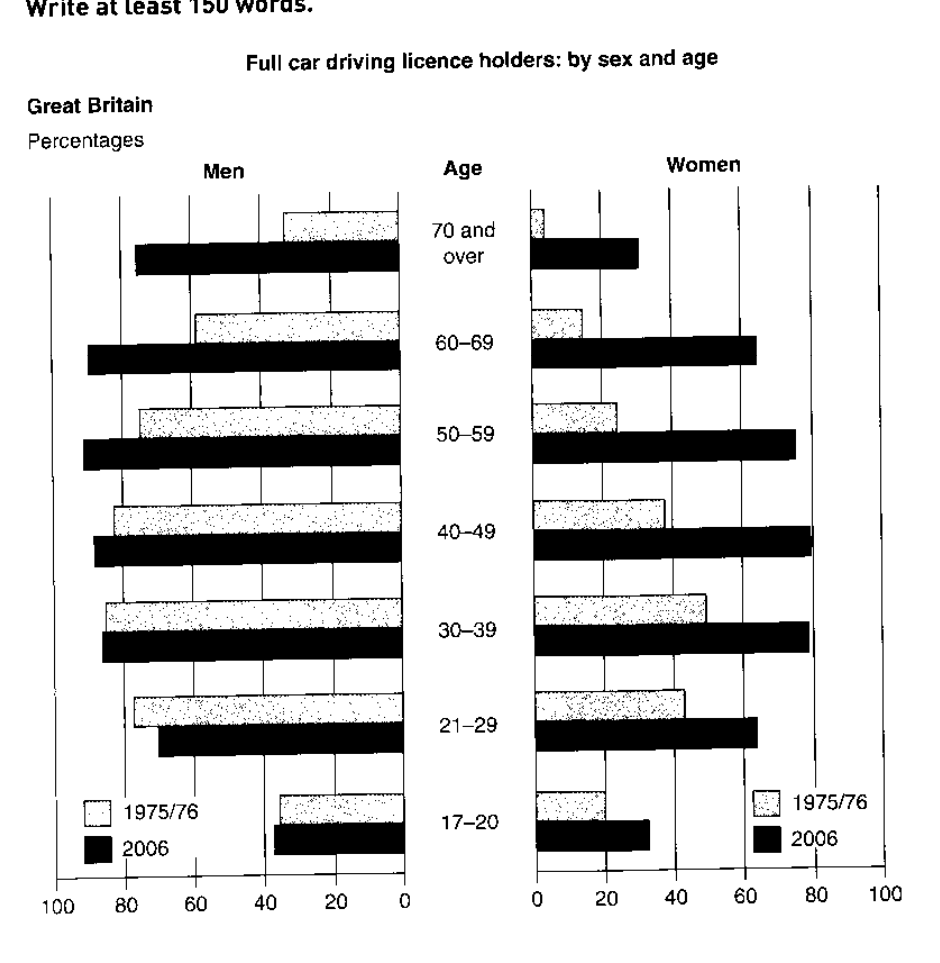
The graphs below show the percentage of people holding full driving licences in Great Britain by age and sex.
Summarise the information by selecting and reporting the main features, and make comparisons where relevant.
Full car driving licence holders: by sex and age
Student answer (Band 4.5)
The graphs below show the percentage of people holding full driving licences in Great Britain by age and sex in to deferent years.
The graphe on the left show us the pecentage and the old of men who get the driving licence in the years 1975/76 and the year 2006 the pecentage of all years near for ages from 17 to 60 then its minmaise for ages older then 65 and few deseper in the ages over 70 .
On the Right we see the graphe of weman how had a driving licence at the same years for men, there is big deference between the year 1975/76 and 2006, the pecentage of woman who holding the driving licence is so small in 1975/76 while its rising in 2006s esspecially for 35 to 59 ages,
AI examiner evaluation
| Criterion | Band |
|---|---|
| Task Achievement / Task Response | 4.0 |
| Coherence and Cohesion | 4.5 |
| Lexical Resource | 5.0 |
| Grammatical Range and Accuracy | 4.5 |
| Overall | 4.5 |
Task Achievement / Task Response: Band 4.0
The response identifies the broad subject and makes a relevant comparison between the two years, especially noting that women’s licence-holding was much lower in 1975/76 and higher by 2006. However, it reports very few accurate, specific features: the claim that men’s figures are similar across ages 17 to 60 overlooks the substantial variation, and the description of women focuses vaguely on ages “35 to 59” rather than the chart’s age groups. There is no clear overview of the main patterns, such as the rise among older women or the high male rates in most middle-age groups. The response is also 115 words, below the required 150, so the task is only minimally addressed. Add a concise overview and several accurate comparisons.
Coherence and Cohesion: Band 4.5
There is a basic attempt to organise the response by discussing men first and women second, and phrases such as “On the Right” signal a shift in focus. However, the ideas do not develop in a clear sequence: the first description combines several age groups and trends in one long, difficult-to-follow sentence, while the second ends without a complete comparison or conclusion. Linking is limited, and references such as “the same years for men” are unclear because the sentence is about women. Use separate paragraphs for an overview and the detailed comparisons, and connect points explicitly—for example, contrast the changes for men and women by age group. This would give the information a more coherent progression.
Lexical Resource: Band 5.0
The response uses some relevant chart vocabulary, including “percentage,” “ages,” “driving licence,” and “deference” (intended as a comparison), so the topic is generally recognisable. However, the range is limited and several spelling and word-choice errors make parts difficult to understand, including “graphe,” “pecentage,” “minmaise,” and “deseper.” Phrases such as “the old of men” and “woman who holding the driving licence” are not natural ways to describe the data. Aim for precise terms such as “proportion,” “licence holders,” “increased,” and “declined,” and check spelling carefully. More accurate vocabulary for describing age groups and changes would help communicate comparisons clearly.
Grammatical Range and Accuracy: Band 4.5
The response attempts longer sentences, but control is weak and errors frequently obscure relationships between ideas. For example, “The graphe on the left show us the pecentage and the old of men” has problems with subject–verb agreement and sentence construction, while “the pecentage of woman who holding the driving licence” lacks a correctly formed relative clause and verb. The opening phrase “in to deferent years” also shows difficulty with prepositions and sentence form. Most of the response consists of long, loosely connected clauses, with little evidence of controlled complex structures or accurate punctuation. Build shorter sentences first, checking agreement and verb forms, then use clear comparisons such as “The proportion rose, whereas…” to extend them accurately.
See this exact question answered at other band scores. The same prompt compared across bands.
Browse more IELTS Writing model answers or get your own writing scored by the same AI examiner.