Band 5.0 IELTS Writing Task 1 Model Answer
Overall Band Score: 5.0 · IELTS Summit Mastery · 2026-11-16
IELTS Writing Task 1 question
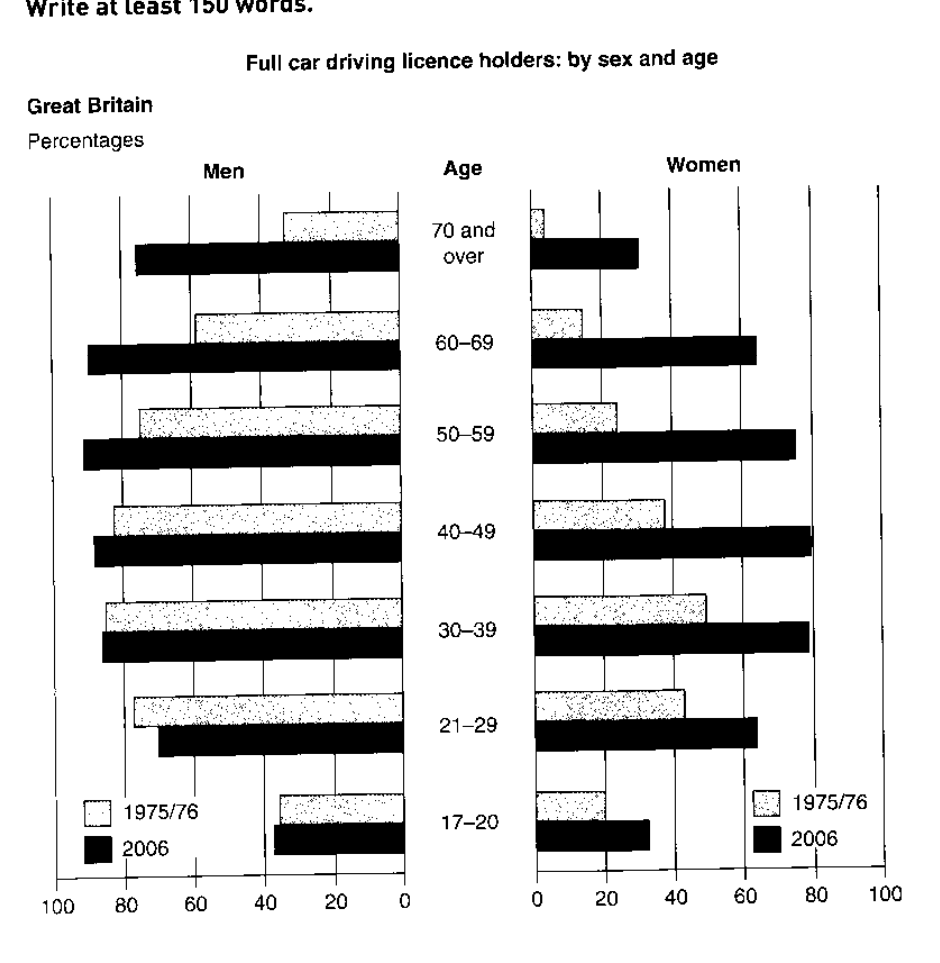
The graphs below show the percentage of people holding full driving licences in Great Britain by age and sex.
Summarise the information by selecting and reporting the main features, and make comparisons where relevant.
Full car driving licence holders: by sex and age
Student answer (Band 5.0)
the given pictorial graph show the percentage of people holding full driving licences in the Great Britain by age and sex over the period of 1976 to 2006.
overall, it evident that the mens of age 50-59 had the most dominating percentage. while the women over 70s had the lowest percentage among other.
at first , the mens in the year 1976 had the proportion over 30% which had the full driving licences in the age of over 70. however the womens were hardly had the licences and accounted for the 5% in age over 70 but the the year the figures were completely changed and showed the growth of 76% in mens and 25% in womens which were holding the full driving licence. in addition the mens in the group of 60-69 and 50-59 had accounted for the 59%,90%,19%65%,77%85%,22%,77% in the years of 1976 to 2006 respectively.
subsequentely, the other age groups had some osculation in the after groups of ages within years 1976 to 2006.
AI examiner evaluation
| Criterion | Band |
|---|---|
| Task Achievement / Task Response | 4.5 |
| Coherence and Cohesion | 4.5 |
| Lexical Resource | 5.0 |
| Grammatical Range and Accuracy | 5.0 |
| Overall | 5.0 |
Task Achievement / Task Response: Band 4.5
You identify the chart’s subject and make an attempt at an overview by noting high licence ownership among men and low ownership among older women. However, the overview is not sufficiently accurate or representative: men aged 50–59 were not the highest group in 2006, as the 60–69 group was slightly lower only? In fact, the peak was 50–59 at about 92%, while the 60–69 group was about 91%, so this comparison is broadly supported. The main limitation is that most age groups and the contrast between the two years are not clearly summarised. The figures in the sentence beginning “the mens in the group of 60-69” are jumbled and difficult to match to categories, and the final paragraph gives no usable trend. Select a few clear comparisons and report them accurately and explicitly.
Coherence and Cohesion: Band 4.5
There is a basic paragraph structure: an introduction, an overview, and two body paragraphs. Sequencing phrases such as “overall,” “at first,” and “in addition” show an attempt to guide the reader. However, progression is weak because the body does not organise the data consistently by age group, sex, or year. The long sequence of percentages in “59%,90%,19%65%,77%85%,22%,77%” is especially difficult to follow, and “the other age groups” in the final paragraph has no clear reference. Some linking expressions are also used mechanically rather than to show a precise relationship. Group the comparisons logically and use clear references, for example, comparing men and women within selected age bands before describing changes over time.
Lexical Resource: Band 5.0
You use some task-related vocabulary, including “percentage,” “proportion,” “accounted for,” and “growth,” so the topic is generally recognisable. However, the range is limited and several choices are inaccurate or unnatural, which sometimes makes the intended meaning unclear. “The mens … had the most dominating percentage” is an awkward way to describe a high figure, while “the figures were completely changed” overstates the pattern. “Osculation” does not fit the context and appears to be an incorrect word choice. There are also spelling and word-form problems, such as “subsequentely” and “womens.” Aim for precise chart language and use straightforward terms such as “share,” “rose,” “increased,” and “was highest.”
Grammatical Range and Accuracy: Band 5.0
You attempt both simple and more complex sentences, including a contrast introduced by “however” and a clause beginning “which had the full driving licences.” Nevertheless, grammatical errors occur frequently and can make relationships between ideas difficult to understand. Examples include “overall, it evident,” “the mens … had,” and “the womens were hardly had,” which show problems with verb forms and sentence construction. Articles and prepositions are also often missing or misplaced, as in “in the Great Britain” and “in age over 70.” Punctuation and capitalisation are inconsistent, and the sentence containing several figures lacks clear grammatical structure. Build accuracy with shorter comparison sentences first, then combine them using correctly formed clauses and consistent past-tense reporting.
See this exact question answered at other band scores. The same prompt compared across bands.
Browse more IELTS Writing model answers or get your own writing scored by the same AI examiner.