Band 5.0 IELTS Writing Task 1 Model Answer
Overall Band Score: 5.0 · IELTS Summit Mastery · 2026-11-16
IELTS Writing Task 1 question
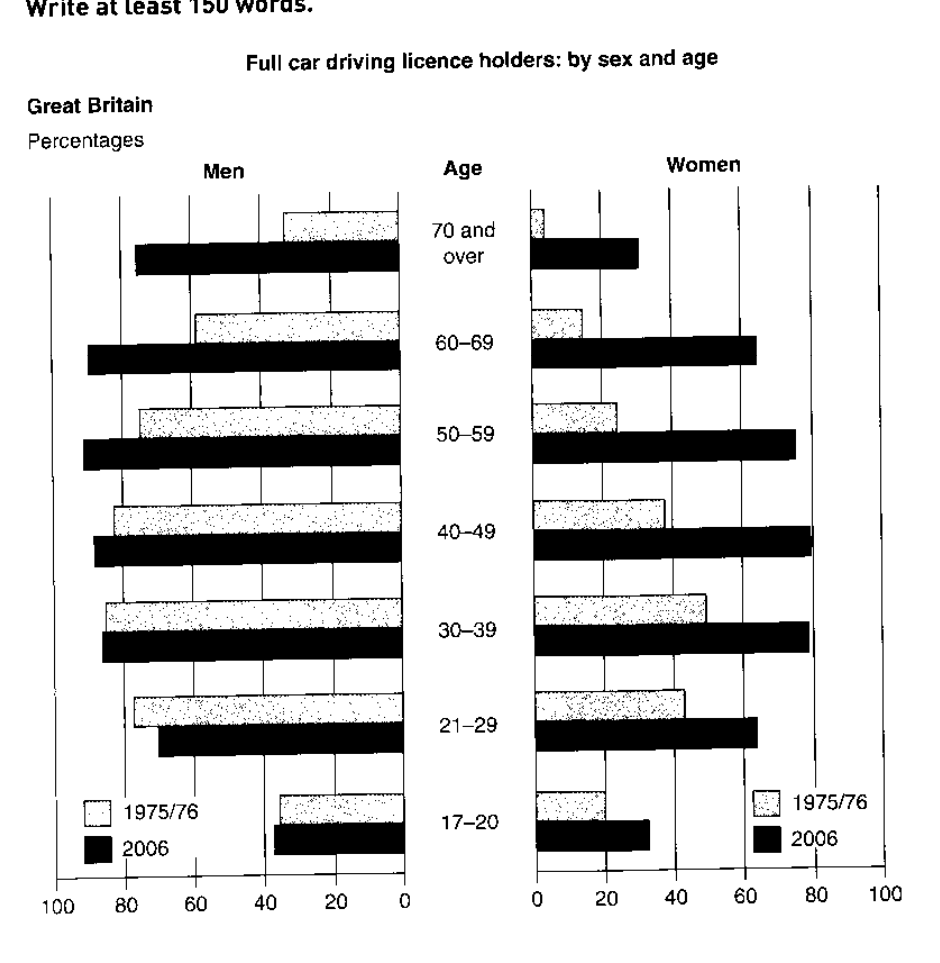
The graphs below show the percentage of people holding full driving licences in Great Britain by age and sex.
Summarise the information by selecting and reporting the main features, and make comparisons where relevant.
Full car driving licence holders: by sex and age
Student answer (Band 5.0)
Driving license is the necessary and needed thing for the people running vehicle on the road. As in driving license test, tou have to go through all the signs, reverse and forward the vehicle, parking and use of mirrors, lights etc. So it is demanded in each and every country according to their rules.
According to data of people having license in britian in the year 1975, Men have valid licenses more than the woman as the man are more attracted to drive. But in 2006, the attraction of woman towards vehicle is increasing but less than the men. Mens are holding the license more than the woman in every era. In the graphs, age is also discussed. People are showing more interest in getting the license in middle-age (30-60).
So the main aim of this graph is to show the interest of people by age and sex in holding the license as the license is the important document in running the vehicle on the roads and to avoid accidents.
AI examiner evaluation
| Criterion | Band |
|---|---|
| Task Achievement / Task Response | 4.5 |
| Coherence and Cohesion | 4.5 |
| Lexical Resource | 5.0 |
| Grammatical Range and Accuracy | 5.0 |
| Overall | 5.0 |
Task Achievement / Task Response: Band 4.5
You identify the chart’s broad subject and make two relevant observations: men had higher licence-holding rates than women in both years, and the figures for many middle-aged groups were high. However, the response only partially reports the visual information. It gives no specific percentages and does not clearly compare how the figures changed between 1975/76 and 2006. For example, women’s rates rose substantially across most age groups, while the change among younger men was small; these are important features that are missing. The opening and closing comments about driving tests, road rules and accident prevention are not shown by the chart, so they take space away from reporting its data. Focus on an overview and accurate age- and year-based comparisons.
Coherence and Cohesion: Band 4.5
The response has a basic sequence, moving from a general introduction to comments about sex and age, then a concluding statement. This gives the reader some sense of organisation, and phrases such as “According to data” and “But in 2006” signal a change in focus. However, the progression is not consistently clear because the opening discussion of driving tests and the final claim about avoiding accidents are unrelated to the chart. The main comparisons are also compressed into a single paragraph, with no clear separation between an overview and supporting details. Organise the response into a brief introduction, an overview of the main patterns, and focused comparisons by age group or year; use linking phrases to show how the figures relate.
Lexical Resource: Band 5.0
You use some relevant topic vocabulary, including “valid licenses,” “age,” “middle-age,” and “holding the license,” so the subject is generally understandable. However, the range is limited and several expressions are repetitive or imprecise, such as “interest” and “attraction” to describe licence ownership. Some word choices and collocations are awkward, including “the necessary and needed thing” and “running vehicle.” Spelling and form errors such as “britian,” “tou,” and “Mens” also reduce accuracy. For this chart, use precise reporting language such as “licence holders,” “the proportion of,” “increased,” and “remained higher.” This would make the comparisons clearer and more appropriate to an academic data summary.
Grammatical Range and Accuracy: Band 5.0
You attempt both simple and longer sentences, and the reader can usually understand the general message. However, control is inconsistent, particularly in agreement, articles, and sentence construction. For example, “Men have valid licenses more than the woman” has an unclear comparison and mismatched singular/plural forms, while “the man are more attracted” has subject–verb disagreement. The opening sentence, “Driving license is the necessary and needed thing,” also lacks a natural article structure. Several sentences join multiple ideas without clear grammatical relationships, which makes the response harder to follow. Practise accurate comparative structures, such as “the proportion of men was higher than that of women,” and check subject–verb agreement and articles when editing.
See this exact question answered at other band scores. The same prompt compared across bands.
Browse more IELTS Writing model answers or get your own writing scored by the same AI examiner.