Band 6.0 IELTS Writing Task 1 Model Answer
Overall Band Score: 6.0 · IELTS Summit Mastery · 2026-11-18
IELTS Writing Task 1 question
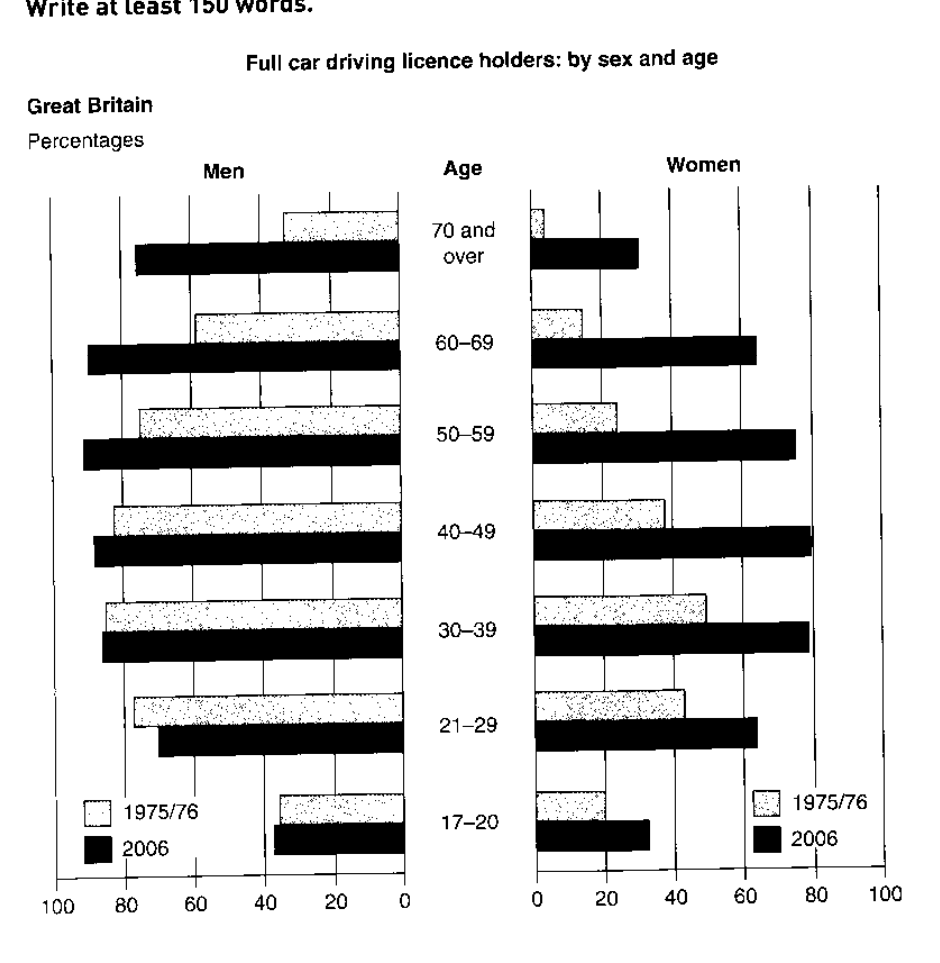
The graphs below show the percentage of people holding full driving licences in Great Britain by age and sex.
Summarise the information by selecting and reporting the main features, and make comparisons where relevant.
Full car driving licence holders: by sex and age
Student answer (Band 6.0)
The graph illustrates the percentage of people holding full driving licenses in Great Britain by their age and sex. The graph shows that the women license holders have increased over the years while the percentage of men holding the driving license hasn’t changed much.
In 1975, the male population holding the driving license was significantly more than the women in their early age. The percentage increased with the age. In their middle age, 82% men had their full driving license while 39% women had their full driving license, which was comparatively lower than men. In old age, there were more male drivers than women.
In 2006 as the society progressed, the percentage of women holding the driving license increased. Although in the young age, there were only 25% of women who had their full driving license but the percentage increased with age and the most number of female drivers are between age 40-49, about 80%.
Though, the percentage declined to 25% in the old age. On the other hand, male population holding the driver license increased with their age as men tend to drive more.
According to the graph, it is clear that the male population holding the driving license hasn’t been changed much over the years while the female population holding the driving license has increased.
AI examiner evaluation
| Criterion | Band |
|---|---|
| Task Achievement / Task Response | 6.0 |
| Coherence and Cohesion | 6.0 |
| Lexical Resource | 5.5 |
| Grammatical Range and Accuracy | 5.5 |
| Overall | 6.0 |
Task Achievement / Task Response: Band 6.0
You identify the broad contrast that women’s licence-holding rose substantially, and you include relevant comparisons between the sexes and age groups. However, the overview is not fully accurate: men’s figures did not simply “haven’t changed much”; they rose markedly among older groups, for example from about 35% to 77% for men aged 70 and over and from 60% to 91% among those aged 60–69. Some details are also misreported: women aged 17–20 in 2006 were about 33%, not 25%, and the oldest women’s figure was about 29%. The claim that male percentages increased with age is too broad, since the 2006 figures peak around ages 50–59 and are lower for younger adults. Select key trends more precisely and support the overview with accurate comparisons.
Coherence and Cohesion: Band 6.0
The response has a clear overall shape: an introduction and overview are followed by discussion of 1975/76 and 2006, then a concluding statement. This makes the main comparison easy to follow. However, the organisation is somewhat mechanical, with repeated references to “the percentage” and “holding the driving license,” and the final paragraph largely repeats the opening overview rather than adding a useful synthesis. Some links between ideas are also unclear: “Though, the percentage declined” does not specify the age group, and “On the other hand” introduces a contrast without clearly connecting the male trend to the preceding female figures. Grouping the data by age pattern or by sex, and using clearer references, would improve progression.
Lexical Resource: Band 5.5
You use enough topic vocabulary to communicate the main subject, including “percentage,” “middle age,” “old age,” and “increased.” There are also attempts at more formal phrasing, such as “comparatively lower.” However, the vocabulary is repetitive and some choices are imprecise or unnatural, including “male population holding the driver license” and “the most number of female drivers.” “License holders” or “people with a full driving licence” would be more natural, while “the highest proportion” is more precise than “the most number.” The repeated phrase “holding the driving license” also limits flexibility. Aim for accurate collocations and vary the language used to describe rises, falls, peaks, and comparisons.
Grammatical Range and Accuracy: Band 5.5
You use a mixture of simple sentences and some longer structures, including the contrast beginning “Although in the young age…” and the clause “as men tend to drive more.” Most of the meaning remains understandable, but some grammatical errors and awkward constructions reduce accuracy. For example, “the percentage of men … hasn’t changed much” uses a singular subject with an unclear time reference, and “the most number of female drivers are” has faulty agreement and sentence construction. “Though, the percentage declined” is also an incomplete or poorly punctuated transition. Use past-tense forms consistently when describing the two years, check subject–verb agreement, and build comparisons in complete, clearly structured sentences.
See this exact question answered at other band scores. The same prompt compared across bands.
Browse more IELTS Writing model answers or get your own writing scored by the same AI examiner.