Band 5.5 IELTS Writing Task 1 Model Answer
Overall Band Score: 5.5 · IELTS Summit Mastery · 2026-11-18
IELTS Writing Task 1 question
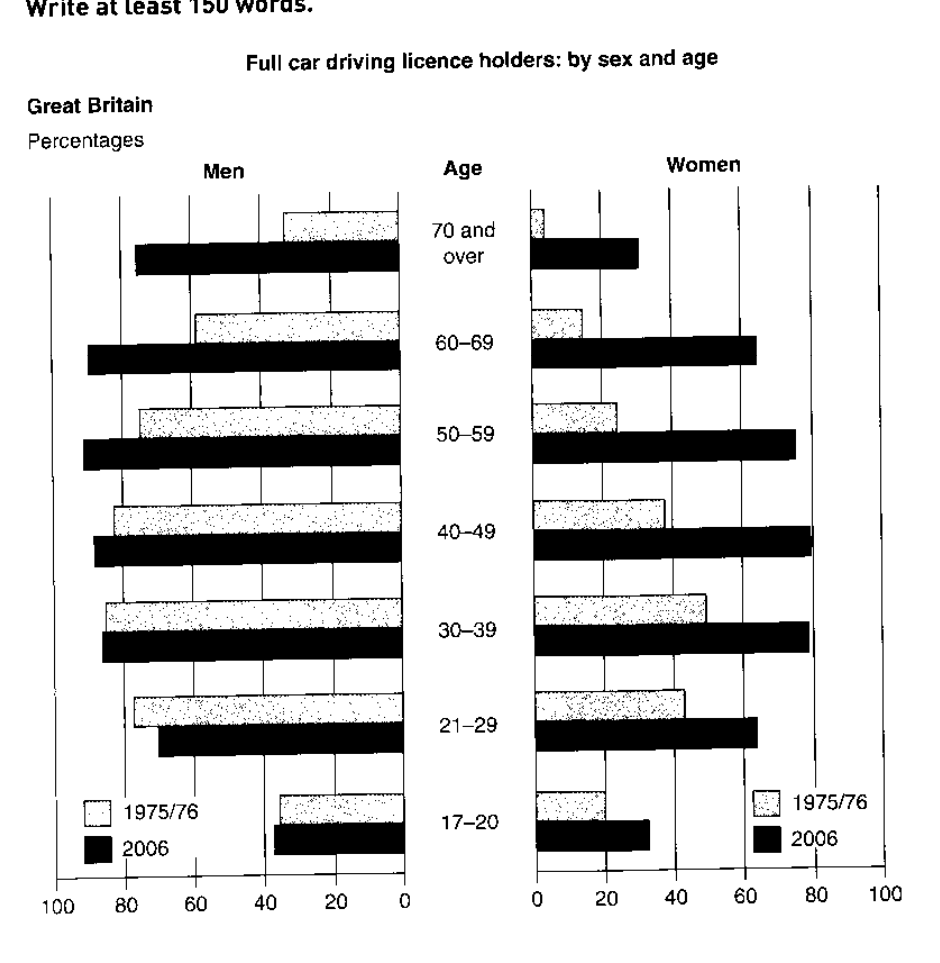
The graphs below show the percentage of people holding full driving licences in Great Britain by age and sex.
Summarise the information by selecting and reporting the main features, and make comparisons where relevant.
Full car driving licence holders: by sex and age
Student answer (Band 5.5)
The provided bar graphs illustrate the percentage of people holding full driving licences in great Britain, it is measured by age and sex.
Overall, it is clear that the percentage of licence holders are male compared with the female and middle-age people are highly dominated.
In 1975/76, the percentage of licence maleand female holders were over 35% and at 20% while male ratio was closely followed by 2006, convesely, the proportion of femaile holders increased remarkably. However, 21-29 year adults male experienced upward trend from over 70% and 50-59 year olders reached at the top approximately 90% in 2006.On the other hand, adults women recorded also upward trend from over 60% to under 80% who were 40-49 year olders. Noticeably, the percentage female holders showed downward trend who were over 50 year old in both 1975/76 and 2006 years.
In contrast, male proportion also declined in both years who were over 60-69, even though average proportion was higher more than female holders while female percentage was less than 10%, male recorded over 30% in 1975/76.
AI examiner evaluation
| Criterion | Band |
|---|---|
| Task Achievement / Task Response | 5.5 |
| Coherence and Cohesion | 5.0 |
| Lexical Resource | 5.5 |
| Grammatical Range and Accuracy | 5.0 |
| Overall | 5.5 |
Task Achievement / Task Response: Band 5.5
You identify the broad comparison between men and women and note that women’s licence-holding increased substantially by 2006. However, the overview is unclear: “middle-age people are highly dominated” does not specify the main age pattern, and the claim that male and female figures were “over 35% and at 20%” is too vague to establish a meaningful comparison. Some details are inaccurate or confusing. For example, men aged 21–29 fell from about 78% to 70%, rather than experiencing an upward trend, and the statement that men’s proportions “declined in both years” among those over 60–69 does not describe the change between years. To strengthen the report, give a clear overview of the major changes and compare the age groups accurately, using selected figures.
Coherence and Cohesion: Band 5.0
The response has a basic paragraph structure, moving from an introduction and overview to details, and it attempts to signal contrasts with “Overall,” “However,” and “On the other hand.” Nevertheless, the progression is difficult to follow because several comparisons are compressed into long, unclear sentences. For instance, “the percentage of licence maleand female holders were over 35% and at 20% while male ratio was closely followed by 2006” does not make the relationship between the years and sexes clear. The final paragraph also introduces a contrast without clearly connecting it to the preceding age comparisons. Organise the body by a consistent principle—such as changes over time, then differences by sex—and make each sentence express one comparison. Clearer referencing would also help readers identify which age group each figure concerns.
Lexical Resource: Band 5.5
You use some task-relevant vocabulary, including “percentage,” “proportion,” “holders,” and “upward trend,” and you attempt to vary wording rather than repeat one term throughout. However, the range and control are uneven, and several word choices or forms make the data hard to interpret. Examples include “maleand female,” “femaile holders,” “male ratio,” “middle-age people are highly dominated,” and “year olders.” Phrases such as “recorded also upward trend” and “reached at the top” are not natural ways to describe chart movements. Use precise terms such as “licence-holding rate,” “rose,” “fell,” and “was highest among,” and check spelling and word forms. More accurate collocations would make your comparisons clearer without requiring more elaborate vocabulary.
Grammatical Range and Accuracy: Band 5.0
You attempt both simple and more complex sentences, including clauses introduced by “while,” “even though,” and “who,” but control is inconsistent. Errors in agreement and sentence construction appear in “the percentage of licence holders are male” and “the percentage of licence maleand female holders were.” Some clauses are difficult to parse, particularly “adults women recorded also upward trend from over 60% to under 80% who were 40-49 year olders.” Punctuation and spacing also affect readability, as in “2006.On the other hand,” and the extra space after “Noticeably,”. These problems sometimes obscure the intended comparison. Build shorter, complete sentences first, then add subordinate clauses only when their relationship is clear; check subject–verb agreement, articles, and punctuation during revision.
See this exact question answered at other band scores. The same prompt compared across bands.
Browse more IELTS Writing model answers or get your own writing scored by the same AI examiner.