Band 5.5 IELTS Writing Task 1 Model Answer
Overall Band Score: 5.5 · IELTS Summit Mastery · 2026-11-20
IELTS Writing Task 1 question
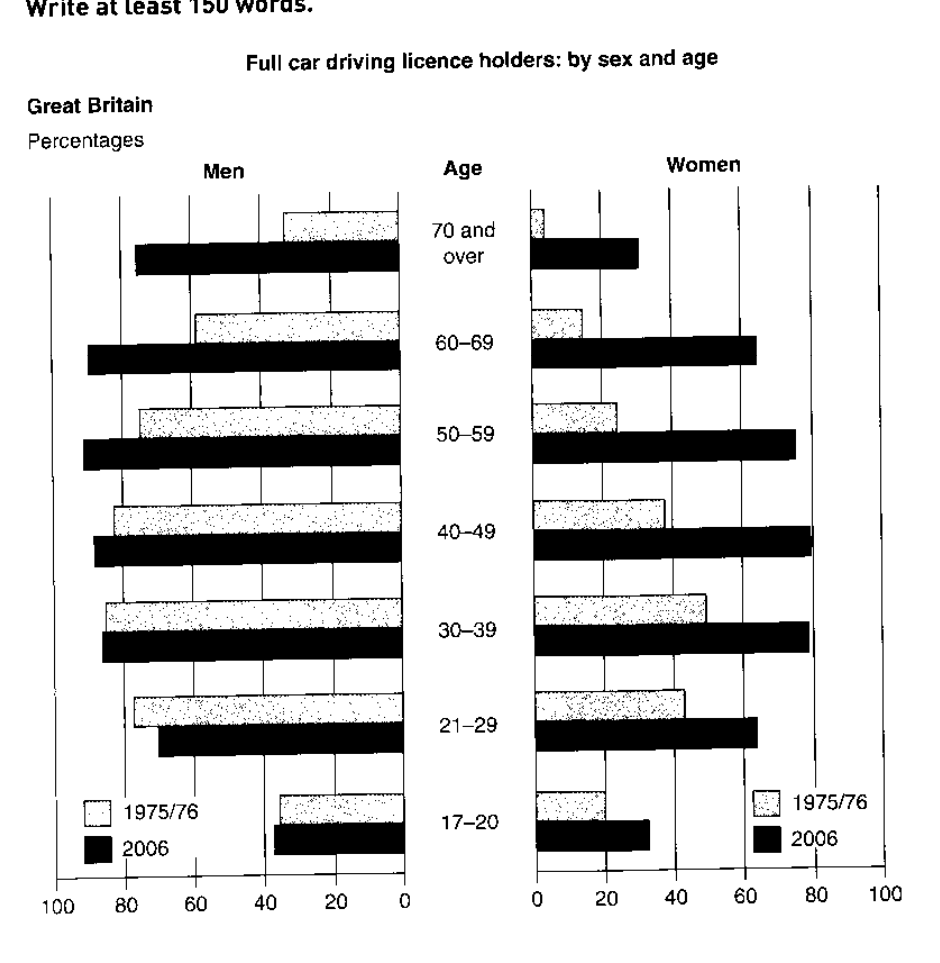
The graphs below show the percentage of people holding full driving licences in Great Britain by age and sex.
Summarise the information by selecting and reporting the main features, and make comparisons where relevant.
Full car driving licence holders: by sex and age
Student answer (Band 5.5)
The bar charts presesnt information on the proportions of males and females of various age groups who hold full driving licences in 1975/76 and 2006.
Overall, there was an increase in the percentage of car driving licence holders in 2006 for both genders. While middle-aged people were more inclined towards having driving licence, younger and older ones acquired lowest figures, and the figures for men were significantly higher than that of women.
In 2006, only more than 35% of women of age 17-20 were showed to hae driving licence, higher than in 1975/76 (20%). The percentage for women experienced a substantial increase over the age groups before declining again for older people, reaching its highest point for those aged 40-49 with 80%.
AI examiner evaluation
| Criterion | Band |
|---|---|
| Task Achievement / Task Response | 5.0 |
| Coherence and Cohesion | 5.5 |
| Lexical Resource | 6.0 |
| Grammatical Range and Accuracy | 5.5 |
| Overall | 5.5 |
Task Achievement / Task Response: Band 5.0
You identify the chart’s subject and give a relevant overview: licence ownership rose overall, men generally had higher rates, and younger and older groups tended to be lower. You also report a useful detail about women, including the rise to around 80% among 40–49-year-olds. However, the response addresses the data only partially: it gives almost no account of the men’s figures or the 1975/76 pattern, and the claim that middle-aged people were most likely to hold licences is not consistently true across both sexes and years. The comparison for women aged 17–20 is also unclear. The response is 28 words below the required minimum, leaving important features underdeveloped. Cover both sexes and both years with a few accurate comparisons.
Coherence and Cohesion: Band 5.5
The response has a recognisable structure: an introduction, an overview, and a paragraph describing women’s results. The overview helps orient the reader, and phrases such as “Overall” and “While” signal relationships between ideas. However, the report ends before it develops a complete account, and there is no clear progression through the main comparisons, particularly for men and the earlier year. Some links are difficult to follow, as in “only more than 35%,” where the intended comparison is not clear. Organise the body by sex or by year, and use each paragraph to compare the two dates and relevant age groups. This would make the progression more complete and the connections between figures clearer.
Lexical Resource: Band 6.0
You use an adequate range of task-related vocabulary, including “proportions,” “substantial increase,” “declining,” and “highest point.” These choices allow you to describe broad trends and comparisons, and the meaning is generally understandable. There are, however, some inaccurate or awkward choices: “inclined towards having driving licence” is not a natural way to describe licence ownership, while “acquired lowest figures” is imprecise. Spelling slips such as “presesnt” and “hae” also reduce accuracy. Aim for precise chart language such as “the proportion holding a licence” and “the lowest percentages,” and check spelling carefully. More accurate collocations would make your descriptions clearer without requiring more elaborate vocabulary.
Grammatical Range and Accuracy: Band 5.5
You attempt a mix of sentence forms, including a complex overview beginning “While middle-aged people…” and a sentence describing a rise followed by a decline. Most of the intended meaning can be understood, but some grammatical errors remain. For example, “were showed to hae” has an incorrect passive construction, and “higher than in 1975/76” lacks a clear grammatical comparison with the percentage. In “the figures for men were significantly higher than that of women,” the comparison is not parallel: use “higher than those for women.” There are also article and number issues in “having driving licence” and “younger and older ones acquired lowest figures.” Review passive forms, articles, and parallel comparisons, while continuing to use complex sentences with careful checking.
See this exact question answered at other band scores. The same prompt compared across bands.
Browse more IELTS Writing model answers or get your own writing scored by the same AI examiner.