Band 6.0 IELTS Writing Task 1 Model Answer
Overall Band Score: 6.0 · IELTS Summit Mastery · 2026-11-20
IELTS Writing Task 1 question
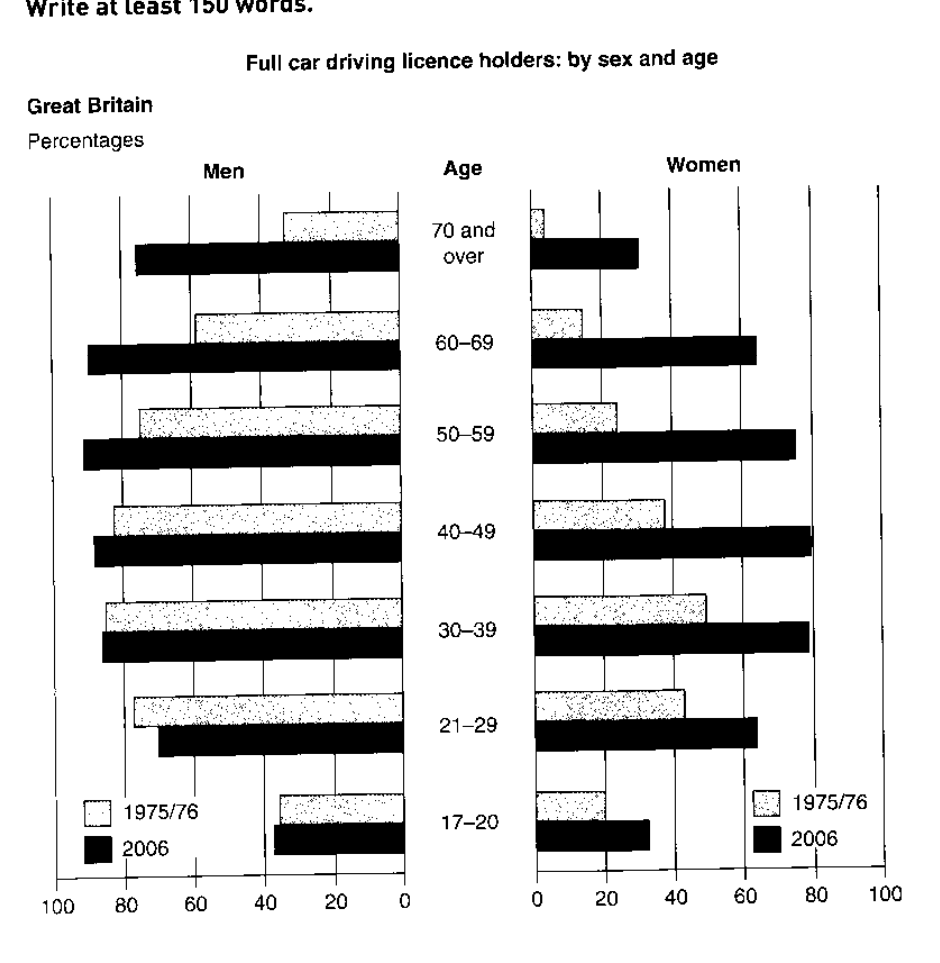
The graphs below show the percentage of people holding full driving licences in Great Britain by age and sex.
Summarise the information by selecting and reporting the main features, and make comparisons where relevant.
Full car driving licence holders: by sex and age
Student answer (Band 6.0)
The bar charts illustrate the proportions of the Britian citizen who had driving licences. The data is arranged according to the sex and age of people at two different times (2006 and 1975/76).
Overall, it is clear that the male of all ages hold more licences as compared to women. It is also noticeable that women in 2006, had more skills to drive cars than in 1975/76.
To begin with younger people, aged between 17-20, they had less knowledge to drive cars in both time periods, such as only 38% male and nearly 33% female have driving licences in 2006. On the other hand, middle aged citizen had good driving skills, where percentages for male ranges nearly 60% to 90%. It is also noticeable that the women of age 21 to 70, had less driving expertise in previous century, while a lot of women learnt to drive and had driving certificates in 2006, and percentage reached close to 80%.
Moving towards elderly people of 70 and over, in year1975/76, only 5% of the women and nearly 32% of the men had driving expertise, while in 2006, percentages increased to 30% in case of the women and 77% for the men.
AI examiner evaluation
| Criterion | Band |
|---|---|
| Task Achievement / Task Response | 6.5 |
| Coherence and Cohesion | 6.5 |
| Lexical Resource | 5.5 |
| Grammatical Range and Accuracy | 5.5 |
| Overall | 6.0 |
Task Achievement / Task Response: Band 6.5
You provide a clear overview that men held a higher share of licences overall and that women’s figures rose by 2006. You also select relevant comparisons, including the sharp increase among women aged 70 and over and the relatively low figures for the youngest group. Most reported figures are close to the chart. However, the claim that 17–20-year-olds had the lowest figures in both periods is not accurate: in 1975/76, men aged 70 and over were slightly lower, and women aged 70 and over were far lower. The discussion of middle-aged men is broad, while the important contrast between the strong rises among older women and the decline among men aged 21–29 is not clearly developed. More precise comparisons would strengthen the overview and coverage.
Coherence and Cohesion: Band 6.5
The response has a recognisable structure: an introduction, an overview, and two body sections that move from younger and middle-aged people to the oldest group. Linking phrases such as “Overall,” “To begin with,” and “Moving towards” help signal this progression. The organisation is coherent, but the grouping is not always effective: the final paragraph repeats the 70-and-over figures after the previous paragraph has already discussed ages up to 70, and the age-group comparisons are not consistently ordered. Some references, such as “they” in the opening of the first body paragraph, are not immediately precise. To make the progression more controlled, group the data by age bands or by changes between years, and avoid repeating figures already covered.
Lexical Resource: Band 5.5
You use a reasonable range of topic-related vocabulary, including “proportions,” “percentages,” “increased,” and “middle aged.” However, several choices are inaccurate or unnatural for describing chart data. “Britian citizen” is both misspelled and an awkward expression, while “had more skills to drive cars” and “driving expertise” describe ability rather than licence ownership. “Driving certificates” is also not the right term for the chart. These choices sometimes make the intended comparison less precise, even though the general meaning remains understandable. Aim for consistent, accurate terms such as “licence holders,” “the proportion of women,” and “rose to,” and check spelling and collocations before finishing.
Grammatical Range and Accuracy: Band 5.5
You attempt a mix of simple and more complex sentences, including clauses introduced by “while” and “where,” and the overall meaning is generally clear. However, errors in agreement, articles, tense, and sentence construction remain noticeable. For example, “the male of all ages hold” has a subject–verb agreement problem, and “percentages for male ranges” also mismatches the plural subject and verb. In “only 38% male and nearly 33% female have,” the noun phrases and verb form need clearer construction. Commas are also misplaced in phrases such as “women in 2006, had.” Practise accurate plural forms and past-tense reporting, and use shorter, well-controlled sentences when comparing figures.
See this exact question answered at other band scores. The same prompt compared across bands.
Browse more IELTS Writing model answers or get your own writing scored by the same AI examiner.