Band 4.0 IELTS Writing Task 1 Model Answer
Overall Band Score: 4.0 · IELTS Summit Mastery · 2026-11-20
IELTS Writing Task 1 question
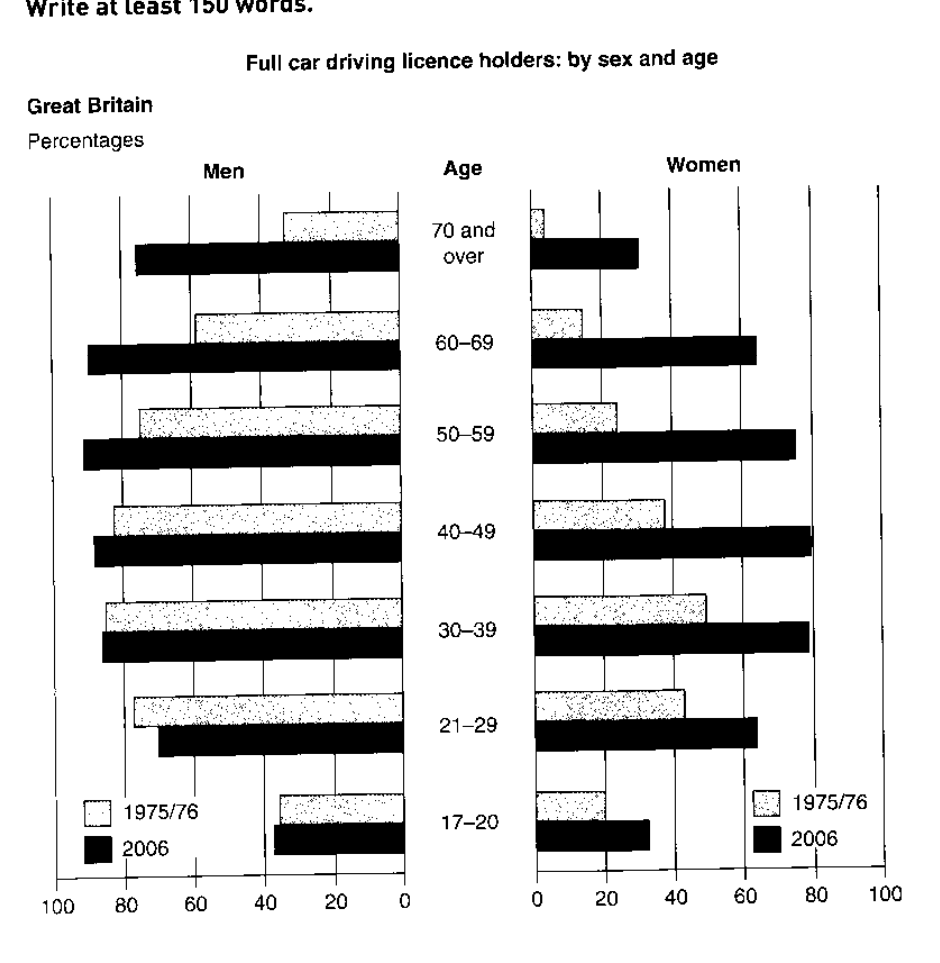
The graphs below show the percentage of people holding full driving licences in Great Britain by age and sex.
Summarise the information by selecting and reporting the main features, and make comparisons where relevant.
Full car driving licence holders: by sex and age
Student answer (Band 4.0)
The graph shows the proportion of people holding full driving liscences in Great Britain by age and sex, between men and women.
The number of men holding full driving lisences has rose from 20% in 1975 but women has minimal rise in 1975 at age of 17 to 20.but at the age of 20 to 29 in 1975 there is gradual increase of men and minmal increase in women side.Also in 2006
AI examiner evaluation
| Criterion | Band |
|---|---|
| Task Achievement / Task Response | 3.0 |
| Coherence and Cohesion | 3.0 |
| Lexical Resource | 5.0 |
| Grammatical Range and Accuracy | 4.5 |
| Overall | 4.0 |
Task Achievement / Task Response: Band 3.0
The response identifies the chart’s general subject and attempts to compare men and women across age groups, but it does not provide a clear overview or accurately report the main patterns. For example, the claim that men’s licence holding “has rose from 20% in 1975” is not supported by the chart: the youngest male group is about 36% in 1975/76, and the response does not specify the age group for the figure. The discussion of women’s “minimal rise” is also too vague to show the substantial increases across most age groups by 2006. The response ends mid-thought at “Also in 2006,” leaving the comparison incomplete. It is also substantially below the required 150 words. To improve, give a concise overview of the main changes, then support it with accurate figures and comparisons for both sexes and years.
Coherence and Cohesion: Band 3.0
There is a basic attempt to organise the response around men, women, age groups and the two years, and phrases such as “but” and “Also” show an effort to connect ideas. However, the information does not progress through a clear structure: there is no developed overview, and the second paragraph-like sentence moves between age groups and sexes without explaining the comparisons. The final phrase, “Also in 2006,” is incomplete, so the reader is left without the intended point or a conclusion. Referencing is also unclear in phrases such as “women side.” Use separate paragraphs for an overview and the key comparisons, and connect each comparison explicitly to its age group and year.
Lexical Resource: Band 5.0
The response uses some relevant chart vocabulary, including “proportion,” “holding full driving licences,” “gradual increase,” and “age,” so the topic is generally recognisable. However, the range is limited and several choices are imprecise or repetitive, such as “minimal rise” and “increase” without specifying what changed or by how much. There are also noticeable spelling errors in “liscences,” “lisences,” and “minmal,” which reduce accuracy. More precise terms would help describe the data, for example “the percentage of licence holders,” “rose substantially,” or “remained relatively low.” Aim to use accurate spelling and vary the language for increases and comparisons while keeping each phrase tied to a specific group.
Grammatical Range and Accuracy: Band 4.5
The response attempts to combine ideas using contrast and time references, but sentence control is inconsistent and the range of structures is limited. In “The number of men … has rose,” the verb form is incorrect; “has risen” or “rose” would be appropriate. The clause “women has minimal rise” has subject–verb agreement and article problems, while “at age of 17 to 20” and “at the age of 20 to 29” show inaccurate grammatical patterns for age ranges. Punctuation and sentence boundaries also need attention: “Also in 2006” is left unfinished. Practise forming complete comparison sentences with accurate past-tense verbs and clear age-group phrases, then check agreement and articles.
See this exact question answered at other band scores. The same prompt compared across bands.
Browse more IELTS Writing model answers or get your own writing scored by the same AI examiner.