Band 5.5 IELTS Writing Task 1 Model Answer
Overall Band Score: 5.5 · IELTS Summit Mastery · 2026-11-20
IELTS Writing Task 1 question
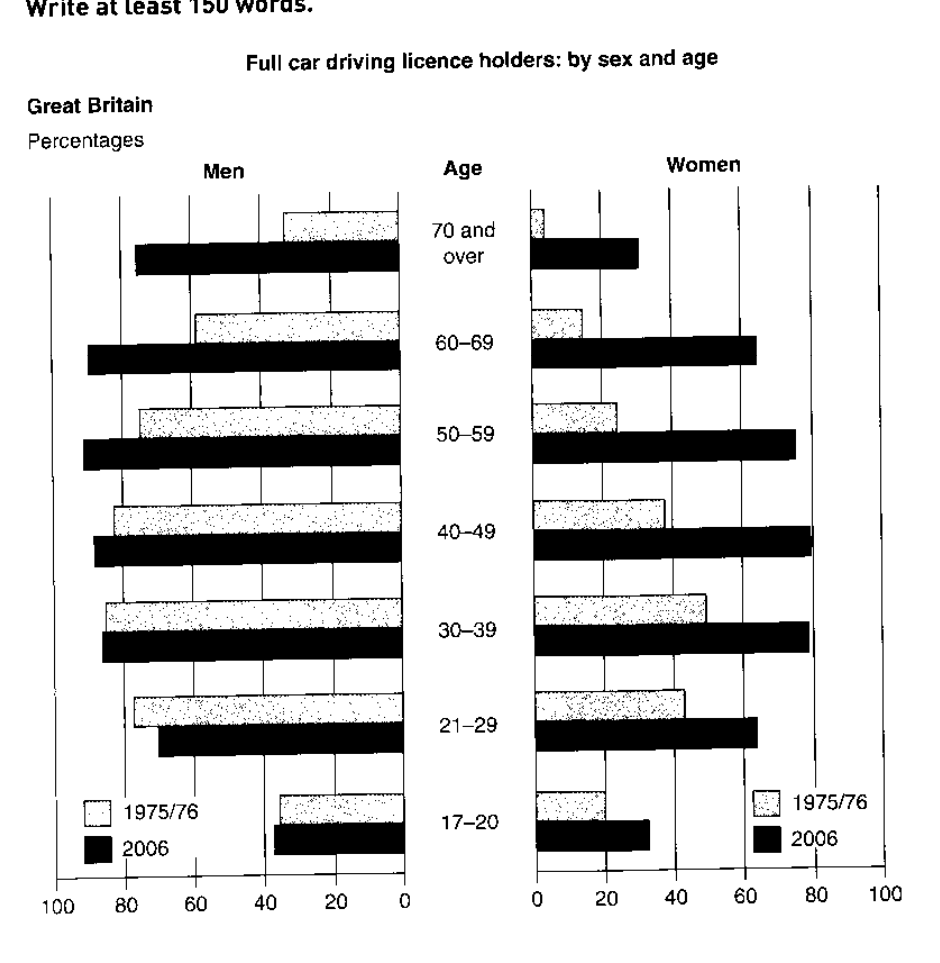
The graphs below show the percentage of people holding full driving licences in Great Britain by age and sex.
Summarise the information by selecting and reporting the main features, and make comparisons where relevant.
Full car driving licence holders: by sex and age
Student answer (Band 5.5)
The graph demonstrates the account of individuals holding driving licences in united kingdom by age 21 to over 70 year old men and women.
Overall view , the percentage of mens are more than the womens holding driving licences, furthermore older men and women in both graphs hold more licences the the youngest men and women.
in the 2006 and 1975 young men hold equal number of licences but the mens over the 70 plus in 2006 hold more licences the the men of 1975 age 70. In 2006 the age of 50 - 59 and 60- 69 men hold equal number of licences.
In second graph the women at the age of 17-20 in 1975 hold less number of licences the women of 2006 age 17-20. Furthermore in 2006 at the age og 30-39 and 40-49 hold equal number of licences but there is difference in the women of 1975 .
AI examiner evaluation
| Criterion | Band |
|---|---|
| Task Achievement / Task Response | 5.5 |
| Coherence and Cohesion | 5.5 |
| Lexical Resource | 5.0 |
| Grammatical Range and Accuracy | 5.0 |
| Overall | 5.5 |
Task Achievement / Task Response: Band 5.5
You identify the broad comparison that men had higher licence-holding percentages than women, and you refer to both years and several age groups. However, the overview is not fully accurate: the claim that older people held more licences than the youngest is too broad, since the 17–20 group often exceeds the 70-and-over group, especially among women. The report also gives few precise comparisons and misses major patterns, such as the substantial rise among women across most ages and the high male figures in 2006. Some statements are unclear or incorrect: men aged 50–59 and 60–69 in 2006 were close, but not equal, and the 21–29 figures fell for men and women between the two dates. Select the main trends and support them with accurate figures.
Coherence and Cohesion: Band 5.5
The response has a basic structure, moving from an opening statement to an overview and then to comments on men and women. This gives the reader some sense of organisation. However, progression is limited: the body paragraphs do not systematically compare the two years or age groups, and several points are difficult to follow, such as “the men over the 70 plus in 2006 hold more licences the the men of 1975 age 70.” Linking words such as “furthermore” are used, but they do not always show a clear relationship between ideas. Organise the details into clear comparisons—for example, one paragraph on men and one on women—and use references and transitions that make each comparison explicit.
Lexical Resource: Band 5.0
You use some relevant task vocabulary, including “percentage,” “age,” “men,” “women,” and “driving licences,” so the topic is generally recognisable. However, the range is limited and several phrases are repetitive or unnatural, particularly “hold number of licences” and “equal number of licences.” There are also word-choice and form problems, such as “account of individuals” and “in united kingdom,” which make parts of the report less clear. Aim for precise chart language and vary the verbs used to describe data, such as “accounted for,” “rose,” “fell,” and “stood at.” Check spelling and forms carefully, including “age” rather than “og” and “men’s” rather than “mens.”
Grammatical Range and Accuracy: Band 5.0
The response attempts a few longer sentences using “furthermore” and “but,” but most sentence patterns are simple, and the longer attempts are often faulty. Errors in agreement and sentence construction appear in phrases such as “older men and women … hold more licences” and “the age of 50–59 and 60–69 men hold equal number.” Articles, plurals, and possessives are also inconsistent, as in “the womens” and “equal number of licences.” Punctuation and capitalisation need attention: the overview begins with a lower-case letter, and spaces appear before commas. Build accurate simple sentences first, then practise combining comparisons with controlled clauses, for example: “In 2006, 92% of men aged 50–59 held a licence, compared with 76% in 1975/76.”
See this exact question answered at other band scores. The same prompt compared across bands.
Browse more IELTS Writing model answers or get your own writing scored by the same AI examiner.