Band 4.5 IELTS Writing Task 1 Model Answer
Overall Band Score: 4.5 · IELTS Summit Mastery · 2026-11-22
IELTS Writing Task 1 question
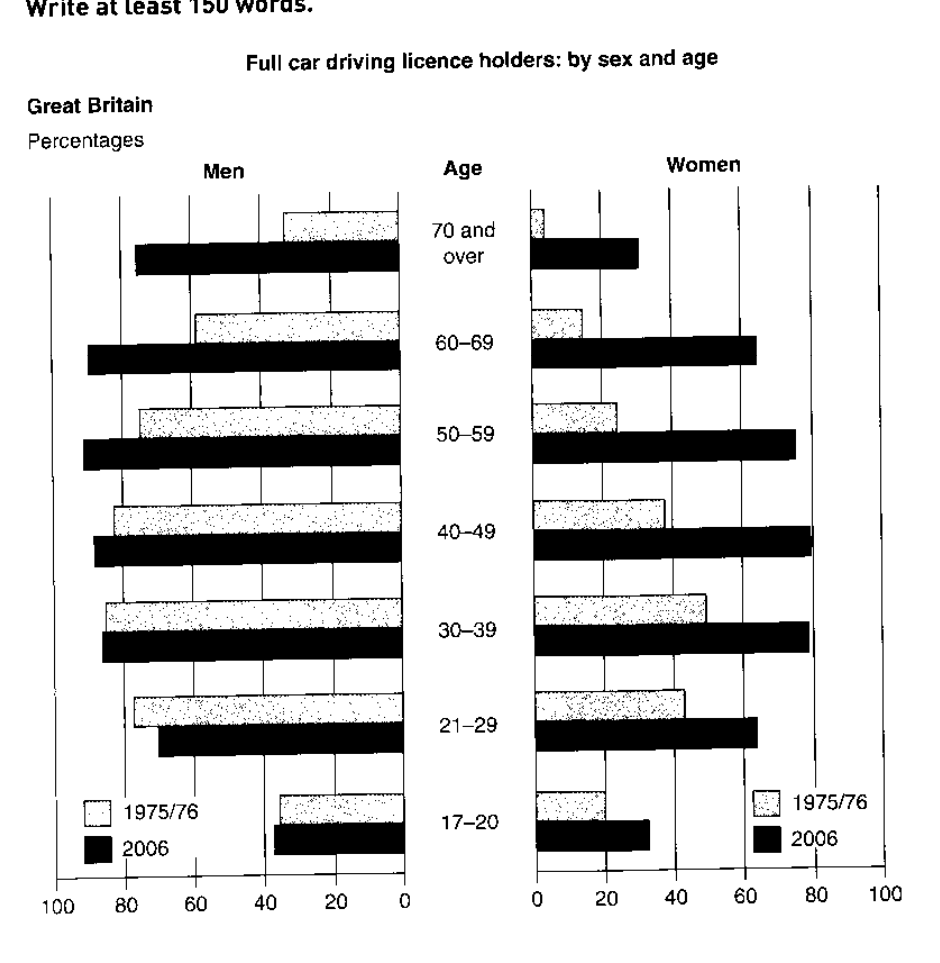
The graphs below show the percentage of people holding full driving licences in Great Britain by age and sex.
Summarise the information by selecting and reporting the main features, and make comparisons where relevant.
Full car driving licence holders: by sex and age
Student answer (Band 4.5)
The following Graphs shows information about the numbers of full car driving licence holders by age and sex and we will discuss the main features and their relevent features between1975 and 2006.
Firstly, in men the people of age 70 and above had the highest percentage in 2006 that was around 75% and in 1975 and 1976 the number was approximately 35% but in women of the same age had overall lowest percentage in 1975 was only 5%.
Next, we talk about the younger generation, so in men the age of peope 17-20 had the percentage is around 40% in both years which we discussed and if we talk about women of the same age and percentage isin 2006 is nearly 35%.
AI examiner evaluation
| Criterion | Band |
|---|---|
| Task Achievement / Task Response | 3.5 |
| Coherence and Cohesion | 5.0 |
| Lexical Resource | 5.0 |
| Grammatical Range and Accuracy | 5.0 |
| Overall | 4.5 |
Task Achievement / Task Response: Band 3.5
The response identifies a few relevant figures, including men aged 70 and over at about 75% in 2006 and around 35% in 1975/76, and notes that women in this oldest group had a very low earlier figure. However, it does not provide a clear overview of the main patterns or compare the age groups and sexes in a sufficiently complete way. Important features are omitted, such as the high licence rates among middle-aged men in 2006 and the substantial rise among women across most age groups. The statement that older men had the highest percentage in 2006 is also inaccurate: men aged 50–59 were slightly higher. The response is 122 words, below the required 150, leaving the summary notably incomplete.
Coherence and Cohesion: Band 5.0
There is a basic sequence, signalled by “Firstly” and “Next,” and the response moves from older people to younger people. This gives the reader some sense of organisation. However, the progression is limited: there is no overview paragraph, and the two short sections do not develop a systematic comparison of the years, sexes, or age groups. Phrases such as “which we discussed” are unclear and do not help connect information. The opening also announces that the writer will discuss features rather than presenting a useful summary. Organise the response into an introduction, an overview of the main trends, and comparison paragraphs grouped by age or sex, using clear links between related figures.
Lexical Resource: Band 5.0
The response uses some task-related vocabulary, including “percentage,” “age,” “same age,” and “approximately,” so the topic is generally understandable. However, the range is limited and several expressions are imprecise or awkward, such as “the numbers of … holders” when the chart reports percentages, “the younger generation,” and “the percentage is around 40%.” There are also spelling errors, including “relevent” and “peope,” and the repeated use of “percentage” makes the description less varied. Use accurate chart language such as “proportion,” “licence-holder rate,” “rose,” and “remained stable,” while checking spelling and choosing natural collocations.
Grammatical Range and Accuracy: Band 5.0
The response attempts longer sentences with linking words such as “Firstly,” “but,” and “if we talk about,” but control is uneven and most sentence patterns are simple or loosely joined. Errors include “The following Graphs shows,” where the subject and verb do not agree, and “the age of peope 17-20 had the percentage is around 40%,” which combines incompatible verb structures. The phrase “in women of the same age had” also lacks a grammatical subject construction, while “percentage isin 2006 is” contains faulty verb sequencing. These errors sometimes make relationships between figures difficult to follow. Build shorter, complete sentences first, then practise accurate comparisons using forms such as “the figure for women was…” and “while the rate for men remained…”.
See this exact question answered at other band scores. The same prompt compared across bands.
Browse more IELTS Writing model answers or get your own writing scored by the same AI examiner.