Band 5.0 IELTS Writing Task 1 Model Answer
Overall Band Score: 5.0 · IELTS Summit Mastery · 2026-11-23
IELTS Writing Task 1 question
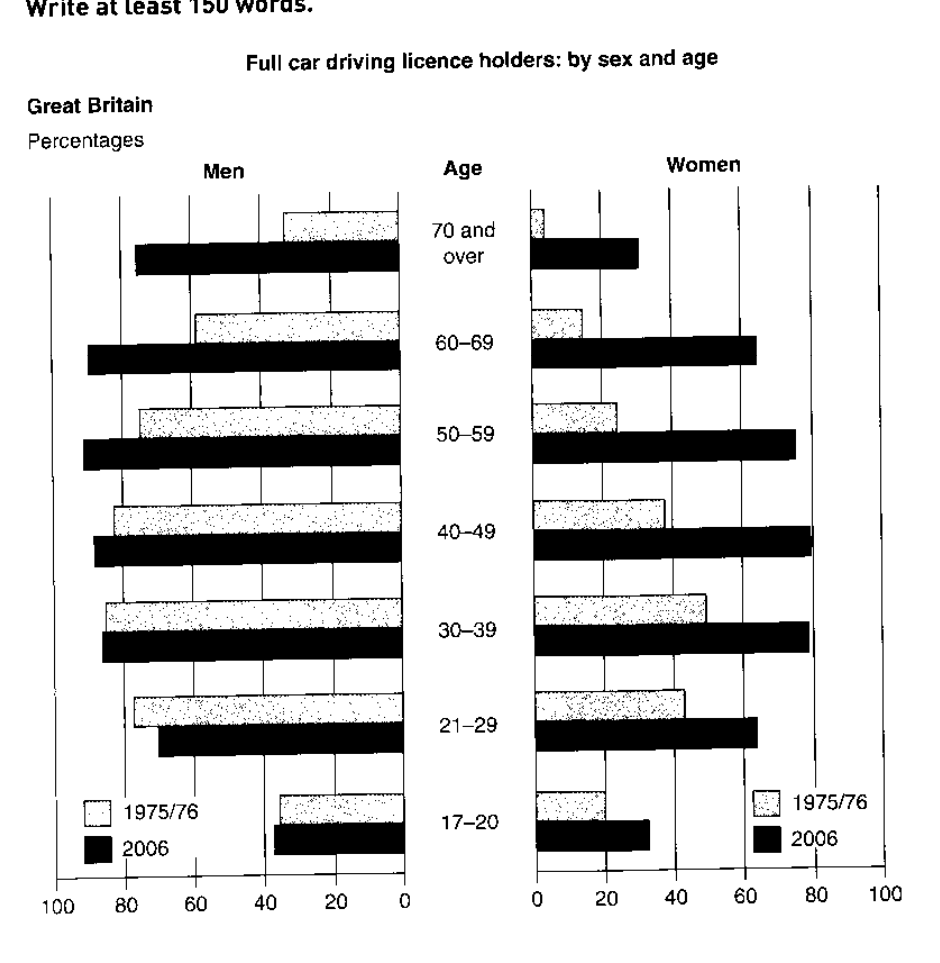
The graphs below show the percentage of people holding full driving licences in Great Britain by age and sex.
Summarise the information by selecting and reporting the main features, and make comparisons where relevant.
Full car driving licence holders: by sex and age
Student answer (Band 5.0)
This graph illustrates the percentage of the individuals holding full driving licences in Great Britian by their age and sex.
Overall, the men holding more licences with different age groups as compared to women. Only two age groups of the women was trying to compete the men community.
As can be seen in the graph, men with the age group of 17-20 has 39 licences holders in 2006 and 38 in 1975. But the individuals in the age of 21 to 29 have 70 grantee in 2006 and 78 in 1975/76. After that, the record of permit holder within the age between 30 to 49 were approximately same just over 80. Furthermore, the the amount of certified men citizens between the age of 50 to 69 are similar in 2006 but in 1976, the elder group 60-69 has fewer cards as compare to 59-59 age group. In the 19th century, people with over 70 had fewer licences as compare to 2006.
For second gender, the ladies between the age of 21 to 69 were more certified as compare to the age group which is over 70 or below 20.
AI examiner evaluation
| Criterion | Band |
|---|---|
| Task Achievement / Task Response | 5.0 |
| Coherence and Cohesion | 5.5 |
| Lexical Resource | 5.0 |
| Grammatical Range and Accuracy | 5.0 |
| Overall | 5.0 |
Task Achievement / Task Response: Band 5.0
You identify the chart’s subject and make a relevant broad comparison: men generally had higher licence-holding percentages than women. You also report several figures for men, including the decline among 21–29-year-olds from about 78% to 70%, and note that the oldest men’s figure was higher in 2006. However, the overview is unclear and partly inaccurate: women did not only compete with men in two age groups, and the response gives no clear summary of the substantial rise among women across most ages. Some details are also misreported or difficult to interpret, such as the 17–20 figures and the comparison of men aged 50–69. Select the main trends accurately, then support them with a few clear comparisons for both sexes and both years.
Coherence and Cohesion: Band 5.5
The response has a basic sequence: an introduction, an overall statement, a paragraph about men, and a final point about women. This gives the reader some organisation, and phrases such as “As can be seen” and “For second gender” attempt to guide the discussion. However, the progression is not consistently clear. The men’s paragraph moves through age groups without a reliable pattern, and the final sentence is too brief to develop the women’s data or connect it to the overview. Some linking phrases are awkward or do not clarify the relationship between ideas. Group the information more deliberately—for example, describe the broad changes for men and women, then compare the age patterns—and use clear references to the years and age groups.
Lexical Resource: Band 5.0
You attempt a range of terms related to the topic, including “holding full driving licences,” “age group,” and “percentage.” However, vocabulary is often inaccurate or unnatural, which sometimes makes the data difficult to understand. Expressions such as “70 grantee,” “certified men citizens,” and “the men community” do not clearly describe licence holders, while “the 19th century” is an incorrect way to refer to 1975/76. There are also spelling and word-form problems, including “Britian” and “licences holders.” Use precise, repeated chart vocabulary rather than searching for varied synonyms: “licence holders,” “the proportion of men/women,” “increased,” and “fell” are suitable. This would make the comparisons clearer and more appropriate to an academic report.
Grammatical Range and Accuracy: Band 5.0
The response attempts both simple and more extended sentences, including comparisons introduced by “But” and “Furthermore.” However, control is inconsistent, and errors in agreement, verb forms, articles, and sentence construction frequently make statements hard to follow. For example, “the men holding more licences” lacks a clear verb, while “Only two age groups of the women was trying” has faulty agreement and an unsuitable construction. The sentence beginning “After that, the record…” also contains an unclear structure, and repeated “the the” shows a proofreading lapse. Practise building accurate comparison sentences with a clear subject and verb, such as “The proportion of male licence holders was higher…” Check singular/plural agreement and keep each sentence focused on one comparison.
See this exact question answered at other band scores. The same prompt compared across bands.
Browse more IELTS Writing model answers or get your own writing scored by the same AI examiner.